Every dental, medical and veterinary practice in Columbus has at least one patient restroom, and almost every one of them has the same fixture: a wall-mounted or floor-mounted commercial toilet with a flushometer valve, no tank and no lid. It is chosen for good reasons. It is durable, it flushes hard, it is fast to clean and there is nothing on it to break. The trade-off is the subject of this article. Nothing covers the bowl when it flushes.
For decades the “toilet plume” was a thing researchers talked about and nobody could see. In December 2022 a team at the University of Colorado Boulder, led by engineering professor John Crimaldi, changed that. They set up a lidless commercial flushometer toilet in a lab, aimed two lasers through the air above it, flushed, and filmed the result with high-speed cameras. The paper, published in Scientific Reports, includes the images, and they are hard to unsee.
What the lasers showed
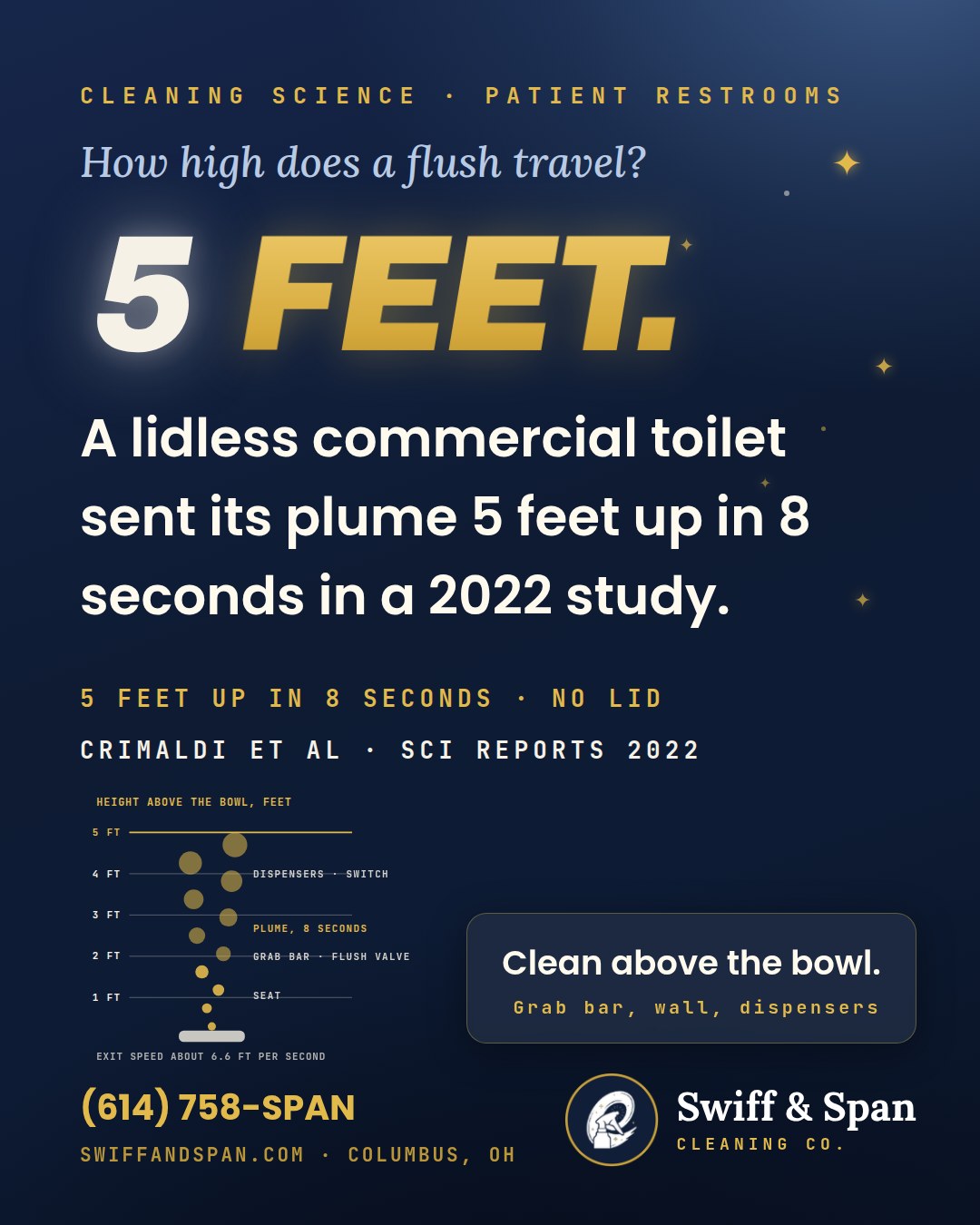
The plume does not drift. It erupts. In the study the aerosol left the bowl at about 2 meters per second, which is roughly 6.6 feet per second, and rose fast. Within 8 seconds of the flush the plume had reached 1.5 meters above the bowl, about 5 feet, and was still spreading up and outward toward the wall behind the toilet. The larger droplets fell back within seconds. The smallest particles, under 5 microns, stayed suspended in the air for minutes.
Three details in the study matter for a practice. First, the toilet contained only clean tap water, with no waste, no paper and no cleaning product, so the plume is a property of the flush itself, not of what is in the bowl. Second, the fixture was a standard commercial flushometer toilet operating at normal pressure, which is the fixture in a medical office and not the fixture in a home. Third, the researchers noted that the energetic upward plume interacts with the wall behind the toilet and the surfaces near it, which is where it deposits.
The researchers were careful about what they did not measure. They measured the physics of the plume, not disease transmission. Whether aerosolized bowl contents actually make people sick is still an open question in the research, and we are not going to close it here. What is not open is where the plume goes, and that is the part a cleaning scope can act on.
Map the plume onto a patient restroom
Stand in a patient restroom and measure up from the bowl. Here is what sits in the plume’s path in a typical Columbus medical office.
1 to 2 feet. The seat, the flush valve handle or sensor, and the bottom of the partition or the wall. The flush valve is touched by every patient who flushes by hand, seconds after the plume passes it.
2 to 3 feet. The grab bar. Every ADA-accessible restroom has one, and it is at exactly the height the plume reaches in its first second or two. It is also the surface a patient with limited mobility grips with both hands.
3 to 4 feet. The toilet paper dispenser, the seat cover dispenser, the sanitary disposal bin, and often the light switch and the hand sanitizer pump on the near wall. All of them are touched. All of them are in the path.
4 to 5 feet and above. The wall behind and beside the toilet, the partition, a wall-mounted shelf or purse hook, and the air a standing adult breathes. This is the zone the study filmed the plume reaching at 8 seconds.
Now read a typical restroom line in a cleaning scope. “Clean and disinfect toilets, sinks and counters. Wipe mirrors. Restock paper.” The bowl and seat are covered. The counter is covered. The grab bar, the flush valve, the dispensers, the switch and the wall above the bowl are not mentioned, so a crew following that line to the letter does not touch them. They sit in the plume all day, they are gripped by every patient, and they are cleaned by nobody.
What a restroom scope needs to say
The fix is a written surface list, and the plume gives you the list.
Name the surfaces above the bowl. Grab bar, flush valve, toilet paper and seat cover dispensers, sanitary bin lid, light switch, sanitizer pump, purse hook, and the wall and partition to about 5 feet within roughly 3 feet of the bowl. If a surface is not written down, it is not in the job.
Clean first, then disinfect. An EPA-registered disinfectant works on a clean surface. Soil on a grab bar shields what is under it, so the cleaning wipe comes first and the disinfectant goes on second.
Hold the contact time. Every disinfectant label states how long the surface must stay wet for the claim to apply, and on a stainless grab bar a light spray dries in under a minute. We have written about why the contact-time clock does not negotiate, and the restroom is where it is most often skipped.
Work top down, bowl last. The bowl is the dirtiest surface in the room and the plume source. Cleaning it first and then wiping the dispensers with the same cloth moves the problem upward instead of removing it. The order is wall and dispensers, grab bar and valve, seat, bowl, then floor.
Name how the work is checked. Who verifies the grab bar was cleaned tonight, what the check looks like, and where the record lives.
The same logic applies to the restroom floor, which catches the larger droplets that fall back, and to the waiting room next door, where a sneeze covers a similar distance in a different direction.
How we check it
We do not test the air, and we do not test for any organism. What we verify is the cleaning step, with ATP readings taken on site and shown to you. ATP measures organic residue on a surface, and a low reading on a grab bar, a flush valve or a dispenser lid after service tells you the surface was actually cleaned rather than passed. A high reading the morning after tells you which line of the scope is failing. It is a cleaning-verification measure. It does not speak to disinfection, to aerosols, or to disease, and we will never say it does.
What it does is close the loop the scope opens. The surface list says what should happen above the bowl. The reading says whether it did.
The one-sentence version for your office manager
A lidless commercial toilet sends its plume 5 feet up in 8 seconds, so the grab bar, flush valve, dispensers, switch and wall above the bowl belong on the nightly list with a named disinfectant, its contact time, a top-down order and a check.
If you would like to see what your patient restroom reads at 8 AM, the complimentary ATP walkthrough takes about 30 minutes, and the restroom is one of the first stops.
Frequently asked questions
How high does a toilet plume travel?
In the 2022 University of Colorado Boulder study, a lidless commercial flushometer toilet sent its aerosol plume to about 1.5 meters, roughly 5 feet, above the bowl within 8 seconds of the flush. The plume left the bowl at about 2 meters per second, or 6.6 feet per second, and the smallest droplets stayed suspended for minutes.
Why do medical office toilets have no lid?
Commercial restrooms use lidless, tank-free flushometer toilets because they are durable, fast to clean and hard to break. The trade-off is that nothing covers the bowl during the flush, which is why the study used exactly that fixture and why the plume it measured is the plume in a patient restroom, not a bathroom at home.
Does the toilet plume spread disease?
The plume carries droplets and aerosol out of the bowl, and the bowl can contain pathogens. Whether that pathway causes real infections is still an open question in the research, and the 2022 study measured the physics rather than the disease. What is not in question is where the plume lands, and that is what a cleaning scope can act on.
Which restroom surfaces does the plume reach?
Working up from the bowl: the seat and flush valve at about 1 to 2 feet, the grab bar at about 2 to 3 feet, the paper and sanitizer dispensers and the light switch at about 3 to 4 feet, and the wall and partition all the way up. A scope that cleans the bowl and seat and wipes the counter leaves most of that path untouched.
How does Swiff & Span verify a patient restroom was cleaned?
The written scope names every surface in the plume’s path, including the grab bar, flush valve, dispensers, switch and the wall above the bowl, with an EPA-registered disinfectant held for its labeled contact time. We check high-touch surfaces after service with ATP readings taken on site and shown to you. ATP measures organic residue, not specific organisms, so it verifies the cleaning step rather than making a disinfection claim.
Sources
- Crimaldi, J.P., True, A.C., Linden, K.G., Hernandez, M.T., Larson, L.T. and Pauls, A.K. Commercial toilets emit energetic and rapidly spreading aerosol plumes. Scientific Reports 12, 20493 (2022). Lidless commercial flushometer toilet; plume velocity about 2 m/s; height about 1.5 m within 8 seconds; particles under 5 microns suspended for minutes.
- University of Colorado Boulder, CU Boulder Today. Lasers show what happens when a toilet is flushed without a lid. December 2022.
- United States Environmental Protection Agency. EPA-registered disinfectant label requirements for pre-cleaning and contact time.
- Centers for Disease Control and Prevention. Guidelines for Environmental Infection Control in Health-Care Facilities: cleaning and disinfection of environmental surfaces, including restrooms.