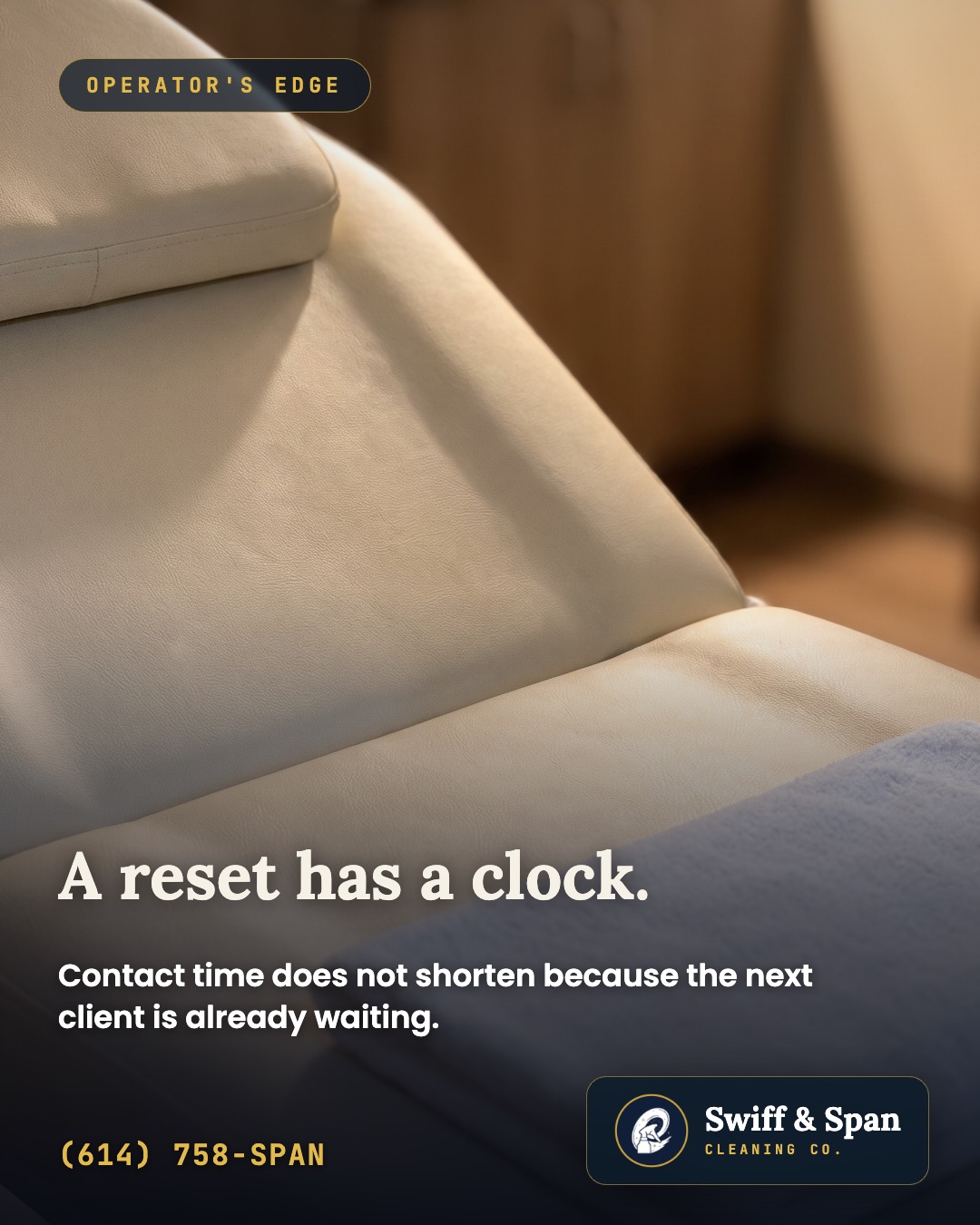
Ask a studio owner how long a room reset takes and you get a number that sounds like a staffing answer. Six minutes. Eight if the room was busy. The number is usually built backward from the booking software, because that is where the constraint feels like it lives.
It does not live there. The reset clock is not set by how fast a person moves. It is set by how long a disinfectant has to sit on a surface before it has done anything at all. That number is printed on the bottle, it does not negotiate, and it runs at the same speed for a rushed tech and a careful one.
Once you accept that, the question changes shape. It stops being “how fast can we turn a room” and becomes “how much of our turnaround is actually waiting, and did we schedule for the waiting.”
The working answer we use across med spas, PT and chiro clinics and recovery studios in Columbus is about 9 minutes for a full reset of a single treatment room: three to strip and reset, four at full dwell time, two to present. Most schedules book about five. The gap between those two numbers is where the risk sits.
Frequently Asked Questions
How long should a treatment room reset take between clients?
About 9 minutes for a full reset of a single treatment room: three minutes to remove linens and reset, four minutes for the disinfectant to sit at full dwell time on high-touch points, the table and its underside components, and product bottles and pumps, and two minutes to restock, spot-check the floor and present the room. If the label on your disinfectant asks for a longer contact time, the reset gets longer. Most studios schedule about five minutes, which is short of what the sequence requires.
Why can't a faster cleaner reset a room in five minutes?
Because nearly half of the reset is waiting, not working. Disinfectants require a label contact time during which the surface must stay visibly wet. That clock runs at the same speed regardless of how fast the person moves, so it cannot be compressed by effort or experience.
What is dwell time and why does it matter for a med spa?
Dwell time, also called contact time, is the number of minutes a disinfectant must remain wet on a surface for its label claim to apply. Contact times commonly fall in a one to ten minute range depending on the product, and the label on the specific product is the governing authority. If the surface dries early, it was wiped rather than disinfected.
Which treatment room surfaces get missed most often?
The underside of the table lip, the headrest hinge, the face cradle stem, the height adjustment lever and hydraulic pedal, and product bottle pump tops. All are high-contact, none are at eye level, and none appear in a typical room-level scope of work.
Why should linens never be shaken during a room reset?
Snapping or shaking a sheet aerosolizes skin cells, lint and product residue across the room, and that plume settles on the surfaces you are about to disinfect. Roll linens inward, contain them, and bag them before any wiping starts.
Every Columbus dental, medical, wellness, and commercial facility gets the same offer: a complimentary 30-minute ATP walkthrough. We swab your highest-touch surfaces, on the spot, and hand you the readings. No obligation, no pitch required to see the number. Book your complimentary ATP walkthrough or text (614) 758-SPAN.
Erik Kuusisto, Owner
Swiff & Span Cleaning Company