The Friday after Thanksgiving is a quiet day for most offices. For a boarding kennel it is the middle of the busiest week of the fall. Dogs from across Upper Arlington, Hilliard and Grandview are sharing runs, play yards and air while their families travel.
Then they come home. And over the next three weeks, some of them walk into your clinic coughing.
The number that frames this is in a canine influenza fact sheet hosted by The Ohio State University College of Veterinary Medicine, written by Michelle Evason and Jason Stull for the AKC Canine Health Foundation. Shedding of the H3N2 strain of canine flu is estimated to last about 21 days. The older H3N8 strain sheds for an estimated 7 to 10.
Twenty-one days is longer than the holiday. It is longer than the boarding stay. It runs right through the weeks your lobby is fullest with post-trip appointments. This article is about what that means for cleaning a veterinary clinic from Thanksgiving to the middle of December.
How long does canine flu stay contagious after a dog leaves boarding?
On the Ohio State fact sheet’s estimate, a dog infected with H3N2 canine flu can shed virus for about 21 days, compared with 7 to 10 days for H3N8. Shedding can start before the dog looks sick, and many infected dogs never show signs at all.
That last part is the one that matters for a clinic. The fact sheet says plainly that “many dogs will appear completely healthy,” and that those dogs “may still be infectious.” So the cough you hear at the front desk is not the whole picture. A dog in for a routine nail trim the Tuesday after Thanksgiving can carry the same virus as the dog in for the cough.
Do the arithmetic on a single boarding weekend. A dog exposed on the Saturday after Thanksgiving could, on the H3N2 estimate, still be shedding into the third week of December. Stack a full kennel’s worth of dogs on top of that, and the post-holiday weeks are the stretch where a veterinary lobby should be cleaned like it expects company.
Why do outbreaks show up at veterinary clinics after the holidays?
Outbreaks follow dogs in groups. The fact sheet lists the settings where most canine flu outbreaks appear: shelters, dog shows, veterinary hospitals, boarding facilities and dog daycares, all places with close dog-to-dog contact and more stress.
Holiday travel puts more dogs into exactly those settings at the same time. Boarding fills up around Thanksgiving and again through the December holidays. When those dogs go home, the next shared indoor space many of them visit is your lobby: a post-boarding wellness check, a vaccine catch-up before the next trip, or the cough itself.
A veterinary clinic is listed by name on that outbreak list for a reason. It is the one place where a sick dog, a healthy dog and a shedding dog that looks healthy all sit on the same floor within the same hour.
Which clinic surfaces carry canine flu the longest?
According to the same fact sheet, canine influenza can remain infectious on contaminated environmental surfaces such as kennels for up to 48 hours, and for 12 to 24 hours on clothing and people’s hands. It spreads by direct contact, cough droplets, and contaminated objects like bedding and hands.
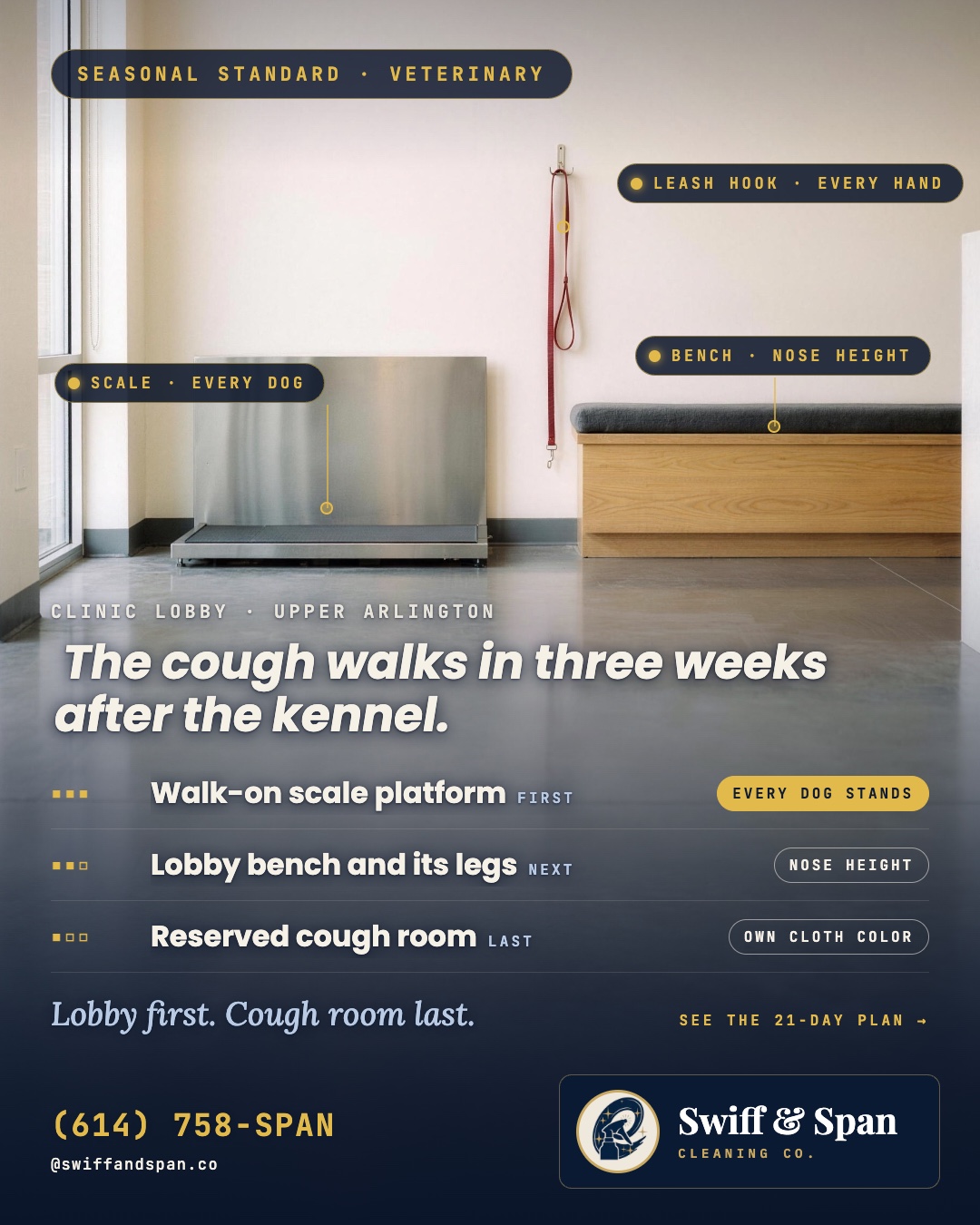
Two days on a surface means last night’s clean is the one meeting this morning’s first appointment. In most clinics we walk in Columbus, the surfaces that carry the most dog traffic share three traits: low, shared, and rarely named on a cleaning scope.
1. The walk-on scale. Nearly every dog stands on it. Noses go down to the platform and the rails. It sits on the floor, so it gets mopped around more often than it gets cleaned. 2. The lobby bench and its legs. Dogs sit under and beside benches while owners wait, nosing the legs and the floor at the base. 3. The leash hook and the door push plate. Hands that just held a leash hit the same steel. 4. The check-in counter front. Not the top, where staff work, but the vertical face at dog height. 5. The exam room floor and table edge, where a coughing dog spends the most time. 6. Kennel bars and ward doors, the surface the fact sheet names first.
The hands and clothing figure belongs to the clinical team’s hand hygiene and laundry plan, which we cover in our piece on veterinary clinic hand hygiene surfaces. The surfaces are where a cleaning partner earns its keep.
What cleaning order works for a vet clinic during dog flu season?
The order that works is clean to dirty, low to the floor last, and the room reserved for coughing dogs at the very end of the route. One cloth, one mop head and one sprayer pass never carry the sick room into the lobby. Here is how we run it.
1. Clean first, then disinfect. Saliva, nasal discharge, hair and dander shield a surface from a disinfectant. A cleaning pass removes them first, so the disinfectant can actually reach the surface it is meant to treat.
2. Use an EPA-registered disinfectant at its full label contact time. Influenza viruses are enveloped viruses, the group the CDC’s disinfection guideline places among the easiest for disinfectants to inactivate. The hard part is rarely the chemistry. It is reach and wet time. We match the product to the surface from our standard set (Diversey Oxivir Tb, Spartan TB-Cide Quat, Clorox Healthcare Bleach Germicidal and PDI Super Sani-Cloth) and keep the surface wet for the full time printed on the label. Our contact time explainer walks through why that number matters more than the brand.
3. Reach the shapes a cloth misses with electrostatic application. Kennel bars, scale rails, bench legs and chair frames are round, ribbed or hollow. A charged electrostatic spray wraps around those shapes instead of landing only on the side facing the nozzle. It goes on after the cleaning pass, never instead of it. We explain what it does and does not do in electrostatic spraying, what it actually does.
4. Color-code by zone. One microfiber color for the lobby and front desk, another for exam rooms, another for the isolation or coughing-dog room and the ward. Mop heads follow the same colors. A cloth never crosses zones.
5. Route the coughing-dog room last. Lobby first, then routine exam rooms, then treatment areas, then the room your team used for respiratory cases. If your clinic has an isolation protocol, we follow it, and we never overrule it.
6. Write it down. Room-by-room checklists with time and initials, plus photo documentation of the lobby and isolation room, so the practice manager can see what was done the night after a respiratory case.
What can a clinic change at the front door before the cough comes in?
A clinic can change who walks through the lobby. The Ohio State fact sheet tells dog owners to call before bringing a dog with a suspected flu into the clinic, so the team can advise how to come in without exposing other dogs.
Three front-door moves that pair well with the cleaning plan:
- Put the call-ahead rule on your phone tree, website and reminder texts for the weeks after Thanksgiving and the December holidays. A dog that waits in the car and goes straight to a reserved room never touches the lobby bench.
- Reserve one exam room for respiratory cases and tell your cleaning partner which one it is, so it moves to the end of the route.
- Ask for a mid-December check of the lobby surfaces, not just the nightly clean. The 21-day window from Thanksgiving boarding closes around then, and the next wave of holiday boarding starts right after.
For the full list of lobby touchpoints we track in veterinary clinics, read veterinary clinic waiting room cleaning: 11 surfaces. For a tougher organism with a very different survival story, read our article on canine parvovirus and veterinary clinic disinfection.
How do you know the lobby was actually cleaned the night before?
You know the lobby was cleaned when someone measured it, not when the floor shines. A dog scale can look spotless and still carry the film a nose leaves behind.
An ATP meter, like the Hygiena EnSURE Touch we carry with UltraSnap swabs, measures organic residue on a surface. It does not detect canine flu or any other virus, and it is not a disinfection test. What it does show is whether a surface was actually cleaned or only passed by. On a walkthrough we swab the scale platform, the bench and the counter front so you can see the readings for yourself against our cleaning target threshold and the acceptable pass band used across the industry. We explain both on our page about how we prove clean.
The short version for a practice manager
- H3N2 canine flu is estimated to shed for about 21 days, and many infected dogs look completely healthy.
- The virus can stay infectious on kennel-type surfaces for up to 48 hours and for 12 to 24 hours on hands and clothing.
- Holiday boarding puts more dogs in group settings at once, and your lobby is often the next shared room they visit.
- Clean first, disinfect at full label contact time, use electrostatic application for bars, rails and legs, color-code by zone, and finish with the coughing-dog room.
If you run a veterinary clinic in Upper Arlington, Hilliard or anywhere in greater Columbus, I would be glad to walk your lobby with you before the December boarding wave. Book your complimentary ATP walkthrough at swiffandspan.com or call (614) 758-SPAN.
Frequently Asked Questions
How long can a dog with canine flu spread the virus?
A canine influenza fact sheet hosted by The Ohio State University College of Veterinary Medicine estimates shedding at about 21 days for the H3N2 strain and 7 to 10 days for H3N8. Shedding can begin before signs appear, and many infected dogs never look sick.
How long does canine influenza survive on surfaces?
The same fact sheet says canine influenza can remain infectious on contaminated surfaces such as kennels for up to 48 hours, and for 12 to 24 hours on clothing and people's hands.
Why do dog flu outbreaks happen after holiday boarding?
Most outbreaks are associated with places where dogs are in close contact and under stress, including boarding facilities, dog daycares, shelters, dog shows and veterinary hospitals. Holiday travel puts more dogs into those settings at the same time.
What should a vet clinic clean first after a respiratory case?
Clean the lobby, routine exam rooms and treatment areas first, and the room used for the coughing dog last, with a separate microfiber color for that room. Clean each surface before disinfecting it, and keep the disinfectant wet for its full label contact time.
Can an ATP test detect canine flu on a clinic surface?
No. An ATP test measures organic residue, which shows whether a surface was actually cleaned. It does not detect or identify canine influenza or any other virus, and it does not confirm disinfection.
Every Columbus dental, medical, wellness, and commercial facility gets the same offer: a complimentary 30-minute ATP walkthrough. We swab your highest-touch surfaces, on the spot, and hand you the readings. No obligation, no pitch required to see the number. Book your complimentary ATP walkthrough or text (614) 758-SPAN.
Erik Kuusisto, Owner
Swiff & Span Cleaning Company