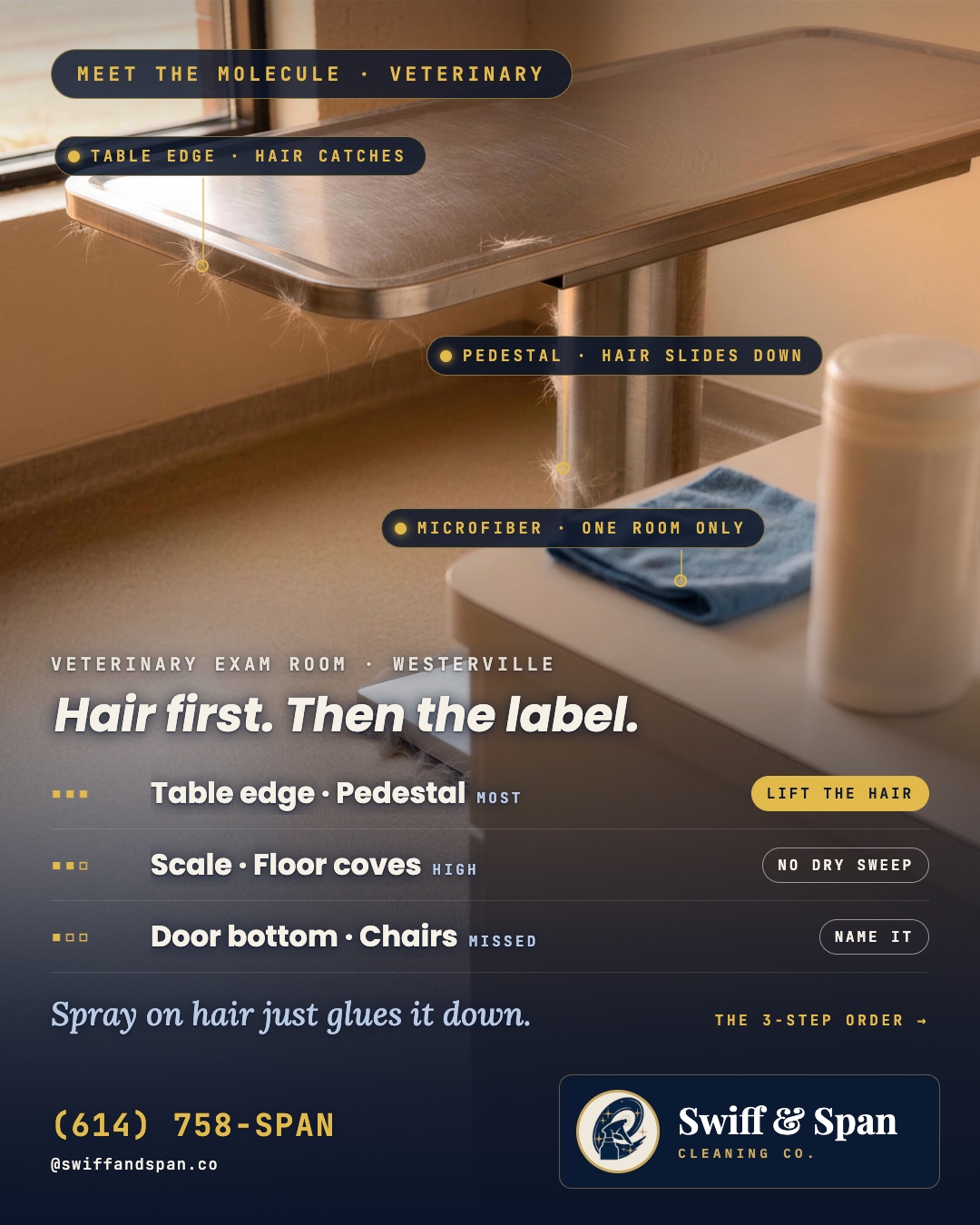
The cat left at 4:40. The ringworm diagnosis came back the next morning. In between, three more patients used the same exam table.
That gap is the whole problem with ringworm in a veterinary clinic. It is not a bacterium and it is not a virus. It is a fungus that travels on shed hair, and the spores on that hair can stay infective on clinic surfaces for up to 18 months, according to veterinary guidance from VCA Animal Hospitals and the Veterinary Information Network’s Veterinary Partner. Nobody has to do anything wrong for those spores to be there. A patient only has to shed.
The fix is not a stronger bottle. The single most useful thing a cleaning crew can do about ringworm is boring, physical and easy to skip: get the hair off before anything else touches the surface. Here is why, in what order, and what a veterinary clinic’s cleaning scope should say about it.
How long can ringworm spores last in a veterinary clinic?
Up to 18 months. VCA Animal Hospitals says the fungal spores may remain dormant for up to 18 months on brushes, bedding, furniture and other surfaces, and VIN’s Veterinary Partner gives the same figure, adding “maybe longer.” Spores are a resting stage, not a growing one.
That last point matters for how you clean. The Merck Veterinary Manual is clear that dermatophyte spores do not multiply in the environment and do not spread across a surface the way mildew does. A clinic does not have a ringworm colony growing in the corner. It has a finite amount of contaminated hair and scale, scattered wherever an infected animal sat, stood, shook or was handled. Remove that material and you remove most of the problem.
Eighteen months also explains why ringworm is a scope question and not a one-day emergency. A clinic in Westerville that sees one positive cat in March can still have that cat’s hair in a floor cove or under a scale platform in the fall if nobody’s job description included the floor cove.
How do ringworm spores get onto clinic surfaces?
On hair and skin scale. An infected dog or cat sheds hair that carries spores, and that hair lands wherever the animal goes: the exam table, the scale, the floor, the carrier set-down spot, the clipper station, the staff member’s sleeve.
Some of those places are obvious. Most are not. The spots where loose hair collects in an exam room tend to be the spots a quick wipe never reaches:
- The exam table’s rolled edge and the pedestal base. Hair catches on the lip and slides down the column to the floor.
- The scale platform, especially its edges and the gap underneath.
- Floor coves and baseboards, where a sweep or a mop pushes hair instead of lifting it.
- The bottom of the exam room door, where hair drifts and stops.
- The clipper and grooming station, including the clippers themselves.
- Chairs in the exam room that owners set carriers on.
Transmission from the environment is less efficient than transmission from the animal itself. Merck notes it usually takes microtrauma to the skin, such as clipping with contaminated clippers, plus moisture. That is why the clipper station deserves its own line, and why the goal of environmental cleaning is plain: take the infective material out of the room.
Why can’t disinfectant alone handle ringworm?
Because disinfectant does not remove anything. The Merck Veterinary Manual puts it directly: disinfectant use alone will not remove environmental contamination. Mechanical removal of hair and organic material, followed by washing with detergent until the surface is visibly clear, is the most important step.
Think about what a spray does to a tuft of cat hair on a stainless table. It wets it. The hair is still there, now stuck to the steel, and the spores inside the clump are shielded by everything around them. Wipe it after the spray and you have smeared contaminated hair across the rest of the table with a cloth that now goes to the next surface.
Disinfectant still has a job. It just comes last. After the hair is gone and the surface has been washed clean, Merck advises a disinfectant whose label lists efficacy against Trichophyton, to kill spores that mechanical cleaning did not remove. The label is the test. We wrote about why chemistry choice matters in our piece on why parvovirus shrugs off a quat, which quotes AAHA’s infection control guidelines on quaternary ammonium having limited impact on dermatophytes. Ringworm is another case where the bottle under the sink deserves a second look.
What order should a vet exam room be cleaned in for ringworm?
Hair first, wash second, disinfect last, and the room top to bottom and clean to dirty. Three steps, in that order, every time a ringworm suspect has used the room. Skip the first one and the other two work on top of the problem instead of after it.
Here is the order we write into a veterinary clinic’s scope:
- Remove the hair. Lift loose hair and debris with a HEPA vacuum (we run the ProTeam GoFit) or damp disposable wipes, starting at the table and working down to the floor. No dry sweeping, which throws hair back into the air and onto the surfaces you just did.
- Wash with detergent until visibly clear. A dedicated color of microfiber for the exam room, folded so every pass uses a clean face, and fresh solution so dirty water never goes back on the surface. Our guide to color-coded microfiber and the two-bucket method explains the system.
- Disinfect, and wait. An EPA-registered disinfectant whose label lists Trichophyton, applied to the clean surface and left wet for the full contact time on its label. We choose from Clorox Healthcare Bleach Germicidal and Diversey Oxivir Tb, matched to the surface, and we read the fungal claim on the label before it goes on the table. If contact time is new territory, here is what dwell time actually means.
Cloths used in a ringworm room go straight to laundry and never travel to another room. Merck notes soft items like towels and bedding can be handled by a thorough machine wash.
Which surfaces in a veterinary exam room need the most attention?
The ones closest to the animal and closest to the floor: the exam table edge and pedestal, the scale platform, floor coves, the door bottom, the clipper station and any chair that holds a carrier. Those six places collect the most loose hair after a shedding patient.
High touch points still matter, and our veterinary lobby walk-through covers the eleven a client’s hand meets on the way in. Ringworm adds a different list. These are not the places hands go. They are the places hair settles. A scope that only names touch points will miss half of them.
Floors earn special mention. A wet mop pushed across a floor with hair on it moves the hair to the baseboard and leaves it there. Vacuum or wipe up the hair first, then damp mop with clean solution. Our article on two-bucket mopping for veterinary floors covers the second half of that job.
Does ringworm in a clinic put staff and clients at risk?
Ringworm is zoonotic, so people can catch it from animals. The Merck Veterinary Manual lists dermatophytosis as a zoonotic disease, and staff who handle patients, clip coats or clean exam rooms are the people closest to the hair.
That is a reason for gloves and good laundry habits, and it is a reason to treat ringworm cleaning as written procedure rather than something the night crew figures out. It is not a reason to panic. Spores in the environment are a less efficient route than direct contact, and the steps above remove most of the infective material. What the risk does change is who should know about a positive case. If your front desk flags a ringworm suspect, the people cleaning that room that night should know too.
What should a veterinary cleaning scope say about ringworm?
It should name the steps, the surfaces, the product and the handoff. “Disinfect exam rooms” says none of that. A useful scope tells the crew what to remove, what to wash with, which label claim to look for, how long it stays wet and how a suspect case gets flagged.
Here is the ringworm section we write for a veterinary clinic:
- Trigger: a ringworm suspect or confirmed patient is flagged by the clinic, with the room number, before the crew arrives.
- Step 1, hair removal: HEPA vacuum or damp disposable wipes on the table, pedestal, scale, chairs, door bottom and floor coves. No dry sweeping.
- Step 2, detergent wash: a dedicated microfiber color for that room, washed until visibly clear.
- Step 3, disinfectant: an EPA-registered product with Trichophyton on its label, named in the scope, held wet for the full label contact time.
- Laundry: all cloths from that room bagged and washed, never reused in another room.
- Record: photo documentation and a room-by-room checklist, so the practice manager can see in the morning that the ringworm room got all three steps.
The short version for a busy practice
Ringworm spores ride on hair, and they can wait up to 18 months. A disinfectant sprayed on top of hair does very little. Get the hair out, wash the surface clean, then let a disinfectant with the right label claim sit for its full contact time.
If you want to see how your clinic’s current scope handles a ringworm room, Book your complimentary ATP walkthrough. We walk the exam rooms with you, read the scope line by line and point out where hair collects. It takes about 30 minutes, and you keep everything we find. Call (614) 758-SPAN or visit swiffandspan.com.
Frequently Asked Questions
How long do ringworm spores survive in a veterinary clinic?
Up to 18 months. VCA Animal Hospitals and VIN's Veterinary Partner both say ringworm spores can remain infective in the environment for up to 18 months on surfaces such as furniture, bedding, brushes and floors.
Does disinfectant kill ringworm spores on clinic surfaces?
Only after the surface is clean. The Merck Veterinary Manual says disinfectant alone will not remove environmental contamination. Remove hair and debris, wash with detergent until visibly clear, then apply a disinfectant labeled effective against Trichophyton.
What is the right cleaning order for a ringworm exam room?
Remove hair with a HEPA vacuum or damp wipes, wash with detergent until visibly clear, then apply an EPA-registered disinfectant with Trichophyton on its label and leave it wet for the full contact time. Work top to bottom and clean to dirty.
Where does ringworm hair collect in an exam room?
On the exam table edge and pedestal base, the scale platform, floor coves and baseboards, the bottom of the door, the clipper station and chairs that hold pet carriers. These are the places loose hair settles after a shedding patient.
Can people catch ringworm from a veterinary clinic?
Ringworm is zoonotic, so people can catch it from animals. Spores in the environment are a less efficient route than direct contact, which is why clinics focus on removing hair, washing surfaces and using gloves and careful laundry for rooms that held a suspect case.
Every Columbus dental, medical, wellness, and commercial facility gets the same offer: a complimentary 30-minute ATP walkthrough. We swab your highest-touch surfaces, on the spot, and hand you the readings. No obligation, no pitch required to see the number. Book your complimentary ATP walkthrough or text (614) 758-SPAN.
Erik Kuusisto, Owner
Swiff & Span Cleaning Company