Every bank branch has two front doors. The first one opens at 9 and locks at 5. The second one, the glass door into the ATM vestibule, never locks at all. It swings for the second-shift nurse depositing a check at 11 PM, the bar crowd on High Street pulling cash at 1 AM, and the contractor in salt-crusted boots at 6 AM before the lobby lights come on. The vestibule is a room, it has a floor and a door handle and a keypad, and it does more customer traffic between close and open than the teller line does all day.
Now read the cleaning scope for that branch. Nine times out of ten it says lobby, teller line, offices, restrooms, break room, trash, floors. The vestibule is either missing or folded into “entry glass,” which means someone sprays the door once a night and steps back out. The room that is open 24 hours gets the least attention of any room in the building, and the reason is simple. It is not where the staff work, so it is not where the staff notice.
What a vestibule actually is
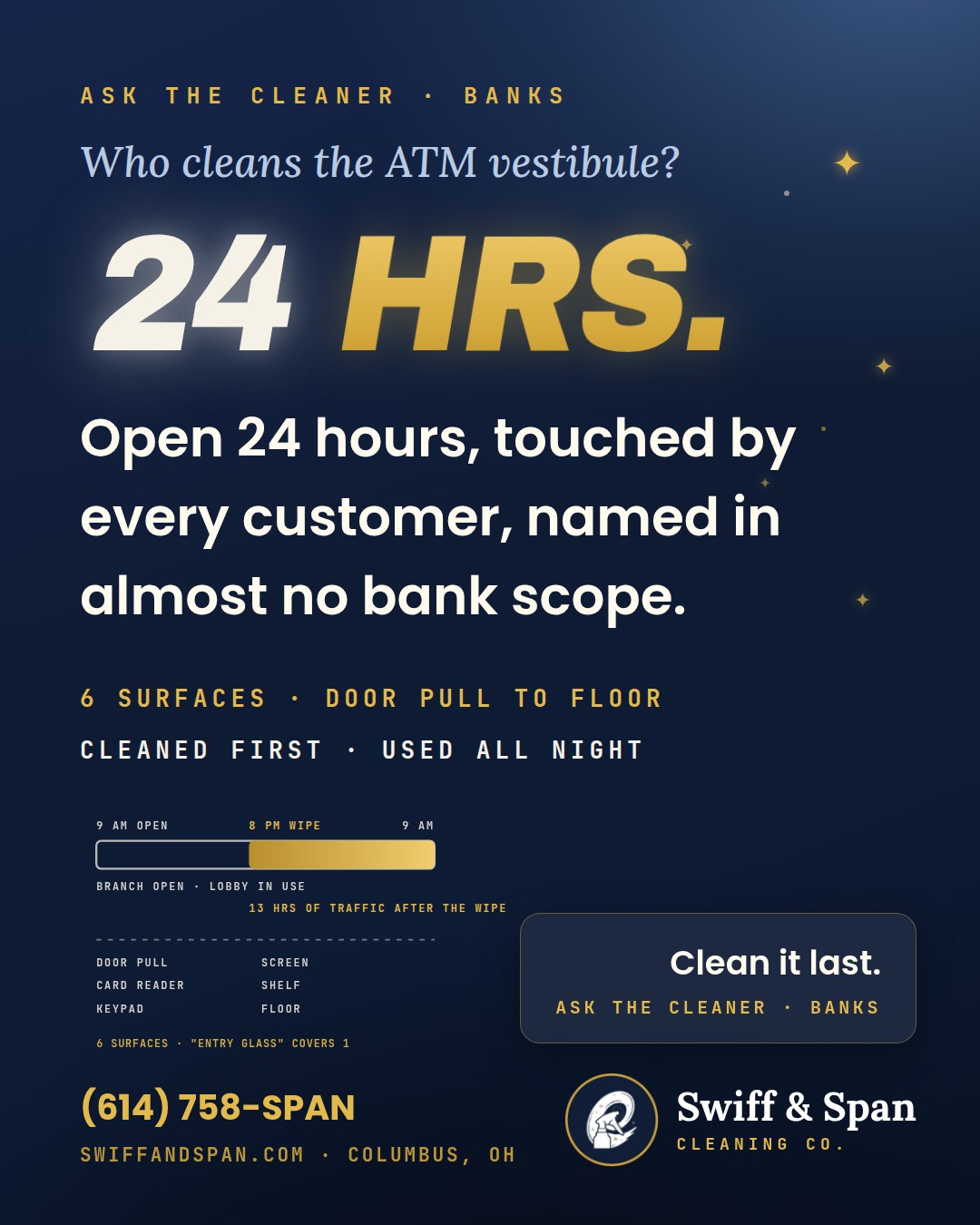
Treat it as a small, high-traffic room with six surfaces that every single visitor touches or stands on, in order.
- The exterior door pull. The most-touched piece of metal on the property, and the one that goes the longest between wipes.
- The card-reader or access panel. A small plastic slot with a lit surround, touched by every card and most thumbs.
- The ATM keypad. Twelve to sixteen raised keys with grooves between them. Grooves hold what fingers leave.
- The screen. On newer machines a touchscreen, on older ones a screen ringed with function keys. Either way, touched at eye level and smeared by mid-morning.
- The deposit shelf and privacy wings. Where wallets, phones and coffee cups sit for ninety seconds.
- The floor. Two hundred square feet that collect everything a Columbus winter puts on a boot: salt, grit, slush, and in July, lawn clippings and pollen.
A scope that says “entry glass” covers one of those six. Sometimes two, if the door pull gets caught in the spray.
Why the timing is the whole problem
Most commercial cleaning happens after close. The crew arrives at 7 or 8 PM, works the branch, and locks the back door around 10. For the lobby, that is perfect. Nobody touches the teller counter between 10 PM and 9 AM, so the counter is as clean at opening as it was when the crew left.
The vestibule does not work that way. If the crew wipes the keypad at 8 PM, that keypad has nearly thirteen more hours of visitors before the branch manager walks past it at 8:45 AM. The first thing a customer sees when the branch opens is the room that has been open all night, cleaned first and used last. By Friday afternoon the floor by the door has a grey arc of tracked-in salt, the screen has a week of fingerprints, and every one of those customers has just formed an opinion about how the bank keeps its house.
That is not a crew problem. The crew cleaned what the scope said, when the scope said. It is a scoping problem, and the fix is not more hours. It is putting the right ten minutes in the right place on the clock.
How we scope a vestibule
Four lines. They cost nothing to write into an existing agreement.
- Clean it last, not first. Reverse the route. The crew works the branch interior first and finishes in the vestibule on the way out, so the six surfaces get the shortest possible gap between the wipe and the first morning customer. On a normal night that alone cuts the exposure window by two hours.
- Name the six surfaces. Door pull, access panel, keypad, screen, shelf and wings, floor. Each one on the checklist, each one every service. “Entry glass” comes off the scope entirely.
- Match the product to the machine. An ATM is a computer. Ammonia glass cleaner and bleach do not belong on its screen or keypad, and nothing gets sprayed directly at the machine where it can run into a card slot. Most terminal and display manufacturers accept 70% isopropyl alcohol or a manufacturer-approved wipe applied to a cloth, then to the surface. The scope should say which product touches the machine and that the cloth, not the bottle, does the touching. The door pull and the shelf get the same EPA-registered disinfectant as the rest of the branch, held wet for its labeled contact time.
- Add a day-porter pass where the traffic earns it. A branch on a bus line downtown or beside a campus does not get to Friday on one night clean. A ten-minute midday pass, door pull, keypad, screen, spot-mop the salt arc, keeps the room in the condition the night crew left it. Not every branch needs it. The ones that do are obvious by Tuesday.
The floor deserves its own paragraph
From November to March in Columbus, the vestibule floor is a salt trap. Rock salt and brine track in on every boot, dry to a white film, and grind into the tile under the next pair of boots. Left for a week it etches grout and dulls the finish; left for a season it is a resurfacing job. Two things fix it. A proper walk-off mat, at least eight to ten feet of it so a customer takes two full steps on it before hitting tile, and a mop pass with a neutral floor cleaner rather than plain water, because plain water spreads brine and lets it dry white again. The scope should name the mat, name who shakes it out and when, and name neutral cleaner for the winter months.
How we check it
On a complimentary ATP walkthrough of a branch we swab the vestibule before we swab the lobby, because the vestibule tells you more. Adenosine triphosphate testing measures the energy molecule present in every living cell, and reports the organic residue on a surface in relative light units in about fifteen seconds. It does not count germs and it does not prove disinfection. What it shows is whether the cleaning step happened on the surface you are looking at.
A door pull that reads low at 8 AM was cleaned recently and cleaned well. A keypad that reads high at 8 AM, the morning after service, was either skipped or wiped at 7 PM and has since seen a night of traffic. Either way the number tells the branch manager something the log sheet cannot, and it points at the fix: move the wipe, or add the pass.
The one-sentence version for your facilities lead
The ATM vestibule is open 24 hours, it is the first room every customer touches, and our cleaning scope covers one of its six surfaces and cleans it thirteen hours before the doors open. Send that, and ask which product touches the keypad.
Frequently asked questions
How often should a bank ATM vestibule be cleaned?
Every night the branch is serviced, and at higher-traffic branches a short midday pass as well. Because the vestibule stays open all night, the nightly clean should be the last stop on the crew’s route rather than the first, so the gap between the wipe and the first morning customer is as short as possible.
What surfaces in an ATM vestibule need cleaning?
Six: the exterior door pull, the card-reader or access panel, the ATM keypad, the screen, the deposit shelf with its privacy wings, and the floor. A scope that only says “entry glass” covers one of them.
What cleaner is safe to use on an ATM screen and keypad?
Follow the machine manufacturer’s guidance. Most accept 70% isopropyl alcohol or an approved wipe applied to a cloth and then to the surface. Do not spray liquid directly at the machine, and keep ammonia glass cleaners and bleach off the screen and keypad. The door pull and shelf can take the same EPA-registered disinfectant used elsewhere in the branch.
Why does the vestibule floor look dirty a day after cleaning in winter?
Tracked-in road salt dries to a white film and spreads when mopped with plain water. A long walk-off mat, at least eight to ten feet, and a neutral floor cleaner in the winter months keep the salt from etching grout and dulling the tile.
Can ATP testing tell whether an ATM keypad was cleaned?
Yes, as a cleaning check. ATP measures organic residue in relative light units, so a keypad that reads high the morning after service either was skipped or has seen a night of use since the wipe. It does not count germs or prove disinfection. It shows whether the cleaning step reached that surface.
Every Columbus medical, dental, wellness, and commercial facility gets the same offer: a complimentary 30-minute ATP walkthrough. We swab your highest-touch surfaces, on the spot, and hand you the readings. No obligation, no pitch required to see the number. Book your complimentary ATP walkthrough or text (614) 758-SPAN.
Erik Kuusisto, Owner
Swiff & Span Cleaning Company