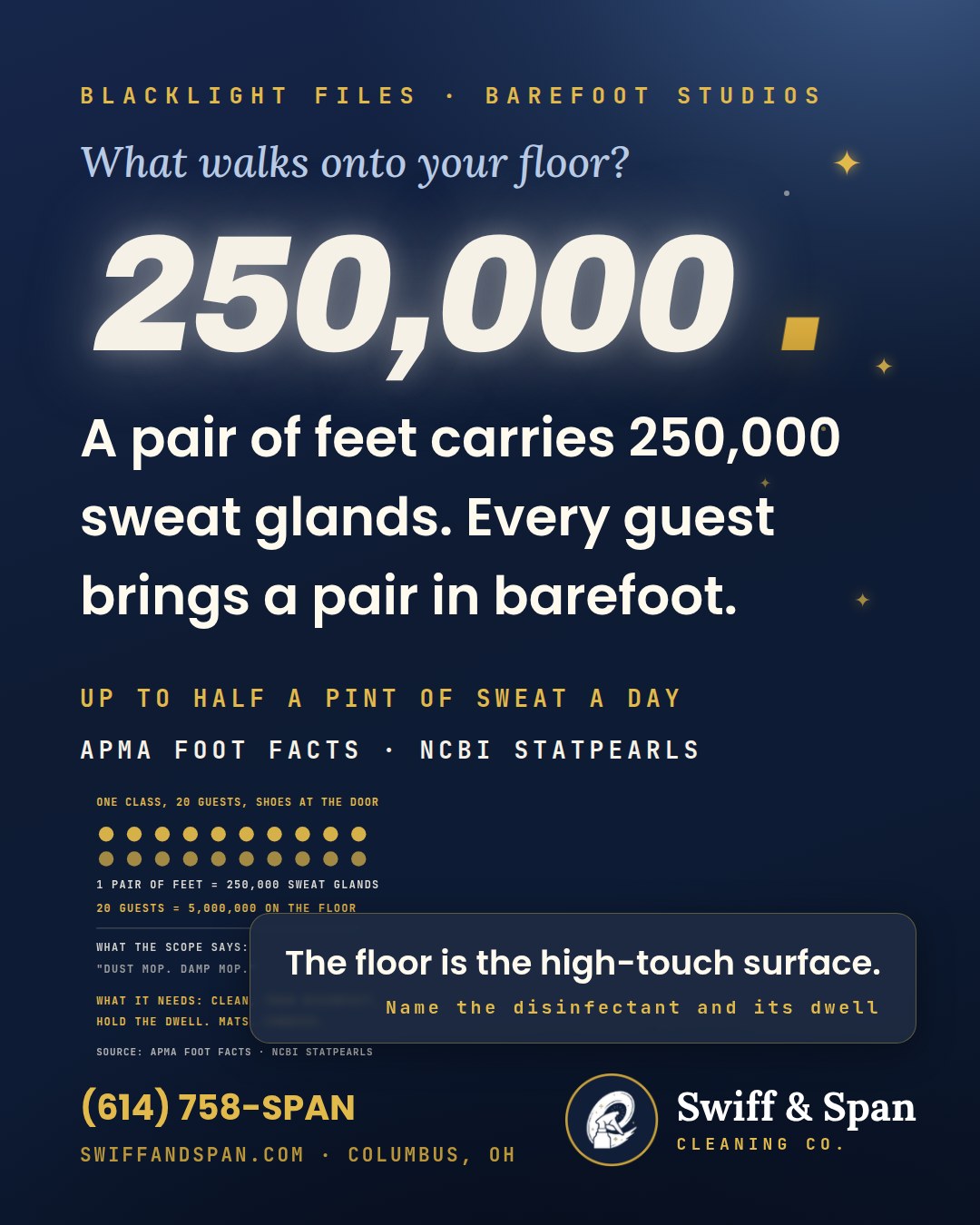
Walk into any barefoot studio in the Short North at 6 PM and you will see the same thing: a neat row of shoes in the cubbies by the door, and twenty people on a hardwood floor with nothing between their skin and the wood. It is the whole point of the practice. It is also a cleaning problem that almost no studio scope is written for.
Start with the number. The American Podiatric Medical Association’s foot facts put approximately 250,000 sweat glands in a pair of feet, and note that they can excrete as much as half a pint of moisture in a day. Per square inch, feet carry more sweat glands than any other part of the body. Now multiply. A 20-person class puts 5 million sweat glands on your floor for an hour, and a hot class runs them at full output. By the time the last class ends, that floor has been walked, gripped, pressed and lain on by every pair of feet that came through the door, and by every palm in every plank.
None of that is a reason to hand out shoes. It is a reason to understand what a barefoot floor actually is: the high-touch surface. Not the door handle, not the front desk. The floor.
What moves foot to floor to foot
The organism that matters most is a dermatophyte, the fungus behind tinea pedis, better known as athlete’s foot. The clinical references describe how it spreads in one sentence: by direct contact with the organism while walking barefoot in locker rooms, showers and swimming complexes. An infected foot sheds skin scales carrying the fungus onto the floor. The next bare foot picks them up. Warmth and moisture help the fungus survive on the surface between the two.
Read that list of places again. Locker rooms, showers, pool decks. What they have in common is not water. It is bare feet on a shared floor in a warm, damp room. A yoga studio at the end of a heated class, or a pilates room after three back-to-back sessions, is that environment with better lighting and a nicer floor.
Two other passengers ride along. Sweat and skin cells build a thin organic film on the wood, the same film that shows up as a high ATP reading and that bacteria feed on. And plantar warts, caused by a virus, spread the same barefoot way, which is why podiatrists tell patients to wear sandals in shared showers. We are not going to overstate the medical risk here. Most guests will never catch anything from a studio floor. But the pathway is real, it is well documented, and it runs straight through the one surface most studio cleaning contracts treat as background.
What the scope usually says
We have read a lot of studio cleaning scopes across Columbus, Dublin and Upper Arlington. Most of them give the floor four words: dust mop, damp mop. Sometimes the product is named, usually a neutral pH floor cleaner chosen to protect the finish. Rarely is there a contact time, because a neutral cleaner has no kill claim to hold a contact time for. Mats, blocks, bolsters and straps are almost never mentioned. Neither are the cubbies where twenty pairs of shoes sit for an hour, the threshold everyone crosses barefoot, or the lower two feet of the mirror wall, where sweaty hands and feet meet glass in every class.
That scope was written for a hallway. It removes visible soil, which matters, and it protects the finish, which matters to the owner. It does nothing about the fungus, because the product cannot, and it says nothing about the props, because nobody wrote them down. A crew that follows it to the letter has done exactly what it was paid to do, and the floor still carries whatever the last class left on it.
Five lines a barefoot studio scope needs
The fix is written, not scrubbed. Five lines, one page.
Clean first, then disinfect the whole floor. The neutral cleaner and the mop remove the soil and the film. Then an EPA-registered disinfectant goes onto the clean floor, and the scope names the product. Look for a label that lists Trichophyton mentagrophytes, which is the athlete’s foot fungus, in its kill claims. Many hospital-grade quaternary disinfectants do. Confirm with the floor manufacturer that the product is safe for the finish, because a hardwood or cork floor has its own rules.
Hold the contact time. The label says how long the floor must stay wet for the claim to apply, and on a warm floor a thin application dries fast. The scope names the number, and the crew treats the whole floor, not the traffic lane down the middle. We have written about why that clock does not negotiate.
Give the props their own line. Studio mats, blocks, bolsters, straps and blankets touch skin every class. Mats get cleaned and disinfected with a product that will not degrade them, held for its contact time, and left to dry before they are stacked. We covered the yoga mat contact-time problem in detail. Blankets go to laundry on a written cadence.
Name the edges. Cubby shelves and their floor, the threshold, the door pull, and the mirror wall to knee height. These are the surfaces the floor scope forgets because they are not floor, and the general scope forgets because they are in the studio.
Name how the work is checked. Who verifies the floor was disinfected tonight, what the check looks like, and where the record lives. A scope without a check is a wish list.
How we check it
We verify the cleaning step with ATP readings taken on site and shown to you: three points on the floor, a mat from the top of the stack, a cubby shelf and the mirror wall at knee height. ATP measures organic residue, including the sweat and skin film left on a surface. A low reading after service shows that the cleaning step reached the surface. A high reading the next morning identifies where the scope needs attention. The result is an immediate RLU surface reading you can use to check the work.
What it does is close the loop the scope opens. The five lines say what should happen to the floor. The reading says whether it did. The same logic applied to the equipment in a fitness studio and to the wet area behind it. The floor is the third piece.
The one-sentence version for your studio manager
Every guest brings 250,000 sweat glands onto our floor barefoot, the fungus behind athlete’s foot moves foot to floor to foot, and our cleaning contract says dust mop and damp mop, so it needs a named disinfectant with a fungal claim and its contact time, a mat and prop line, the cubbies and the mirror wall, and a check.
If you would like to know what your own floor reads at 8 AM, the complimentary ATP walkthrough takes about 30 minutes and starts at the cubbies.
Frequently asked questions
How many sweat glands are in your feet?
The American Podiatric Medical Association puts the figure at approximately 250,000 sweat glands in a pair of feet, which can excrete as much as half a pint of moisture in a day. Per square inch, feet carry more sweat glands than any other part of the body.
Can you catch athlete’s foot from a yoga or pilates studio floor?
Yes. Tinea pedis, the fungal infection behind athlete’s foot, spreads by barefoot contact with surfaces an infected foot has crossed. The medical literature names locker rooms, showers and pool decks because they are warm, damp and walked barefoot. A studio floor after a hot class meets the same description.
Does mopping a studio floor with a neutral cleaner kill the athlete’s foot fungus?
No. A neutral floor cleaner removes soil, which is a necessary first step, but it carries no fungicidal claim. Killing the fungus takes an EPA-registered disinfectant whose label lists Trichophyton mentagrophytes, the athlete’s foot fungus, applied to a clean floor and left wet for the contact time on that label.
How often should a barefoot studio floor be disinfected?
After the last class of the day, every day the studio is open, with the whole floor treated rather than just the traffic lanes. Hot yoga rooms and studios with more than one class per evening benefit from a midday pass. Mats, blocks and straps follow the same cadence and get their own line in the scope.
Can ATP testing detect athlete’s foot fungus on a floor?
No. ATP testing measures organic residue, the sweat, skin cells and film that organisms live in, and does not identify fungus or any specific organism. Swiff & Span uses it to verify that a floor, mat or cubby shelf was actually cleaned after service, with readings shown on site. It is a cleaning check, not a disinfection or medical claim.
Sources
- American Podiatric Medical Association. APMA Foot Facts: approximately 250,000 sweat glands in a pair of feet, excreting as much as half a pint of moisture each day.
- Nigam, P.K. and Saleh, D. Tinea Pedis. StatPearls, NCBI Bookshelf. Transmission by direct contact with the organism while walking barefoot in locker rooms, showers and swimming complexes.
- United States Environmental Protection Agency. EPA-registered disinfectant label requirements for pre-cleaning, listed organisms including Trichophyton mentagrophytes, and contact time.
- Centers for Disease Control and Prevention. Cleaning and Disinfecting Your Facility: routine cleaning and disinfection of high-touch surfaces.