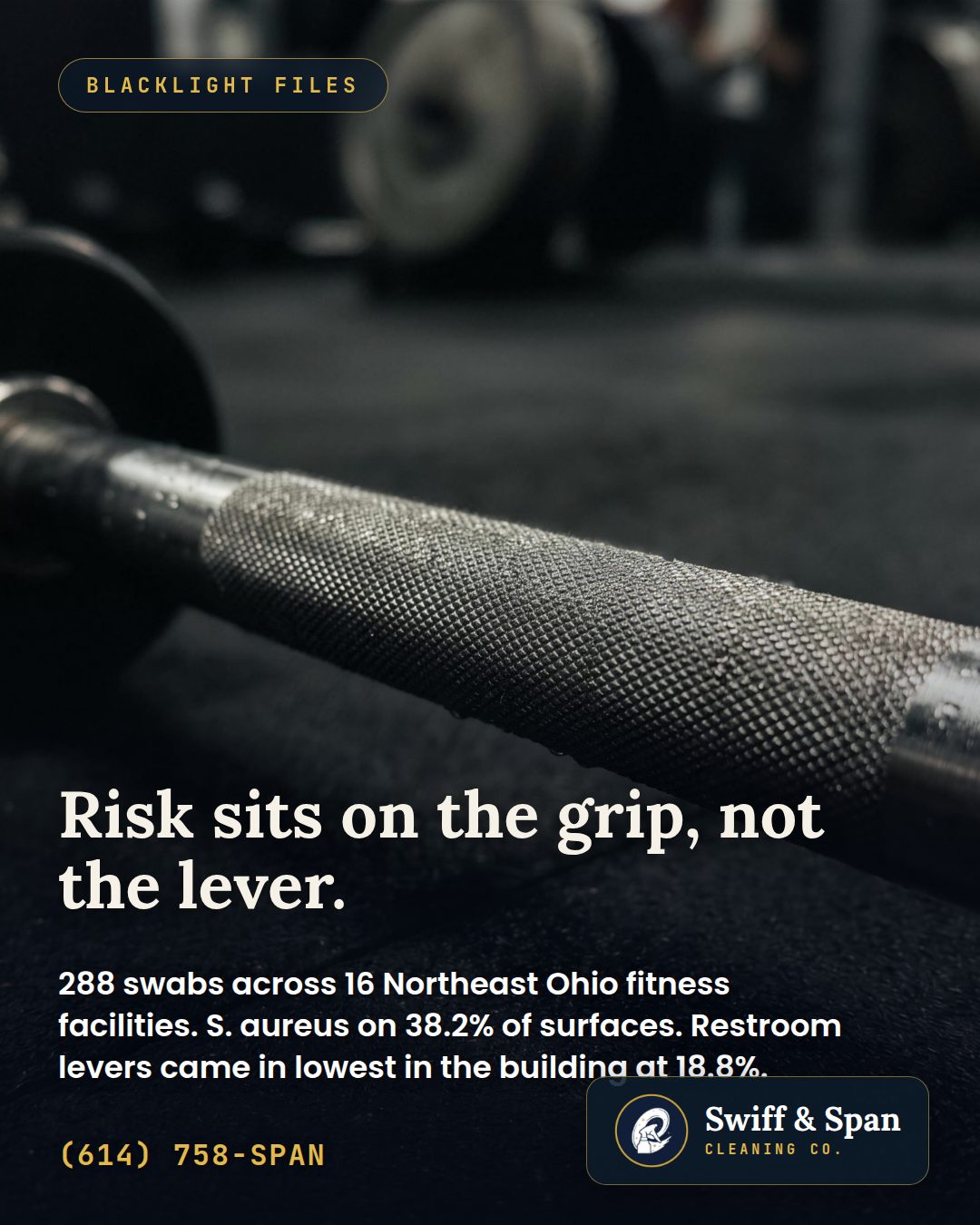
Somebody swabbed 288 surfaces across sixteen fitness facilities in Northeast Ohio, and the single cleanest object in the entire data set was the handle on the bathroom door.
That is not a joke about how bad the rest of the building was, although it is a little bit that. It is the finding, printed in BMC Infectious Diseases in January 2019, and it rearranges where a studio owner should be spending cleaning money.
The sample was four CrossFit boxes, four traditional gyms, five community centers and three hospital-associated fitness facilities. Not Columbus. Northeast Ohio, a couple hours up the road, close enough that the equipment catalogs, the climate and the cleaning contracts all look like the ones in Grandview and Worthington. Most contamination research gets run in a hospital in another country. This one got run in Ohio gyms.
How much staph is actually on gym equipment?
A lot, and evenly. Across 288 environmental swabs in 16 Northeast Ohio fitness facilities, Staphylococcus aureus was recovered from 38.2% of surfaces, 110 of 288. MRSA specifically appeared on 11.5%, and 36.3% of the isolates were multidrug resistant.
Multidrug resistant means resistant to three or more classes of antibiotic. On more than a third of what they picked up. In a gym.
Facility type barely mattered. The CrossFit boxes, the machine gyms, the community centers and the hospital-affiliated fitness rooms all carried it. Which tracks, because the bacteria are not coming from the building. They come in on the members, who carry S. aureus on their skin the way a large share of healthy people do, and then they grip things.
Which surfaces in a gym are the dirtiest?
The ones people grip. Weight balls, cable-driven curl bars and CrossFit boxes each tested positive at 62.5%. Weight plates came in at 56.3%. Treadmill handles at 50%. Every one of those is an object held hard in a bare, sweating hand.
Look at the shape of that list. No mystery surface, nothing structural, nothing in the ductwork. It is the knurled steel of a curl bar, the rubber skin of a wall ball, the painted plywood top of a box, the raised lettering on a weight plate.
Texture is the part most cleaning scopes underrate. Knurling exists to increase surface area so skin has something to catch on, which is also a fair description of a good bacterial substrate. A wipe dragged fast across a knurled grip touches the peaks and skips the valleys, and the valleys are where the sweat went.
Then watch what a member does thirty seconds after racking the bar. Wipes the forehead. Adjusts a contact lens. Picks up a phone and holds it to a face. The hand is the vector, the face is the destination, the equipment is the surface in between.
Is the gym bathroom the dirtiest room in the building?
No. In this study it was the cleanest. The authors found the bathroom levers and door handles were the least contaminated surfaces in both male and female restroom facilities, at 18.8%. The curl bar scored more than three times worse.
Sit with that, because it is the whole argument.
The restroom is the room your members complain about. It produces the one-star review, the front desk conversation, the text to the owner at 9pm. So it gets the most attention, the most product, the most minutes on the checklist. And the data says that worked. At 18.8%, restroom hardware was the best-performing surface category in the building. Your cleaning is not failing. It is aimed.
It is aimed at complaints. Complaints come from what looks bad and what smells bad. Risk sits on the knurled grip of a curl bar, which never looks like anything and never smells like anything, so it never generates a complaint and never earns a line item.
We see this on walkthroughs constantly. Owners hand us a scope heavy on floors, mirrors, glass and restrooms, heavy on the visible, thin to nonexistent on the objects themselves. Nobody wrote that carelessly. They wrote it in response to feedback, and feedback is a signal about appearance, never about load. We took the longer version apart in why a clean smell is not a clean surface.
How long does staph survive on gym equipment?
Months. Kramer, Schwebke and Kampf reviewed the survival literature and found S. aureus, including MRSA, persists on dry inanimate surfaces for months. Candida albicans, a yeast, survives up to four months. These organisms do not need daily resupply.
This is the detail that breaks the intuitive model. Most owners picture contamination as something that happens during the 6pm class and dissipates overnight, the way a smell does. It does not. A dry steel handle is a perfectly acceptable place for S. aureus to wait, and it will wait through your closed Sunday, through the holiday Monday, through the week you were out of town.
So the load on a Tuesday morning is not Tuesday's load. It is cumulative, and it resets only when something physically removes it.
Does fogging or spraying the whole studio reduce MRSA?
CDC guidance for athletic facilities says there is little evidence that large-scale use of disinfectants will prevent MRSA infections better than a targeted approach of cleaning surfaces. That is the federal government, not a competing vendor, arguing against the fog machine.
We want to be precise about what that line does not say.
It does not say disinfectant is useless. It says volume is not the variable. Filling a room with mist covers a large area quickly, which is not the same as removing organic soil from the grip surfaces that scored worst. Product landing on a soiled bar has to work through the soil before it works on anything alive, and it usually runs out of wet time first. We walked through the mechanics in what electrostatic spraying actually does, a real tool with a narrow job.
The instruction the CDC does give is short: clean shared equipment after each use and allow it to dry before use, with EPA-registered products from List H. Two verbs carry the weight. Clean, meaning physically remove the soil, which is a separate act from disinfecting. And dry, meaning the product stayed wet long enough to do what the label claims. A grip wiped dry in eight seconds with a product that needs four wet minutes has been tidied, not disinfected. That gap is the subject of cleaning versus disinfecting and why dwell time decides.
What should a fitness studio clean after every class?
Every object a member grips. Barbells and dumbbell handles, kettlebell handles, weight plates, cable attachments and curl bars, wall balls, box tops, treadmill and elliptical rails, reformer straps and foot bars, and mats. Grip points first, then the room.
Three things separate an equipment protocol from an equipment intention.
An object list, not a room list. "Wipe down the weight room" gets satisfied by the fastest available interpretation, which is the floor and the mirrors. "Wipe the curl bar, the plates, the wall balls and the box tops" is an object instruction, and it can be checked by somebody standing there.
Contact time that somebody actually timed. Read the label on your spray bottle, find the minutes the surface must stay visibly wet, then watch one staff member do the wipe with a stopwatch running. This is the most common gap we find in wellness spaces. Mat protocols in yoga studios are the worst offenders, and we took that apart in yoga mat disinfectant contact time.
A number, so the interval stops being a guess. ATP bioluminescence testing reads organic residue on a surface in about fifteen seconds, using the firefly enzyme chemistry the food industry has used for decades. Under 100 RLU is the general industry line. Swiff & Span holds to 25. Untested surfaces commonly read north of 300. Swab a curl bar grip, a mat corner and the restroom door handle on one visit, and three numbers will tell you whether your scope is pointed at your risk or at your complaints.
ATP does not make a facility compliant, and it does not identify S. aureus. It measures organic soil, the food and the shelter bacteria need. On a knurled grip, soil is what you are fighting.
Your next move
Go stand at the rack in your studio, a Short North strength gym, a Clintonville yoga room, a New Albany training floor, and ask one question. When was the curl bar, specifically, last cleaned by name.
Not the weight room. The bar.
If the answer is a shrug, you have learned something and it cost nothing. Then ask your provider for their object list in writing. Not their frequency. Their list.
If you want numbers instead of assurances, we run a complimentary ATP walkthrough for studios in Columbus, Dublin and Upper Arlington, grip surfaces included, and the readings are yours to keep. Call (614) 758-SPAN.
Frequently Asked Questions
What percentage of gym surfaces test positive for staph?
38.2%, in the Ohio study that measured it. Researchers collected 288 environmental swabs across 16 Northeast Ohio fitness facilities and recovered Staphylococcus aureus from 110 of them. MRSA specifically was found on 11.5% of surfaces, and 36.3% of the isolates were multidrug resistant.
Which piece of gym equipment is the most contaminated?
The things people grip hardest. Weight balls, cable-driven curl bars and CrossFit boxes each tested positive at 62.5%. Weight plates followed at 56.3% and treadmill handles at 50%. Textured surfaces held by wet hands scored worst across every facility type in the study.
Is the gym bathroom cleaner than the weight room?
In this study, yes. The bathroom levers and door handles were the least contaminated surfaces in both male and female restroom facilities, at 18.8%, which is more than three times better than the curl bar. Restrooms get attention because they generate complaints. Equipment does not.
Does spraying or fogging a whole gym prevent MRSA?
CDC guidance for athletic facilities says there is little evidence that large-scale use of disinfectants will prevent MRSA infections better than a targeted approach of cleaning surfaces. Volume of product is not the variable. Physical removal of soil from the objects people touch is.
How often should a fitness studio clean shared equipment?
After each use, per CDC guidance for athletic facilities, using an EPA-registered product from List H and allowing the surface to dry before the next use. The practical version is an object list rather than a room list: bars, handles, plates, balls, box tops and mats.
Sources
- Dalman M, Bhatta S, Nagajothi N, Thapaliya D, Olson H, Naimi HM, Smith TC. Characterizing the molecular epidemiology of Staphylococcus aureus across and within fitness facility types. BMC Infectious Diseases, 2019;19:69.
- Centers for Disease Control and Prevention. MRSA: Information for Coaches and Athletic Directors.
- Kramer A, Schwebke I, Kampf G. How long do nosocomial pathogens persist on inanimate surfaces? A systematic review. BMC Infectious Diseases, 2006;6:130.
- United States Environmental Protection Agency. List H: Antimicrobial Products Registered with EPA for Claims Against MRSA, VRE and VISA.