A microneedling pass leaves pinpoint bleeding by design. An injectable appointment ends with a cotton pad pressed to a lip. A permanent makeup session runs a needle through skin for an hour. None of that is a problem. It is the work. The problem is what happens to the drop that does not land on the pad, because a drop of blood the size of a period dries clear in about a minute and then sits there looking like nothing.
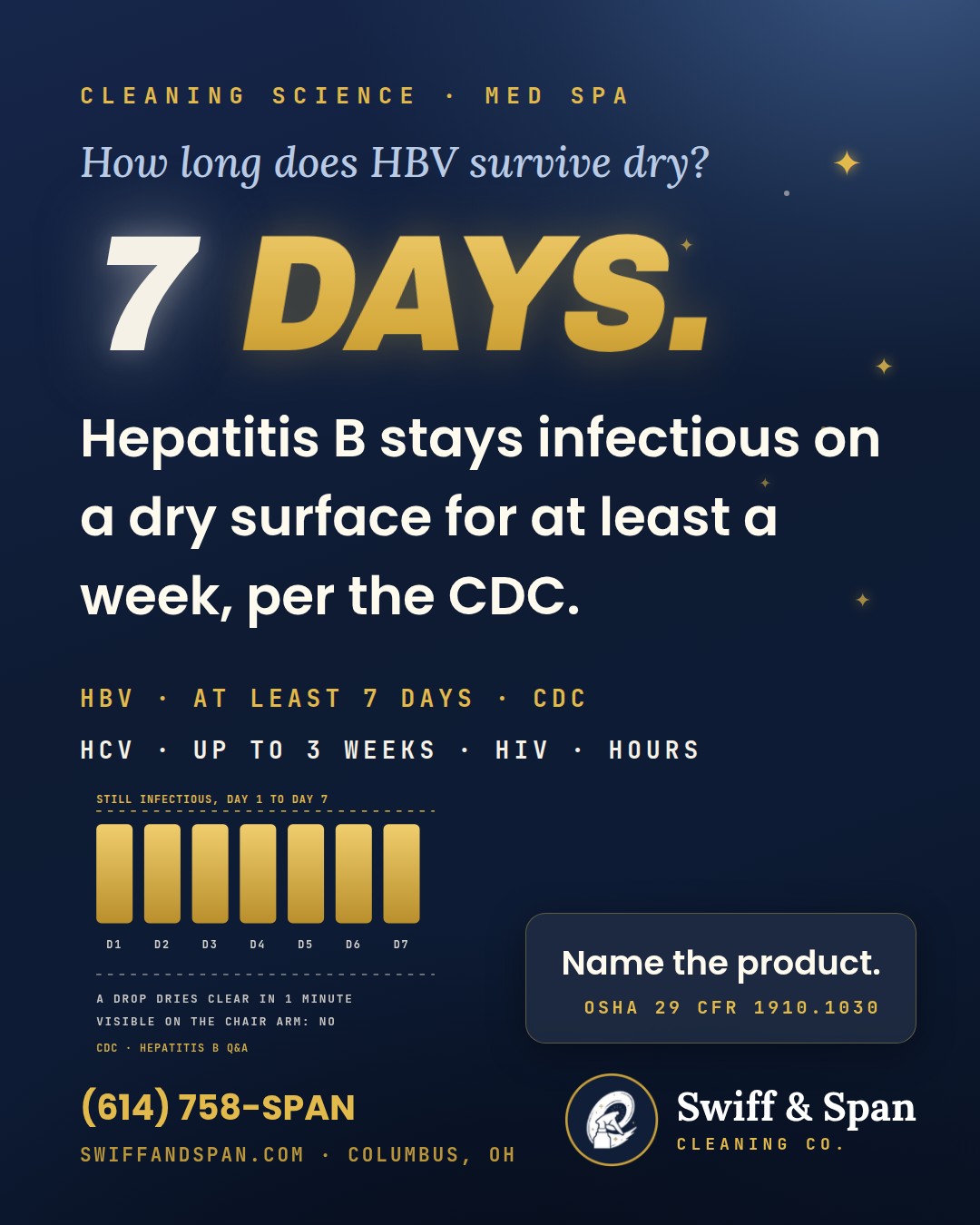
The Centers for Disease Control and Prevention answers the obvious question plainly. Hepatitis B virus can survive outside the body for at least 7 days, and during that time it is still capable of causing infection. Not seven hours. Seven days, on a dry surface, at room temperature, with no visible sign it is there.
That single number changes how a treatment room should be cleaned, and it changes who is responsible for which part of the job.
Why hepatitis B is the molecule to plan around
Bloodborne pathogens are usually named as a group, HIV, hepatitis B and hepatitis C, and the group hides a wide spread in how tough each one is outside a body. HIV is fragile. Once blood dries, the virus loses its ability to infect within hours, which is why casual surface contact has never been a documented route of HIV transmission. Hepatitis C sits in the middle. The CDC notes it can remain infectious on surfaces at room temperature for up to three weeks. Hepatitis B is the outlier. It is stable, it is present in blood at very high concentrations in an infected person, and the amount needed to start an infection is small.
That combination is why the Occupational Safety and Health Administration built its Bloodborne Pathogens Standard, 29 CFR 1910.1030, around hepatitis B specifically. The standard requires employers to offer the hepatitis B vaccine to every worker with occupational exposure, at no cost, within ten working days of assignment. It does not require an HIV vaccine because there is none, and it does not single out hepatitis C. The vaccine requirement exists because the agency looked at the same seven-day number you are reading now and decided the room could not be trusted to be clean.
The vaccine protects the worker who takes it. It does nothing for the client who sits in the chair at 2 PM after the 1 PM appointment, and nothing for the cleaner who wipes the chair arm at 8 PM without knowing what dried on it.
What OSHA says has to happen to the surface
The same standard tells you when a contaminated work surface must be decontaminated. Three triggers, and they are worth reading as written because most treatment-room schedules only honor one of them.
- After completion of procedures. The between-client wipe. This is the one everyone does.
- Immediately, or as soon as feasible, when a surface is overtly contaminated or after any spill of blood or other potentially infectious material. Not at the end of the appointment. Now.
- At the end of the work shift, if the surface may have become contaminated since the last cleaning. The end-of-day clean, applied to every surface that might have caught something, not just the ones that were visibly used.
The word “appropriate” does the heavy lifting in the standard. An appropriate disinfectant, in OSHA’s enforcement guidance, means an EPA-registered product with a tuberculocidal claim, an EPA-registered product with a specific claim against HIV and hepatitis B, or a fresh dilution of household bleach. A wipe that says “kills 99.9% of bacteria” and nothing about viruses does not qualify, no matter how clean the room smells afterward. And every one of those products carries a contact time on its label, the number of minutes the surface has to stay visibly wet. We have written before about why that clock does not negotiate, and it does not negotiate here either.
The two jobs in a treatment room
Here is where a med spa owner in Dublin or Bexley usually finds a gap they did not know was there. The between-client reset belongs to the clinical team. They are the ones present when the procedure ends, they know where the blood went, and they are the people the Bloodborne Pathogens Standard trains, vaccinates and equips. No outside cleaning company should be doing a between-client turnover of a room where a needle was just used, and any company that offers to is telling you something about how it reads the standard.
The end-of-day environmental clean is a different job, and it is the one that hires a company like ours. It covers the surfaces the clinical wipe was never aimed at: the arms and underside of the treatment chair, the stool, the cart top and its drawer pulls, the light handle, the counter edge, the door handle, the floor around the chair base, the sink surround, the waste bin lid. Surfaces where a dried microdrop from the 1 PM microneedling can sit unnoticed through six more appointments and a full night, and still be infectious at the 9 AM opening.
The gap opens when the scope for that second job is written like an office scope. “Wipe counters, empty trash, mop floor.” Nothing about which product. Nothing about a virucidal claim. Nothing about contact time. Nothing about which surfaces count as the treatment zone. A cleaner handed that paragraph will do exactly what it says, with whatever is on the cart, and the chair arm will get a damp pass and dry in twenty seconds.
What a treatment-room scope should say
You do not need a longer contract. You need five specific lines in it.
- Name the zone. List the surfaces inside arm’s reach of the treatment chair as a set: chair arms, headrest and hinge, chair base and pedal, stool, cart top and pulls, light handle, counter edge, door pull. That set is cleaned as a unit, every night the room was used.
- Name the product and the claim. An EPA-registered disinfectant whose label carries a hepatitis B claim or a tuberculocidal claim. Write the product name into the scope so nobody swaps it for a fragrance wipe.
- Name the contact time. Copy it from the label. If it says four minutes, the surface stays wet four minutes, and the cleaner works the rest of the room while it does.
- Assign the cloth. A dedicated microfiber color for the treatment zone that never touches a restroom and never touches a reception desk. One cloth per room, then it goes in the bag.
- Name the check. How does anyone know the cleaning step happened? A signature says a person was in the building. A reading says the surface changed.
None of that is a hospital protocol. It is what the standard your clinical team already works under would say if it were written for a cleaning company instead of a nurse.
What ATP can and cannot tell you here
We verify with adenosine triphosphate testing, and it matters to be precise about what that means in a bloodborne-pathogen conversation. ATP is the energy molecule in every living cell, and a swab reads the organic residue left on a surface in relative light units in about fifteen seconds. Blood is rich in ATP. Skin cells are rich in ATP. A chair arm that was wiped properly reads low. A chair arm that was visited with a damp cloth reads high.
What ATP does not do is detect a virus, and we will never tell you it does. Viruses carry no ATP of their own. A low reading tells you the cleaning step removed what the day left behind, and cleaning is the step that has to succeed before a disinfectant can reach the surface at all. A high reading the morning after service tells you the step was skipped on that surface, whatever the log sheet says. That is the honest use of the tool, and it is enough to find the gap.
The one-sentence version for your practice manager
The CDC says hepatitis B stays infectious on a dry surface for at least 7 days, OSHA says contaminated surfaces get an EPA-registered virucidal disinfectant at the end of every shift, and our end-of-day cleaning scope does not name the product, the surfaces or the contact time. Send that, and ask which cloth touches the chair.
Frequently asked questions
How long does hepatitis B survive on a surface?
According to the CDC, hepatitis B virus can survive outside the body for at least 7 days and remain capable of causing infection. Dried blood on a surface shows no visible sign that the virus is present, which is why surfaces in a room where skin is broken are cleaned on a schedule rather than on sight.
Does a med spa fall under the OSHA Bloodborne Pathogens Standard?
Any employer whose workers can reasonably be expected to contact blood or other potentially infectious material during their duties is covered, and microneedling, injectables, permanent makeup and similar procedures create that exposure. The standard requires an exposure control plan, hepatitis B vaccination offered at no cost, training, and decontamination of work surfaces with an appropriate disinfectant.
What disinfectant should be used in a treatment room?
OSHA’s enforcement guidance accepts an EPA-registered disinfectant with a tuberculocidal claim, an EPA-registered product with a specific claim against HIV and hepatitis B, or a fresh dilution of household bleach. Whatever the product, the surface must stay visibly wet for the full contact time printed on its label.
Should the cleaning company do the between-client turnover?
No. The between-client reset belongs to the clinical team, who are present when the procedure ends and are trained and vaccinated under the standard. The cleaning company’s job is the end-of-day environmental clean of every surface in the treatment zone, using a named virucidal product held for its contact time.
Can ATP testing detect hepatitis B on a surface?
No. ATP testing measures organic residue, not viruses, and no honest cleaning company will claim otherwise. A low ATP reading shows the cleaning step removed what the day left on the surface, which is the step that has to happen before any disinfectant can work. A high reading shows the surface was skipped.
Every Columbus medical, dental, wellness, and commercial facility gets the same offer: a complimentary 30-minute ATP walkthrough. We swab your highest-touch surfaces, on the spot, and hand you the readings. No obligation, no pitch required to see the number. Book your complimentary ATP walkthrough or text (614) 758-SPAN.
Erik Kuusisto, Owner
Swiff & Span Cleaning Company
Sources
- Centers for Disease Control and Prevention. Hepatitis B Questions and Answers for Health Professionals: survival of HBV outside the body.
- Centers for Disease Control and Prevention. Hepatitis C Questions and Answers for Health Professionals: survival of HCV on environmental surfaces.
- Occupational Safety and Health Administration. Bloodborne Pathogens Standard, 29 CFR 1910.1030, paragraphs (d)(4)(ii)(A) and (f)(1), and enforcement directive CPL 02-02-069 on appropriate disinfectants.