Ask most people how long germs live on a countertop and they guess in hours. A day, maybe, for something stubborn. The instinct makes sense. A surface dries, it looks clean, and whatever was on it feels like it should be gone by morning.
In 2006 a team led by Axel Kramer at the University of Greifswald went through the published literature and pulled every study that measured how long a nosocomial pathogen stayed alive on an inanimate, dry surface. The review ran in BMC Infectious Diseases, and it remains the reference most infection-prevention guidance leans on when it talks about the environment. The ranges it reports are not hours.
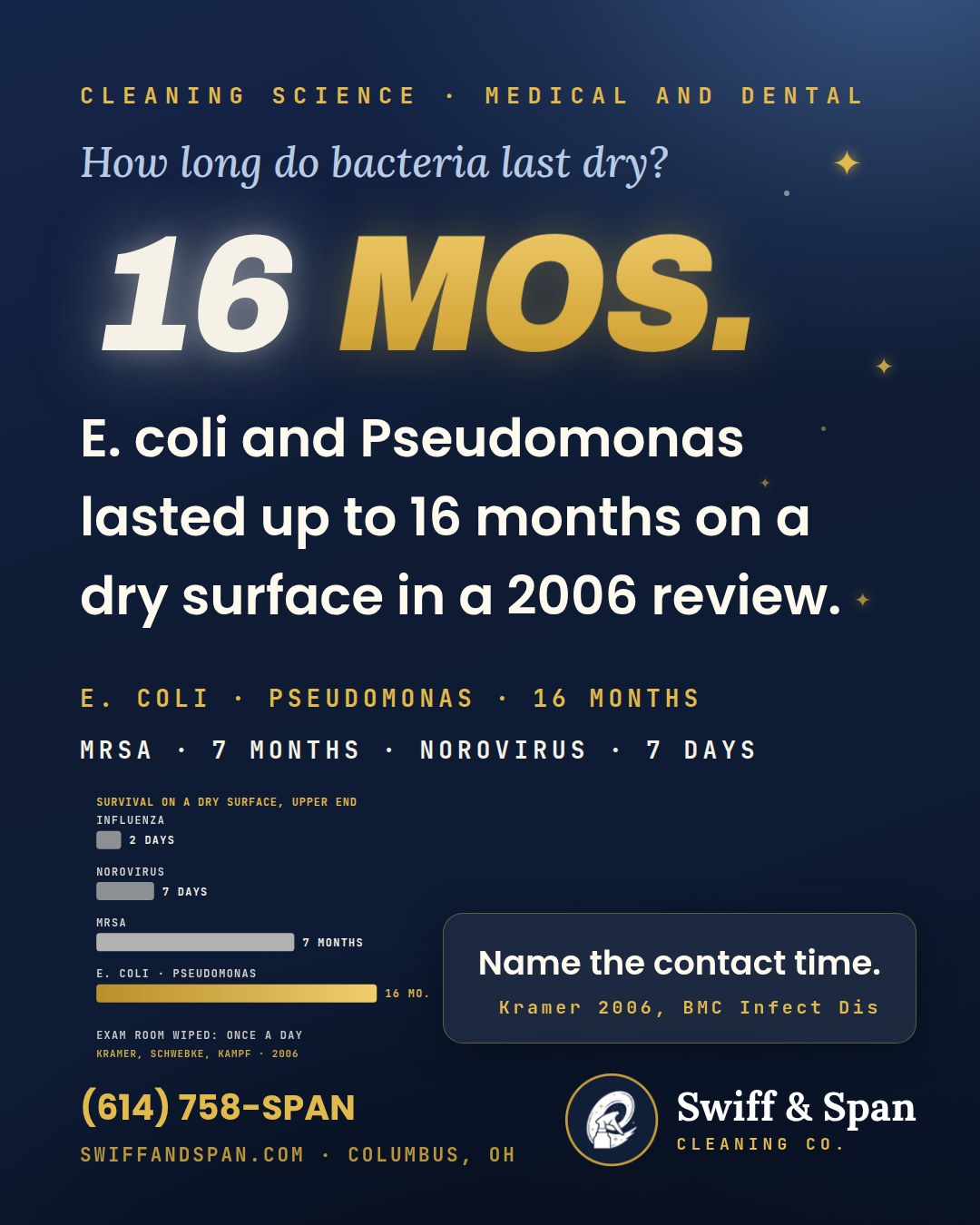
Escherichia coli: 1.5 hours to 16 months. Pseudomonas aeruginosa: 6 hours to 16 months. Klebsiella: 2 hours to more than 30 months. MRSA: 7 days to 7 months. Vancomycin-resistant Enterococcus: 5 days to 4 months. Acinetobacter: 3 days to 5 months. Clostridioides difficile spores: 5 months. Candida albicans: 1 to 120 days. The viruses are shorter but not short. Norovirus: 8 hours to 7 days. Rhinovirus: 2 hours to 7 days. Rotavirus: 6 to 60 days. Influenza: 1 to 2 days.
The wide spread inside each range is the point, not a weakness of the data. It depends on how much was deposited, how humid the room is, how cool it is, and what the surface is made of. The upper end of each range is what a surface can do when conditions favor the organism. In a climate-controlled exam room the conditions are steady, and steady is what most of these organisms like.
What that means for a surface that gets wiped once
An exam room in Dublin or Worthington turns over several times a day. The exam table paper changes, the clinical team wipes what it touched, and the room is ready for the next patient. That between-patient work is the practice’s job and it is aimed at the surfaces the last patient contacted.
The survival data is about everything else. The chair arm in the corner. The door pull. The counter edge where the laptop sits. The blood pressure cuff hanging on the wall. The stool. The light switch. The floor around the table base. None of those are wiped between patients, because none of them are supposed to be. They are the end-of-day environmental clean, and whether they get a real disinfectant with its full contact time, or a damp cloth and twenty seconds, is decided by a cleaning scope that was probably written for an office.
Here is the arithmetic that the review forces. If an organism can persist for weeks on a dry surface, then a surface that gets a cosmetic wipe every night is not being reset every night. It is accumulating. Each pass removes some of what is there and leaves the rest, and the rest is joined by tomorrow’s deposits. The room looks identical on day one and day thirty. The load on the door pull does not.
Why a wipe is not a reset
Two things have to happen for a surface to actually return to zero, and most office-style cleaning does one of them badly and skips the other.
The first is cleaning, the physical removal of soil. Skin cells, dried respiratory droplets, hand lotion, the film that builds on a chair arm over a week. Disinfectants are formulated to work on a clean surface. Put one on a soiled surface and the organic load consumes it before it reaches what you are trying to kill. This is why every EPA-registered disinfectant label says to pre-clean heavily soiled surfaces, and why a one-step spray-and-wipe on a surface that has not been cleaned in a month does less than the bottle promises.
The second is contact time. The label states how many minutes the surface must stay visibly wet for the kill claim to apply. Thirty seconds to ten minutes, depending on the product and the organism. A cloth that leaves a surface dry in twenty seconds has not met any label. We have written about why that clock does not negotiate and about why one wipe does not cover a room. The survival data is the other half of that argument. If the organism outlasts the wipe by months, the wipe has to be done properly or it is theater.
The surfaces the data points at
The organisms with the longest persistence in the review are the ones that live on skin and in the gut, and they are moved by hands. So the surfaces that matter are the ones hands touch that nobody owns between patients. In a medical, dental or veterinary practice that list is short and specific.
- The door pull, both sides. Every patient, every staff member, every hour.
- The chair arms and stool. Soft or hard, sat in by every patient and companion, almost never named in a scope.
- The counter edge and keyboard. Where the clinician leans and types between the sink and the patient.
- The wall-mounted equipment. Blood pressure cuff, otoscope handle, the light handle over a dental chair, the scale in a vet exam room.
- The light switch and thermostat. Touched on the way in and out of every room.
- The floor within a few feet of the table. Bags land there, then on laps. We covered why the floor is a reservoir in its own article.
Each of those gets three things in a scope worth signing: a named EPA-registered disinfectant appropriate for the surface, a written contact time copied from its label, and a cadence. Nightly for the hand-touched items in a room that saw patients. A dedicated microfiber color that never enters a restroom. And a check.
How we check it
We verify the cleaning step with adenosine triphosphate testing. ATP is the energy molecule in every living cell, and a swab reads the organic residue on a surface in relative light units in about fifteen seconds. It does not count bacteria and it does not prove disinfection. What it does is show whether the cleaning step, the physical removal, actually happened on the surface in front of you. That is the step the survival data says has to succeed, because if the soil stays, the disinfectant never reaches what has been living underneath it for weeks.
On a complimentary ATP walkthrough of a practice, the door pull and the chair arm are two of the first surfaces we swab, precisely because they are the ones that accumulate. A high reading the morning after service is not a judgment of the crew. It is a description of the scope they were handed.
The one-sentence version for your office manager
A systematic review found common pathogens can survive weeks to 16 months on dry surfaces, our cleaning scope names the desk and the floor, and nobody has written down what product touches the door pull or how long it stays wet. Send that, and ask which cloth touches the chair.
Frequently asked questions
How long can bacteria survive on a dry surface?
In the 2006 systematic review by Kramer and colleagues, most gram-positive bacteria such as MRSA and Enterococcus and many gram-negative bacteria such as E. coli, Klebsiella and Pseudomonas persisted for months on dry surfaces under favorable conditions. E. coli and Pseudomonas aeruginosa were reported at up to 16 months and MRSA at up to 7 months.
Do viruses last as long as bacteria on surfaces?
Generally no, but longer than most people assume. The same review reports norovirus at 8 hours to 7 days, rhinovirus at 2 hours to 7 days, rotavirus at 6 to 60 days and influenza at 1 to 2 days on dry surfaces.
Why does the survival range vary so much for one organism?
Persistence depends on how much was deposited, the humidity and temperature of the room, and the surface material. Higher inoculum, cooler temperatures and, for most bacteria, higher humidity extend survival. The upper end of a range describes what an organism can do when conditions favor it.
Does a nightly wipe reset an exam room surface?
Only if the surface is cleaned of soil first and then kept wet with an EPA-registered disinfectant for its full labeled contact time. A damp pass that dries in seconds removes some soil and meets no label claim, so a surface that hosts organisms for weeks is accumulating between visits rather than resetting.
Can ATP testing tell whether a surface still carries bacteria?
No. ATP testing measures organic residue, not specific organisms, and does not prove disinfection. A low reading shows the cleaning step removed what hands and breath left on the surface, which is the step that must happen before any disinfectant can work. A high reading the morning after service shows the surface was skipped or only visited.
Every Columbus medical, dental, wellness, and commercial facility gets the same offer: a complimentary 30-minute ATP walkthrough. We swab your highest-touch surfaces, on the spot, and hand you the readings. No obligation, no pitch required to see the number. Book your complimentary ATP walkthrough or text (614) 758-SPAN.
Erik Kuusisto, Owner
Swiff & Span Cleaning Company
Sources
- Kramer A, Schwebke I, Kampf G. How long do nosocomial pathogens persist on inanimate surfaces? A systematic review. BMC Infectious Diseases. 2006;6:130.
- United States Environmental Protection Agency. Selected EPA-registered disinfectants and label requirements for pre-cleaning and contact time.