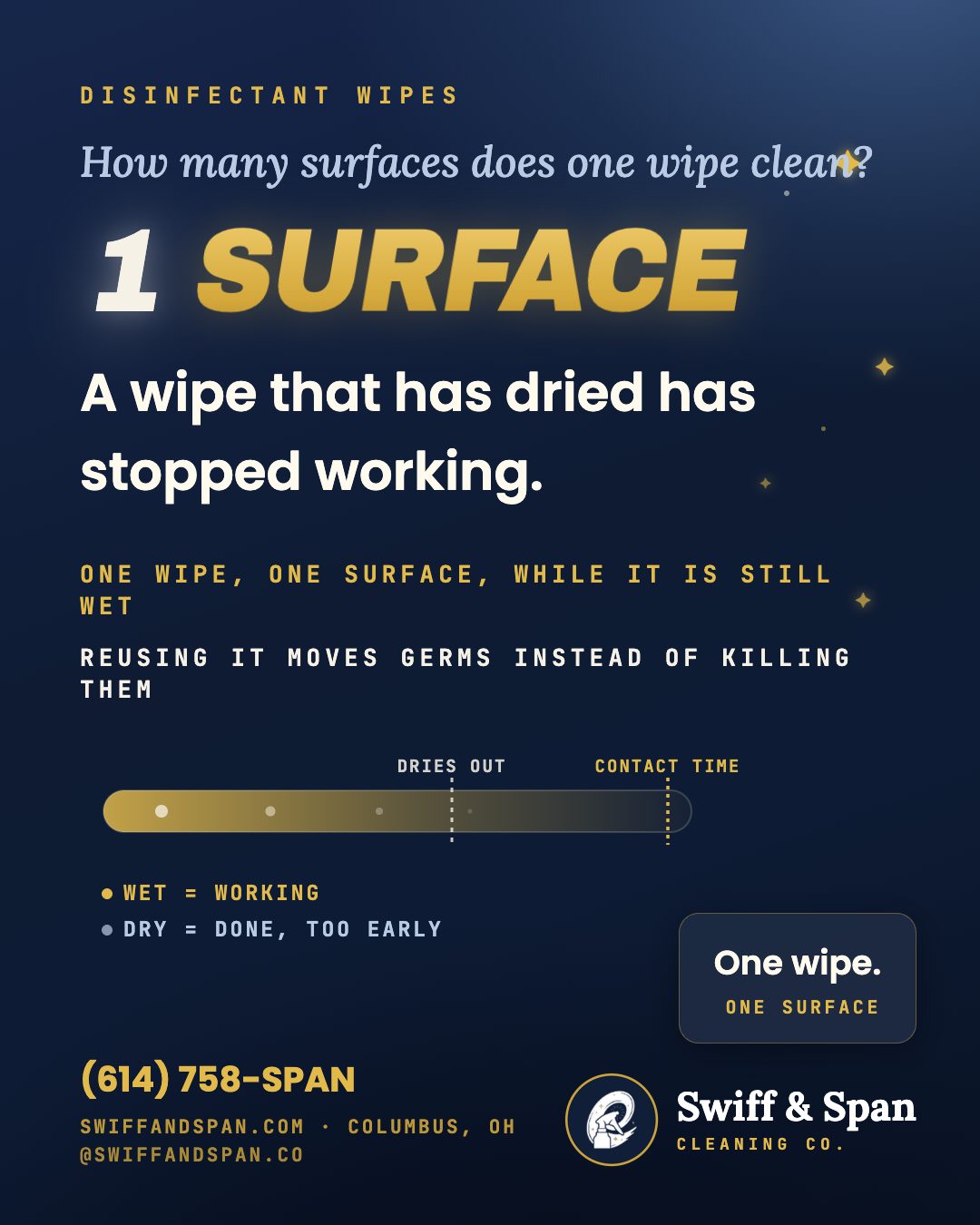
One wipe does not disinfect a surface. Most disinfectant wipes don’t carry enough liquid to keep a surface visibly wet for the length of time the label requires, and once a wipe has touched one surface, using it on the next one doesn’t clean that surface either, it just moves the problem. Contact time and cross-contamination are the two words missing from almost every wipe-down in Central Ohio, and they explain the whole gap between “wiped” and “disinfected.”
Here’s the choreography, and you’ve probably watched it happen without noticing: someone pulls a wipe from the canister, swipes a doorknob, swipes a counter, swipes a light switch, and drops the wipe in the trash. Four seconds, maybe five. The canister sitting three feet away says the product inside needs one to ten minutes of contact time to do what it claims on the label. Nobody reads that part. Nobody has time to read that part. So a ritual that looks like disinfection happens, while the chemistry that would actually make it disinfection never gets to finish.
What Is Contact Time, and Why Does It Matter More Than the Wipe Itself?
Every EPA-registered disinfectant is tested against specific pathogens under a specific condition: the surface has to stay visibly wet for a set number of minutes. That number is on the label, usually in small print, and it isn’t a suggestion, it’s the entire basis for the product’s kill claim. A quat-based wipe might need four minutes. An alcohol wipe might need thirty seconds but evaporate in fifteen, because alcohol is a fast-drying solvent by design. Either way, if the surface dries before the clock runs out, the manufacturer’s own data no longer applies. A wipe was used. Nothing was necessarily disinfected.
This is why a wipe canister is a deceptively hard tool to use correctly. It carries a fixed, small amount of liquid, and a countertop, an exam table, or a reception desk is a comparatively large surface. Wipe once, and most of that liquid is gone before the pathogen load has been exposed to it long enough to matter.
Why Does Reusing One Wipe Across a Room Make Things Worse?
A wipe doesn’t disappear the organic material it picks up, it carries it. Run the same wipe from a doorknob to a counter to a phone, and three surfaces haven’t been disinfected. Whatever was on the doorknob has been distributed across two more surfaces, while the disinfectant itself gets diluted with each pass and loaded with the very bioburden it’s supposed to neutralize. Most disinfectant chemistries lose potency in the presence of organic soil, sometimes called the “organic load” problem, a documented limitation of surface disinfectants generally, not a flaw specific to one brand. One wipe, several surfaces, and the outcome is worse than doing nothing, because now the mess has been spread around.
The standard used in clinical and food-service settings is simple: one wipe, one surface, one direction, then a fresh wipe for the next zone. It sounds almost too basic to count as a “standard.” It’s also the single most skipped instruction on the label.
How Many Wipes Does a Surface Actually Need?
There’s no universal number, it depends on surface size, soil load, and product, but the comparison below is what separates the habit from the method:
- The one-wipe habit: One wipe per room. Surface touched for two to four seconds. Dries in under a minute. Same wipe reused on the next high-touch point.
- The verified method: Fresh wipe (or enough spray volume) per zone. Surface stays visibly wet for the full labeled contact time. Wipe discarded, not reused, once it’s touched a surface.
The difference isn’t effort. It’s sequencing, and it’s the difference between a surface that looks clean and a surface a lab would call clean.
What Does This Look Like in a Dublin Dental Office or a New Albany Med Spa?
In a reception area in Dublin, that’s a wipe per counter zone, per door handle, per card reader, not one wipe swept across all four. In a treatment room in New Albany, it’s holding the surface wet through the labeled contact time before the next patient walks in, not wiping and moving on because the schedule is tight. The technique costs a few extra seconds per surface. It’s also the entire difference between disinfection and the appearance of disinfection.
How Do You Know a Wipe-Down Actually Worked?
You test it. We run ATP bioluminescence swabs on high-touch points after a clean, doorknobs, counters, exam tables, and the device returns a number in about fifteen seconds. It doesn’t care how the surface looks or smells. It reads residual organic material, a reasonable proxy for whether the surface was actually cleaned before it was disinfected. We photograph the reading and put it in the report we hand the client.
This is also where a rotating crew tends to fall apart. The industry has a name for it, the “Franchise Fade,” where a new team does the job right for the first few visits, then the technique erodes once nobody’s watching. Wipe-per-zone discipline is exactly the kind of step that erodes first, because it’s invisible unless someone is testing for it. Our accounts get the same trained team every visit, and every visit gets a timestamped, photo-verified completion record, not because it’s flashy, but because that’s what keeps a two-second habit from creeping back in by month three.
If your facility is in Dublin, New Albany, Short North, or anywhere in Central Ohio and you’ve never seen a number attached to your last cleaning, that’s worth asking about. Right now we’re running the Founder’s Deal for ten accounts: a three-month commitment, your fourth month free, and your rate locked forever after that, plus a walkthrough that includes a live ATP test on your own surfaces, so you see the number before you sign anything. Call (614) 758-SPAN to claim one of the remaining spots.
Frequently Asked Questions
Does one disinfectant wipe kill germs on a surface?
Rarely all the way. A single wipe often dries before the product's labeled contact time is reached, and contact time is what the EPA-registered kill claim is based on. If the surface doesn't stay visibly wet long enough, the disinfectant hasn't had the time it needs to work.
What is contact time, and where do I find it?
Contact time, also called dwell time, is the number of minutes a disinfectant must stay wet on a surface to achieve its labeled kill claim. It's printed on the product label near the EPA registration number, and it ranges from about 30 seconds to 10 minutes depending on the product and pathogen.
Can I reuse the same wipe on multiple surfaces?
No. Reusing a wipe moves organic material and pathogens from the first surface to the next instead of removing them, and it dilutes the disinfectant with each additional use. The standard practice is a fresh wipe per surface or zone.
How do I know if a cleaning company is actually hitting contact time?
Ask what they measure. A company that can show an ATP reading, a photo, or a documented wipe-per-zone protocol is treating contact time as a rule, not a courtesy. If the answer is just "we use quality products," that describes the chemical, not the technique.
Is spray-and-wipe better than pre-moistened wipes?
It can be, if enough product is applied to keep the surface wet for the full contact time, the tool matters less than whether that wet-time threshold is actually met. Both methods fail the same way when they're rushed.
Every Columbus dental, medical, wellness, and commercial facility gets the same offer: a complimentary 30-minute ATP walkthrough. We swab your highest-touch surfaces, on the spot, and hand you the readings. No obligation, no pitch required to see the number. Book your complimentary ATP walkthrough or text (614) 758-SPAN.
Erik Kuusisto, Owner
Swiff & Span Cleaning Company
Keep reading
- What does “clean” actually mean? Inside the ATP numbers
- Clean versus disinfect, and why dwell time decides it
- Bleach is not a magic wand: four common mistakes
- What electrostatic spraying actually does
- Color-coded microfiber and the two-bucket method
- What happens in a complimentary ATP walkthrough
- How we prove clean · FAQ · Contact