Walk into a laser hair removal room after a full afternoon of appointments and you can smell what happened there. Burnt hair has a signature. The operator knows it, the client knows it, and the front desk knows it when the door opens. Most people treat the smell as a nuisance. A research team at Boston University treated it as a measurement problem, and the numbers they published should change how a med spa writes its cleaning scope.
Dr. Gary Chuang and colleagues published the study in JAMA Dermatology in 2016. They sealed hair samples in gas chromatography chambers, fired a laser at them, and ran the plume through mass spectrometry. Then they walked into a working treatment room with a portable particle counter and measured the air during real laser hair removal sessions, with the smoke evacuator on, and with it off.
What the plume is made of
The chemistry came back with 62 organic compounds. Thirteen of them are known or suspected carcinogens, including benzene and acrylonitrile. More than 20 are recognized environmental toxins. This is burning hair, so none of that should surprise a chemist. Keratin under a laser breaks down the way any protein does under heat, and the products of combustion are the same family you would find in any smoke.
The authors put it plainly. The burning-hair plume present during laser hair removal should be considered a biohazard, warranting smoke evacuators, good ventilation, and respiratory protection, especially for staff with prolonged exposure. That conclusion is aimed at the operator holding the handpiece. We are going to aim it at the surfaces.
The particle count that matters
The particle counter is where the study turns from a chemistry lesson into a cleaning problem. The team measured ultrafine particles, under one micron, in the treatment room during a session.
| Condition | Ultrafine particles per cubic cm | Versus room baseline |
|---|---|---|
| Room at rest, before treatment | 15,300 | baseline |
| Laser running, evacuator on, nozzle within 5 cm | 129,376 | 8 times |
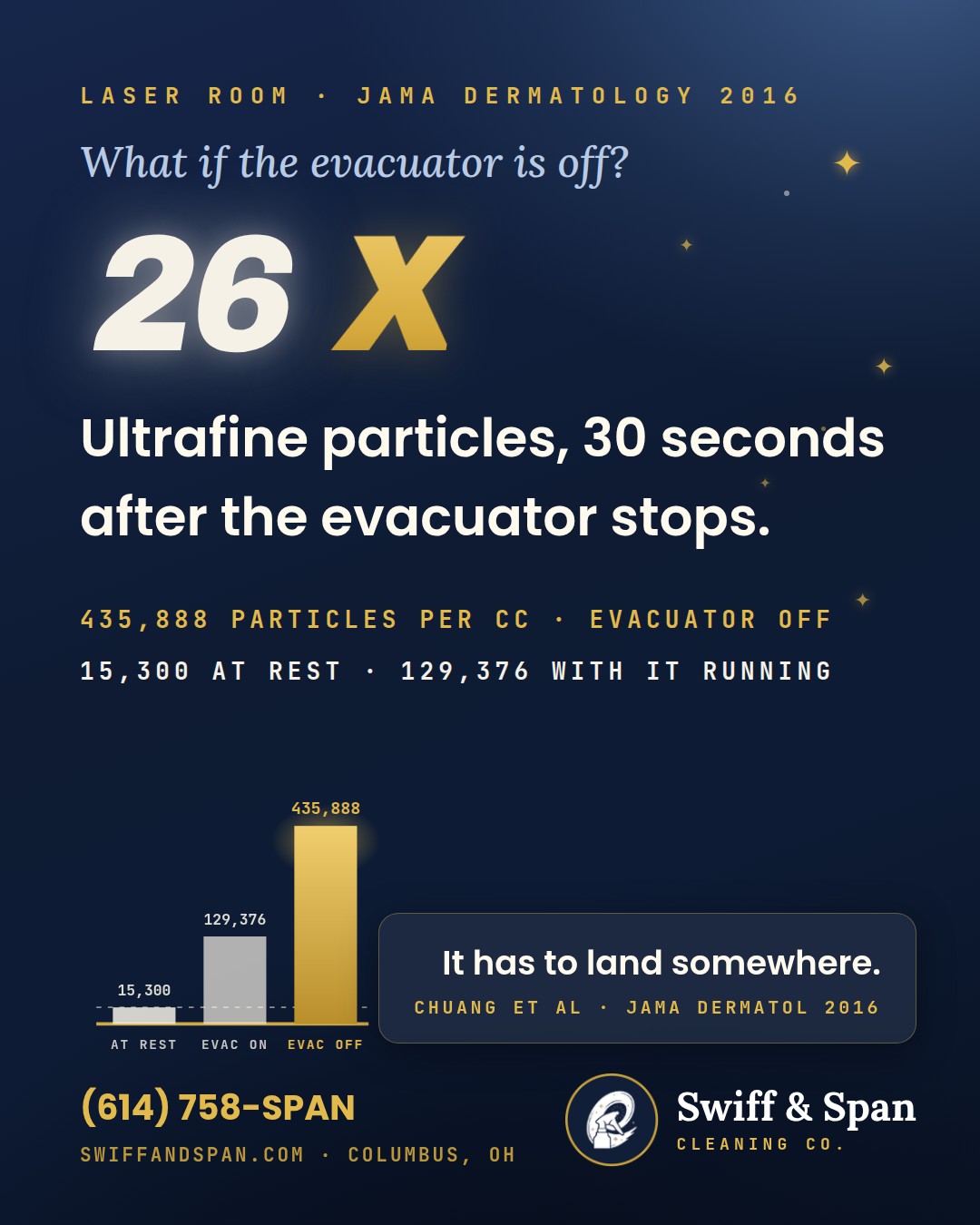
| Laser running, evacuator off for 30 seconds | 435,888 | 26 times |
Read the middle row twice. With the evacuator on and positioned almost touching the treatment site, the room still carried eight times its resting particle load. The evacuator is doing its job. It is not catching everything. Switch it off for half a minute, which happens in real rooms every time a hose gets in the way of a treatment angle, and the count climbs to 26 times baseline.
The team also took readings in the waiting room and outside the building. The plume does not respect the treatment room door.
Where 435,888 particles per cubic centimeter go
Ultrafine particles behave like smoke because they are smoke. They drift on the room’s air currents, they ride the HVAC return, and eventually they settle. They settle on the treatment bed and the paper covering it. On the laser cart, the handpiece cradle, the evacuator housing and the hose that carries the plume away. On the countertop where the numbing cream sits. On the wall behind the bed, in a band at the height of the treatment. On the top edge of the door, on the return-air grille, and on the chair in the waiting room where the next client is scrolling their phone.
By the end of the day the film is invisible. It is a fine, greasy, organic residue, and it is the reason a laser room smells like a laser room even after the evacuator has run for an hour. The smell is not in the air anymore. It is on the surfaces.
This is the part that belongs to whoever cleans the room, and the honest answer in most med spas is that nobody has written it into the scope. The cleaning contract says treatment rooms, wipe surfaces, mop, trash. It does not say the evacuator housing. It does not say the wall band behind the bed. It does not say the return grille or the waiting room chair backs, and the person cleaning it at 8 p.m. has no idea a JAMA study exists.
How much heat, how much smoke
There is an older number that dermatology and surgical nursing have carried for decades. In 1981, Tomita and colleagues measured the mutagenicity of smoke condensate from carbon dioxide laser and electrocautery on tissue and found that the condensate from one gram of tissue matched three to six cigarettes. Laser hair removal is a different procedure on a different target, so we do not borrow that figure for a med spa room. We mention it because it explains why professional societies have spent forty years telling operators to run the evacuator. The American Society for Laser Medicine and Surgery’s position statement says all medical personnel should consider vaporized and ejected tissue plume potentially hazardous, in particulate matter and in infectivity.
Your operator handles the air during the treatment. The clinical protocol is theirs, and we do not write it. Our job starts when the client leaves and the particulate has finished settling.
What a laser room reset should include
Here is the scope language we bring to a Columbus med spa that runs laser hair removal, in the order the room gets worked.
- Every horizontal surface, wet-wiped with full contact time, including the ones above eye level. The film settles on the top of the laser unit and the top of the door frame just as it settles on the counter.
- The evacuator housing, the outside of the hose, the laser cart, and the handpiece cradle, using the wipe the equipment manufacturer approves. These are the surfaces closest to the source and the ones nobody names.
- A wall band behind and beside the treatment bed, from bed height to about shoulder height. Walls in most scopes are annual. In a laser room the wall is a landing strip.
- The return-air grille and the supply diffuser, monthly at minimum. If it is grey, the room has been telling you for weeks.
- The waiting room chair backs and arms, because the study measured the plume there too.
Then the swab. An ATP meter reads organic residue in relative light units, and burnt keratin is organic residue. A swab of the evacuator housing or the counter next to the bed after the reset tells you whether the wipe removed the film or just moved it. We are careful about what that number means: it does not measure benzene, and it does not tell you what was in the air during the appointment. It tells you whether the surface your next client’s bag sits on was actually cleaned. That is the question the cleaning contract is supposed to answer, and it is the one nobody was asking.
We covered the time pressure between appointments in how long a treatment room reset really takes. The laser room is the case where the reset is not about speed. It is about knowing what settled.
Frequently Asked Questions
Does the smoke evacuator make cleaning the room unnecessary?
No. In the JAMA Dermatology study the evacuator, positioned within 5 cm of the treatment site, still left the room at eight times its baseline particle count. What the evacuator misses settles on surfaces, and the evacuator itself collects a film on its housing and hose.
Can an ATP swab detect laser plume chemicals?
No. ATP testing measures organic residue, not specific chemicals or germs. It is useful in a laser room because settled plume is an organic film, so a swab of the counter or evacuator housing shows whether the reset removed it. It says nothing about air quality during the procedure.
Who is responsible for plume safety in a med spa?
The operator and the practice, through evacuator use, ventilation, and protective equipment as the study authors and ASLMS recommend. A cleaning company’s responsibility is the surfaces after the session. Both need to be written down; in most med spa scopes we review, neither is.
How often should the walls in a laser room be cleaned?
A wall band behind and beside the treatment bed should be wet-wiped on the same cadence as the counters, daily on treatment days. Full walls can stay on the normal periodic schedule.
Every Columbus med spa, dental, medical, and wellness facility gets the same offer: a complimentary 30-minute ATP walkthrough. We swab your highest-touch surfaces, on the spot, and hand you the readings. No obligation, no pitch required to see the number. Book your complimentary ATP walkthrough or text (614) 758-SPAN.
Erik Kuusisto, Owner
Swiff & Span Cleaning Company