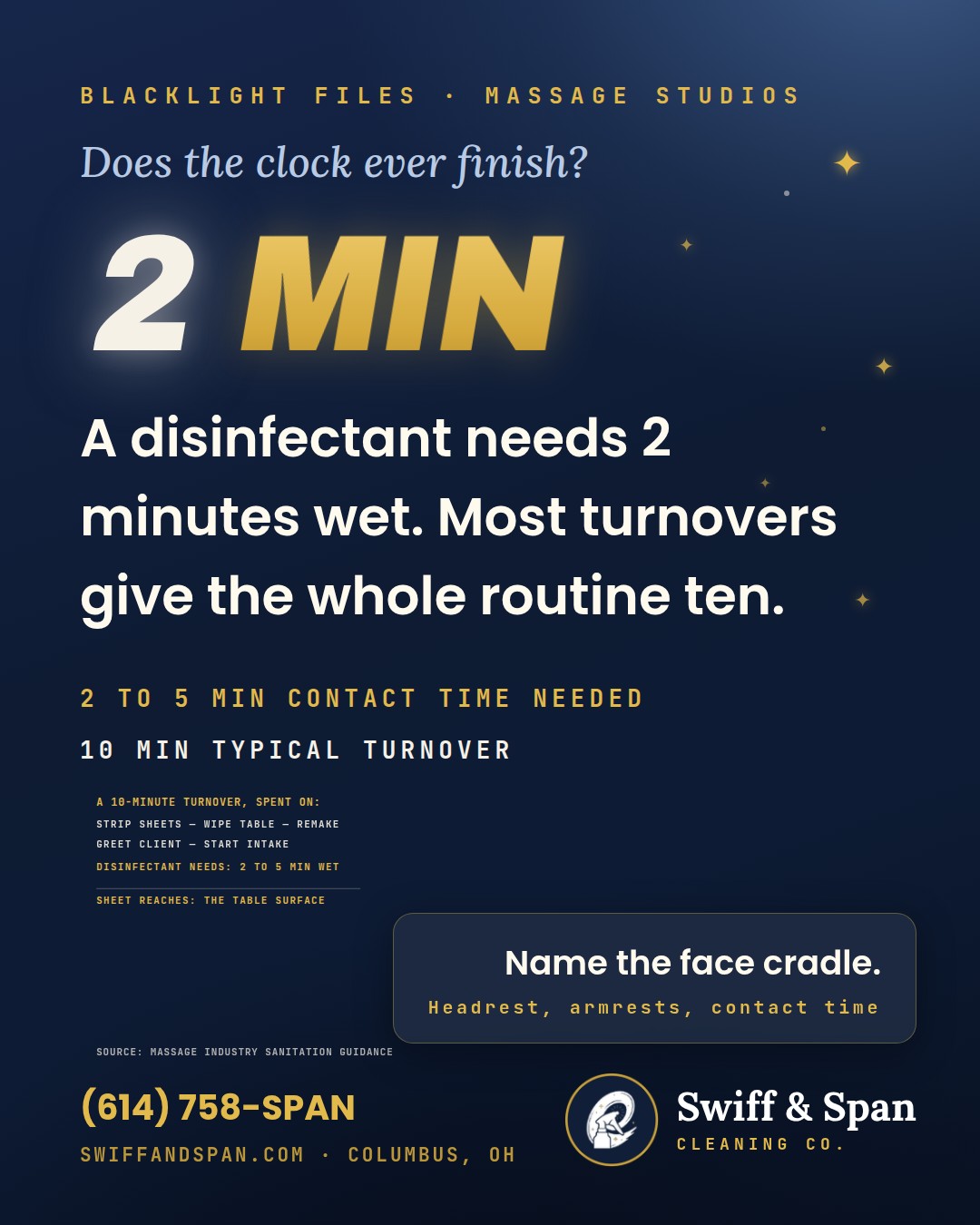
A ten-minute turnover between massage clients is normal, and it is not lazy scheduling. Strip the sheets, wipe the table, remake it, greet the next client, start the intake. Every one of those steps takes real time, and the schedule usually has ten minutes to spend on all of them combined.
Sanitation guidance for massage practices agrees on one number that does not bend to a schedule: the wet contact time a disinfectant needs before it has done its job. Massage-industry sanitation guidance puts it at two to five minutes, depending on the product, and the table has to stay visibly wet for that entire window. A wipe that dries in thirty seconds under a warm room's airflow has been used, not held.
Run the arithmetic. Two minutes of dwell time out of a ten-minute turnover is a fifth of the whole window, spent standing next to a table waiting, before the sheet goes back on. Most therapists do not have a fifth of their turnover to spare, so the step that gets shortened is the one nobody is watching: how long the table actually stays wet before it gets covered up again.
The surface the linen change does not reach
A fresh sheet solves the part of the table a client lies on. It does nothing for the face cradle, the padded ring most clients press their entire face into for fifty minutes, or the armrests and headrest edges that skin, oil and hair contact throughout the session. Sanitation guidance for massage practices names these three by name as the highest-contact surfaces on the table, separate from the table surface itself, precisely because a sheet change does not touch any of them.
The face cradle is the sharpest version of the problem. It sits below the linen line, it is foam or vinyl rather than fabric, and it holds body oil and skin cells in a shape that is hard to wipe evenly. A quick pass with a dry or half-dry cloth can look clean and still carry the last client's residue into the next session.
What a massage room scope usually says
Most spa and wellness cleaning contracts we have reviewed in Columbus treat the massage room as a general room: floors, mirrors, trash, linens laundered off-site. The table itself, the actual point of skin contact for fifty minutes, appears as one line: wipe down between clients. No product named, no contact time, no separate mention of the face cradle, headrest or armrests.
That line is not wrong. It is incomplete in exactly the way that matters for a surface a client's face rests in. A scope that only says wipe down between clients gives a rushed staff member nothing to hold them to when the ten-minute turnover runs to eight.
Two lines a massage room scope needs
Name the face cradle, headrest and armrests on their own line, with a contact time. An EPA-registered disinfectant safe for the cradle's foam or vinyl surface, applied and left wet for its full label contact time, commonly two to five minutes, before the next client sits down. The scope states the number, not just the product.
Put a second face cradle cushion into rotation. Massage-industry guidance recommends alternating two face cushions so one can sit through its full contact time while the other is already back on the table for the next client. This is the single change that lets a ten-minute turnover actually hold a two-minute dwell time, instead of racing it.
How we check it
Our process runs clean, disinfect, verify, document on every high-touch surface in a treatment room, the face cradle and armrests included, not just the table linen line. Cleaning removes the visible residue. Disinfection follows with a product rated for that surface, held for its label contact time. ATP verification then gives a measurable read on the face cradle and headrest after service, shown on site, so a rushed turnover shows up as a number instead of a guess. It is a cleaning-verification step, not a claim about what happened to any specific organism.
The one-sentence version for a studio owner
A disinfectant needs two to five minutes of wet contact time, a ten-minute turnover rarely has that to spare on a wipe-down, and the face cradle, headrest and armrests need their own scope line with a stated contact time, backed by a second cushion in rotation so the clock never has to be raced.
If you would like to see what your own treatment room reads at 8 AM, the complimentary ATP walkthrough takes about 30 minutes and starts at the table.
Frequently asked questions
How long should a massage table disinfectant stay wet before the next client?
Massage-industry sanitation guidance puts the required wet contact time at commonly two to five minutes, depending on the specific EPA-registered product's label. The surface has to remain visibly wet for that full window for the disinfectant to have worked.
What part of a massage table needs the most attention between clients?
The face cradle, headrest and armrests. A fresh sheet covers the table surface a client lies on, but it does not reach these three high-contact points, which sanitation guidance names separately because they hold direct skin, oil and hair contact through the session.
Why do some massage studios use two face cradle cushions?
Alternating two face cushions lets one sit through its full disinfectant contact time while the other is already back on the table for the next client, so a short turnover does not force staff to rush or skip the dwell time.
Does wiping a massage table count as disinfecting it?
Only if the disinfectant is left on the surface for its full label contact time, commonly two to five minutes. A wipe that is applied and immediately covered with a fresh sheet has cleaned visible soil but has not completed disinfection.
Can ATP testing verify a massage table was disinfected?
ATP testing measures organic residue on a surface and gives a reading in RLU. It verifies that a surface, including the face cradle and headrest, was actually cleaned rather than passed over. It does not identify specific organisms or confirm that a disinfectant's full contact time was held; it is one measurable step in a clean, disinfect, verify, document sequence.
Sources
- Massage industry sanitation guidance on disinfectant wet contact time, commonly two to five minutes depending on product label.
- Massage industry infection-control guidance naming the face cradle, headrest and armrests as the highest-contact surfaces on a treatment table, separate from the table surface and linens.
- Massage industry sanitation guidance recommending two alternating face cradle cushions to preserve full contact time between clients.