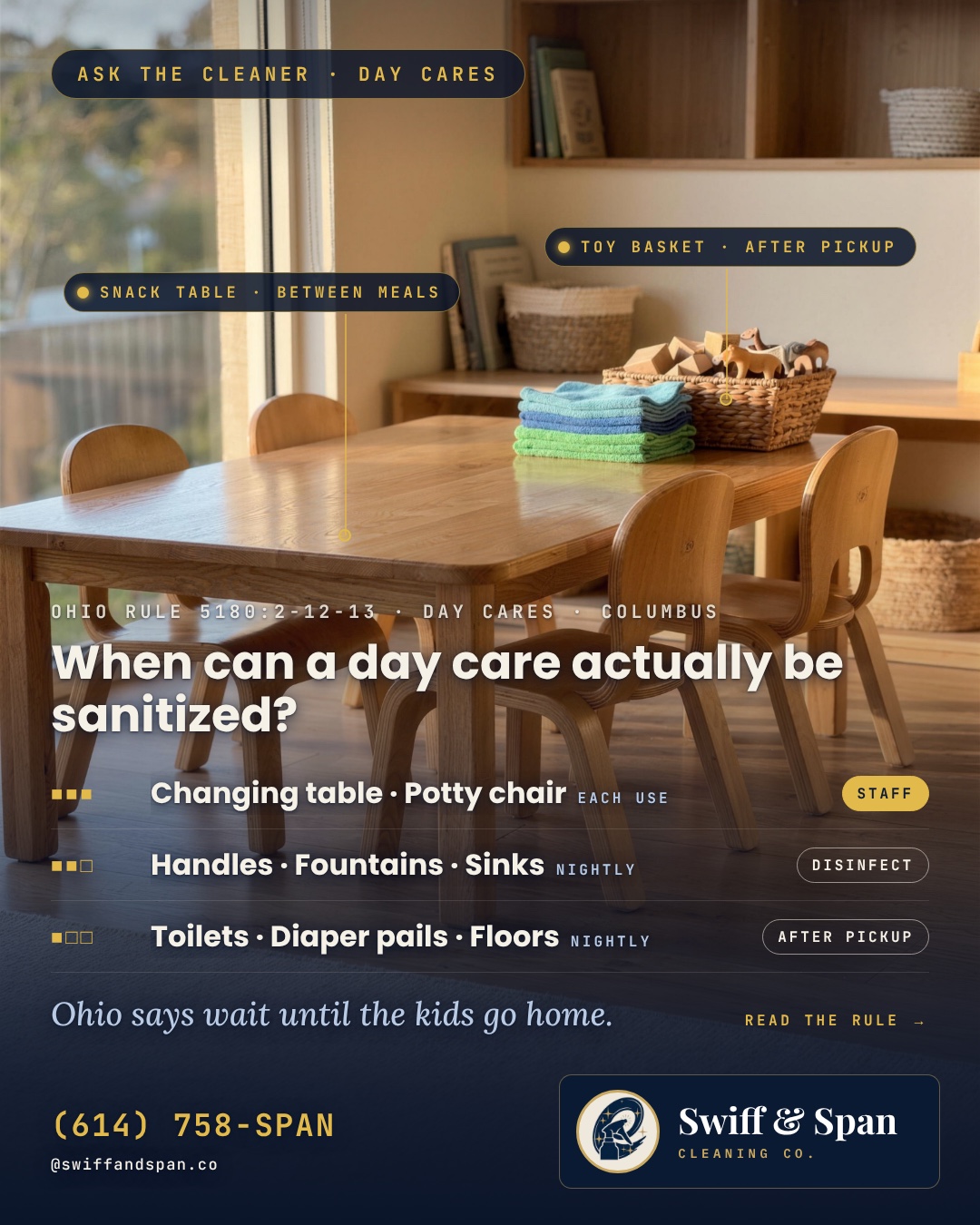
Ohio’s child care center rule contains a sentence that most day care cleaning scopes never quote: cleaning and sanitizing shall not take place while rooms are occupied by children, apart from daily routine cleanup. If you run a day care in Columbus, that sentence decides when the real cleaning can happen, and it is not at noon.
I am a cleaner, not a licensing specialist, so take this as a cleaner’s reading of a public rule. Your licensing specialist has the final word on how it applies to your center. What I can tell you is what the rule means for the people who hold the spray bottles.
Does Ohio Really Bar Sanitizing a Day Care While Children Are in the Room?
Yes, with one carve-out. Ohio Administrative Code 5180:2-12-13(A)(4) says cleaning and sanitizing shall not take place while rooms are occupied by children, except general cleanup that is part of the daily routine, such as sweeping, vacuuming, mopping and wiping off tables.
The same paragraph says the center “shall be cleaned daily” and kept in a sanitary condition at all times. It also names items to be cleaned and sanitized between uses, before they are used again: diaper changing stations, potty chairs, tables where food is served, and food prep areas.
Read those two ideas together and a pattern appears. The between-use items belong to the classroom staff, in the minutes between one child and the next. The deeper cleaning belongs to the hours when the rooms are empty. The rule does not name a time of day, a product, a concentration or a dwell time. It leaves those to the center, which is exactly where a written scope earns its keep.
Which Day Care Surfaces Call for a Disinfectant, Not Just a Wipe?
Nine rows in the Caring for Our Children cleaning schedule call for a disinfect step: door and cabinet handles, drinking fountains, changing tables, potty chairs, handwashing sinks and faucets, toilet-area countertops, toilets, diaper pails, and the toilet-area floor.
That schedule is Appendix K of the national health and safety standards, titled “Routine Schedule for Cleaning, Sanitizing, and Disinfecting.” Count the rows that say “Clean, Disinfect” in the edition we read and you get nine. Everything else is cleaned, or cleaned and sanitized.
Two comments in that table are worth repeating because they are so specific. For changing tables it says to clean with detergent, rinse, then disinfect, which is three steps in a fixed order. For computer keyboards it says to use sanitizing wipes and not spray. A schedule that bothers to say “do not use spray” on a keyboard was written by people who have watched what happens when a rule stays vague.
Who Cleans What: The Teachers or the Cleaning Crew?
Split it by the clock. Teachers own the between-use items while children are present: the changing station after each diaper change, the potty chair, the table before and after a meal. The cleaning crew owns everything that needs an empty room, a full dwell time and a documented order of work.
Here is the split we draw in a written day care scope:
1. During the day, staff: changing stations, potty chairs, food tables and food prep areas between uses, as the Ohio rule lists them. 2. After the last pickup, the crew: door and cabinet handles, drinking fountains, sinks and faucets, toilets, diaper pails, and floors, each with its product and dwell time on the checklist. 3. Checked afterward: a room-by-room checklist with photos, so the director can see the work without staying late.
If your current cleaner’s scope lists “classrooms: clean” as one line, neither half of that split is written down.
What Does an After-Pickup Day Care Cleaning Scope Look Like?
It runs top to bottom and clean to dirty, in a fixed order, with a different color of microfiber for each zone. High surfaces first, handles and fountains next, restrooms and the diapering area last, floors at the end. Nothing from the restroom ever touches a toy shelf.
The details that make it repeatable:
- Color-coded microfiber, so the cloth that touched a toilet-area countertop never visits a food table.
- The two-bucket method on floors, so mop water does not carry yesterday’s soil across today’s room.
- HEPA vacuuming (we use ProTeam GoFit units) on rugs and soft flooring, where small children spend much of the day.
- An EPA-registered disinfectant matched to the surface, applied wet and held for the full dwell time printed on the label, not wiped dry early.
- Photo documentation and a room-by-room checklist that you can read the next morning.
None of that is exotic. It is written down, which is the whole difference between a scope and a hope.
How Long Does a Disinfectant Have to Stay Wet?
As long as the product label says. Dwell time is the number of minutes a surface must stay visibly wet with the disinfectant for the label claim to apply, and it varies by product and by claim. Wiping it dry early cancels the claim you were counting on.
This is the other reason the clock matters. A disinfectant that needs several minutes of wet contact cannot be applied to a classroom table while eleven toddlers are waiting for snack. After pickup, nobody is hurrying the surface along. If you want the chemistry behind that, our piece on clean versus disinfect and why dwell time decides it covers it in plain language.
How Can a Columbus Day Care Check Its Own Cleaning Scope?
Put your current scope next to three questions. Does it say when the work happens relative to pickup? Does it list the nine disinfect rows by name, with a product and dwell time? Does it say how you will see proof the next morning?
A scope inherited from a previous vendor often says “daily cleaning” and nothing else, in Hilliard, Westerville or anywhere in Columbus. The surfaces that decide whether a classroom is truly clean, cubby handles, toy bins, changing station latches, are the ones a one-line scope skips. We wrote about that gap in ATP Testing in Day Cares: The Surface Everyone Skips, and our daycare and school cleaning page shows how we scope the low, mouth-contact band of a classroom.
If you would rather see it than read about it, Book your complimentary ATP walkthrough. It takes about 30 minutes, we walk your rooms with you, and you keep the readings. You can also read how we prove clean before you decide. Call (614) 758-SPAN or visit swiffandspan.com.
Frequently Asked Questions
When can a day care be sanitized in Ohio?
Under Ohio's child care center rule, cleaning and sanitizing shall not take place while rooms are occupied by children, except daily routine cleanup such as sweeping, vacuuming, mopping and wiping off tables. In practice, deeper sanitizing is scheduled for after the last pickup, when the rooms are empty.
Which day care items does Ohio say must be cleaned and sanitized between uses?
Rule 5180:2-12-13(A)(4) lists diaper changing stations, potty chairs, tables where food is served, and food prep areas, and says the list is not limited to those. Each must be cleaned and sanitized before it is used again.
What is the difference between sanitizing and disinfecting a day care surface?
They are different label claims. Sanitizing lowers germs on a surface to a level the label defines, and disinfecting uses an EPA-registered product to destroy more kinds of germs. The product label states which claim it makes and how many minutes the surface must stay wet.
How many day care surfaces need a disinfectant under the national cleaning schedule?
In the Caring for Our Children schedule (Appendix K) as we read it, nine rows say "Clean, Disinfect": door and cabinet handles, drinking fountains, changing tables, potty chairs, handwashing sinks and faucets, toilet-area countertops, toilets, diaper pails and toilet-area floors.
Does Swiff & Span clean day cares in Columbus?
Yes. We scope day care and school cleaning in Columbus, Hilliard, Westerville and nearby, with a written room-by-room checklist and photo documentation. Book your complimentary ATP walkthrough at swiffandspan.com or call (614) 758-SPAN to see the scope on your own rooms.
Every Columbus dental, medical, wellness, and commercial facility gets the same offer: a complimentary 30-minute ATP walkthrough. We swab your highest-touch surfaces, on the spot, and hand you the readings. No obligation, no pitch required to see the number. Book your complimentary ATP walkthrough or text (614) 758-SPAN.
Erik Kuusisto, Owner
Swiff & Span Cleaning Company