You will not feel a static shock until it reaches roughly 3,000 volts. Some electronic parts can be damaged by less than 100.
That gap, between what a person notices and what a circuit board survives, is why so many data halls are built on floors designed to bleed static away. It is also why the way those floors are cleaned matters more than it looks. The wrong finish, the wrong mop or the wrong habit with a tile lifter can quietly undo what the floor was built to do.
If you run facilities for a data center in New Albany, Hilliard, Dublin or anywhere else in the Columbus region, this article covers how much static a person generates, why drier data halls make the floor's job harder, what a cleaning crew can get wrong on a raised floor and what your cleaning scope should say.
The short version: a static-control floor only works if nothing insulating builds up on top of it. That usually rules out ordinary wax and film-forming finishes, and it means damp microfiber with a cleaner your flooring maker approves. Tiles stay down unless your team says otherwise. Your facility owns the floor's electrical testing; your cleaning vendor's job is to keep from undoing it between tests.
How much static does a person carry walking across a floor?
Thousands of volts, and far more in dry air. Published ESD figures put a person walking across carpet at about 35,000 volts at low humidity and across vinyl tile at about 12,000. In humid air, the same walks produce about 1,500 and 250.
Those figures are why humidity used to be the first line of defense in a server room. Moist air lets charge leak away before it builds. Dry air lets it pile up on people, carts and anything else rolling across the floor.
A discharge you never feel can still reach a component, and the damage is not always immediate. A part can be weakened by one discharge and fail weeks later, which makes static one of the harder data center problems to trace back to its cause.
Why do data centers care more about static now?
Because data halls are allowed to run drier than they used to. ASHRAE's thermal guidelines for data processing equipment now allow some equipment classes to operate as low as 8 percent relative humidity, which saves the energy humidifiers used to burn.
The research ASHRAE commissioned on low humidity and static, project RP-1499 at Missouri University of Science and Technology, measured how flooring, footwear and grounding change the charge a person builds up. Its authors recommended at least moderately conductive flooring in controlled areas. Put simply: the drier the room, the more the floor has to do. A floor that has been waxed into an insulator cannot do it.
What does cleaning have to do with a static-control floor?
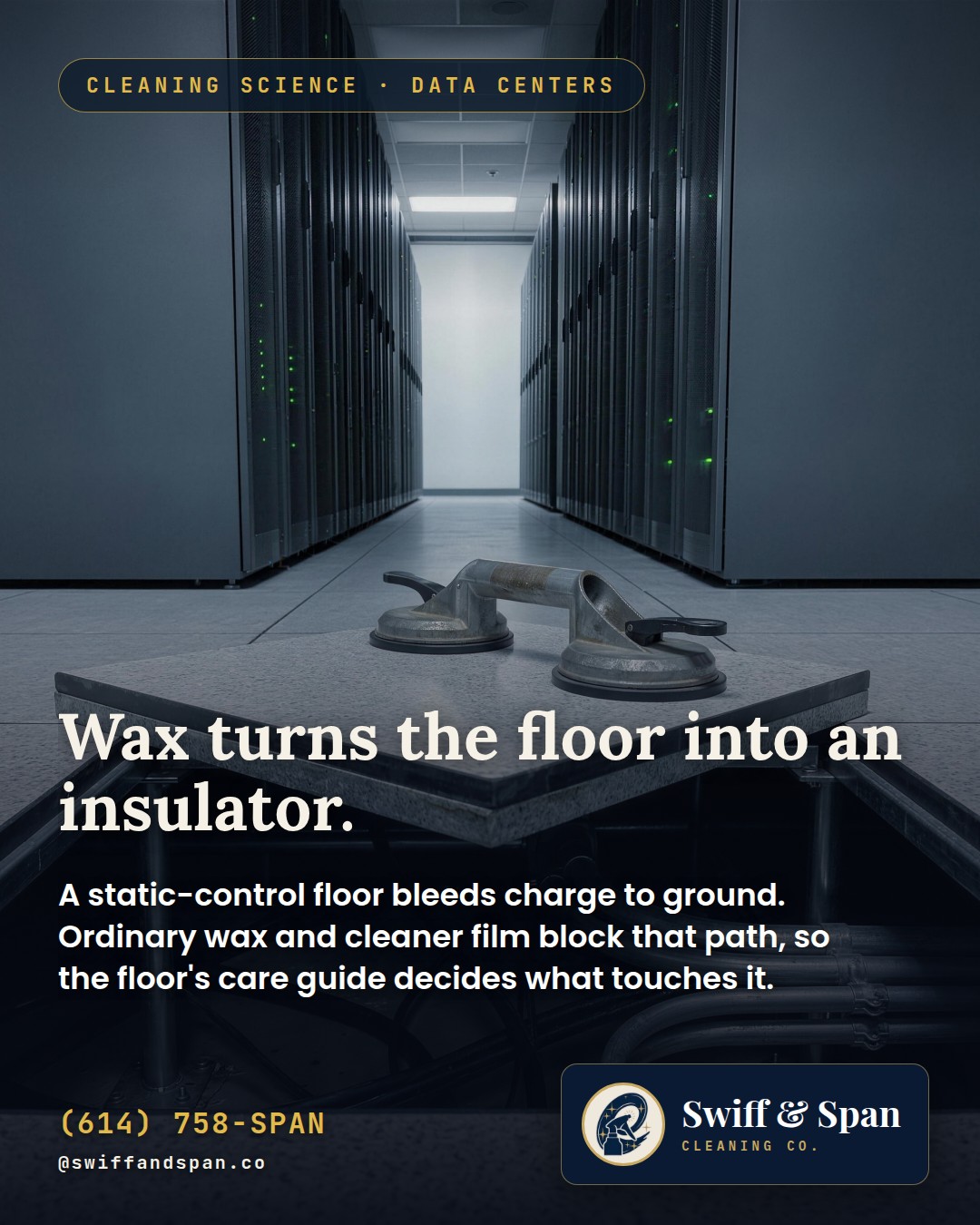
Everything on its surface. A static-dissipative or conductive floor moves charge through the tile to ground. Anything insulating left on top, such as ordinary wax, a film-forming floor finish or a buildup of cleaner residue, slows or blocks that path.
That is why most static-control flooring makers tell you not to apply standard floor wax or finish. Some approve one specific static-dissipative finish; many say damp mop with a neutral cleaner and nothing else. The care guide for your exact floor decides, and your cleaning crew should have a copy before the first night.
Residue is the quieter problem. A cleaner mixed too strong, or a mop that never gets rinsed, leaves a thin film behind every visit. That film also holds dust and fibers, which are their own problem in a data hall. We clean with damp microfiber, change the water often and work from the cleanest aisle outward so nothing gets dragged back in.
What else on a raised floor can a cleaning crew get wrong?
Three things, mostly: lifting tiles, letting water reach the plenum and using the wrong vacuum.
- Lifting tiles. A suction lifter makes a raised floor tile easy to pull. That does not make it the crew's call. Open tiles change underfloor air pressure, expose cabling and create a fall hazard. Underfloor cleaning is planned work, done with your facilities team's permission, a few tiles at a time.
- Water in the plenum. Perforated tiles are holes in the floor. A wet mop pushed across them drips into the space that carries cooling air and cable. Perforated tiles get a damp wipe, not a mop.
- The wrong vacuum. An ordinary vacuum exhausts fine dust back into the room. In a data hall, a true HEPA vacuum is the minimum. We use one.
Lifting tiles carries one more risk that is easy to miss. Older raised floors with zinc-electroplated parts can grow microscopic metal whiskers, and disturbing the floor can send them into the air. We covered that in the metal growing in the dark under your raised floor.
How do you test whether a floor still dissipates static?
With a resistance test. ANSI/ESD STM7.1 is the standard method for measuring a floor's electrical resistance, from the surface to ground and between two points. Your facility or its flooring contractor runs it and keeps the results.
A cleaning crew should not be the people testing the floor. It should be the people making sure nothing they do changes the result. The most useful thing a cleaning record can show is that the floor was maintained exactly as its care guide says, every visit between tests.
What should a data center cleaning scope say?
Six things, in writing, before anyone mops anything.
- The floor type and its care guide. Static-dissipative, conductive or standard, with the manufacturer's maintenance instructions attached.
- Approved cleaners and a no-wax rule. Named products and dilutions, and a plain line that no wax or finish goes down unless the care guide approves it.
- The method. Damp microfiber, not a wet mop. Perforated tiles wiped, not mopped.
- The tile rule. No tile is lifted without your facilities team's permission, and only a set number open at once.
- The vacuum. True HEPA inside the data hall, nothing else.
- The record. Each visit logged against the care guide, with the date of the floor's last resistance test noted so everyone can see when the next one is due.
How do you know the cleaning worked?
For the floor, the resistance test is the measurement that matters. For the rest of the building, we measure what people touch.
When ATP verification is part of the scope, we swab high-touch surfaces after cleaning and read organic residue in relative light units, or RLU, against our standard of 25 RLU or under.
In a data center, those surfaces are the badge readers, door hardware, mantrap buttons, the keyboard and mouse on the crash cart and the break room counters. That is where hands go between the parking lot and the racks. How the reading works is explained in what ATP testing and RLU scores mean. Our sequence is the same in every building: Clean. Disinfect. Verify. Document.
Your next concrete move
Find the maintenance guide for your data hall floor, then ask your cleaning vendor exactly what they put on it. If the answer includes the word "finish," or nobody knows, compare it to the guide before the next visit.
If you would like a second set of eyes, I will walk your facility with you for 30 minutes. It is a complimentary ATP walkthrough for data centers in New Albany, Dublin, Hilliard, Westerville, Upper Arlington and Downtown Columbus, run inside your site's access rules. We swab your high-touch surfaces, you see the readings on the spot, and they are yours to keep. Here is what to expect from that walkthrough.
A portion of every contract supports Columbus youth programs.
Sources: ESD Association, fundamentals of electrostatic discharge (typical electrostatic voltages). ANSI/ESD STM7.1, Floor Materials: Resistive Characterization of Materials. ASHRAE TC 9.9, Thermal Guidelines for Data Processing Environments, and ASHRAE research project RP-1499.
Frequently Asked Questions
Can you wax a static-dissipative data center floor?
Usually not with ordinary wax or floor finish, because standard finishes insulate the floor and block its path to ground. Some flooring makers approve one specific static-dissipative finish. The care guide for your exact floor decides, and it belongs in the cleaning scope.
How do you clean a raised access floor?
Damp microfiber with a cleaner the flooring maker approves, fresh water and no standing liquid. Perforated tiles are wiped, not mopped, so nothing drips into the plenum. Tiles are lifted only with the facility team's permission, and vacuuming uses a true HEPA vacuum.
Does low humidity increase static?
Yes. Widely published ESD figures put a person walking across vinyl tile at about 12,000 volts in dry air and about 250 volts in humid air. That is why drier data halls lean harder on static-control floors and grounded footwear.
How is a static-control floor tested?
With an electrical resistance test such as ANSI/ESD STM7.1, which measures the floor's resistance from the surface to ground and between two points. The facility or its flooring contractor runs the test and keeps the record.
Does Swiff & Span offer a walkthrough for data centers?
Yes. Swiff & Span offers a complimentary 30-minute ATP walkthrough for data centers across the Columbus region, including New Albany, Dublin and Hilliard. It runs inside your site's access rules, and the readings are yours to keep.
Every Columbus-area data center gets the same offer: a complimentary 30-minute ATP walkthrough. We swab your highest-touch surfaces, on the spot, and hand you the readings. No obligation, no pitch required to see the number. Book your complimentary ATP walkthrough or text (614) 758-SPAN.
Erik Kuusisto, Owner
Swiff & Span Cleaning Company