This one is written for the person in the waiting room, not the owner. Owners are welcome to read along, because it describes how their lobby is being judged.
Here is the situation every med spa guest is in. You have booked a treatment that involves a needle, a laser, a peel or a device pressed against your skin. You have read the reviews, checked the injector’s credentials and looked at the before-and-after photos. The one thing you cannot check in advance is the room where it happens, because you will not see it until you are sitting in the chair with your consent form signed.
What you do get is the lobby. Ten or fifteen minutes in it, with a tablet in your hand and nothing to do but look around. The lobby and the treatment room are cleaned by the same people, on the same night, from the same list. That makes the lobby a fair sample. Not a guarantee, but a sample, and you can read it without touching anything or making a scene.
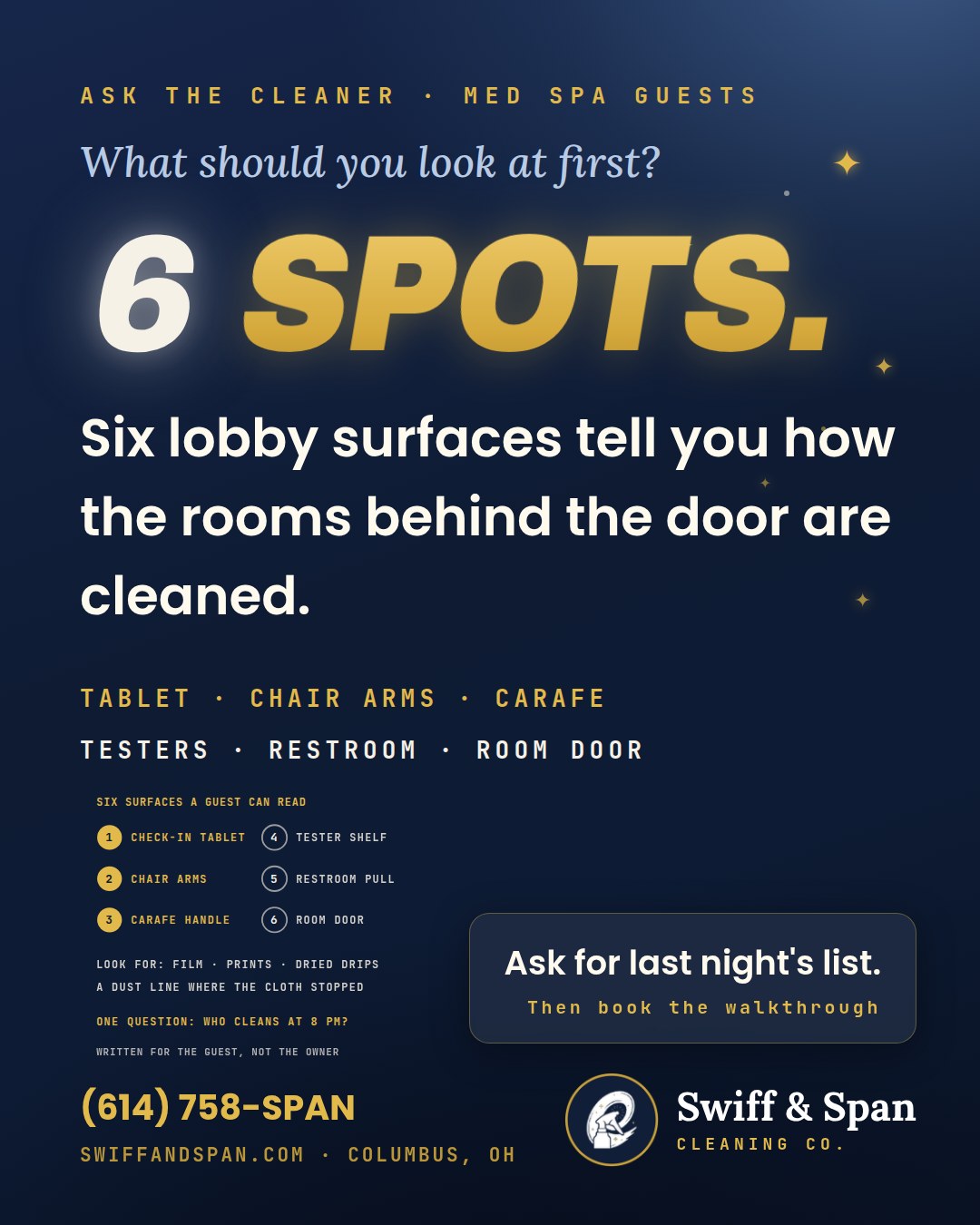
Six surfaces do most of the talking.
1. The check-in tablet
Tilt it toward the window before you start typing. A tablet that was cleaned last night shows a clean matte screen or a uniform gloss. A tablet that was not shows a haze of fingerprints in the shape of a hundred signatures, and a smear across the bottom where a hundred thumbs scrolled to the consent box. It is the most-touched object in the room, and it is the first thing the practice hands you. If it was not wiped, the crew’s list did not include it, and that list is short.
2. The chair arms
Look at the arm of the chair you are about to sit in, especially if it is upholstered in the pale leather or velvet that med spa lobbies favor. The tell is a faint darkening along the front edge, where forearms rest, and on the top surface where hands push off to stand. On light fabric it reads as a slightly greyer stripe. On leather it reads as a dull patch in an otherwise glossy surface. A crew that cleans the lobby properly wipes chair arms nightly, because they know exactly how many arms rest there in a day.
3. The water carafe handle
Almost every med spa lobby has a glass carafe of cucumber water or a dispenser with a lever. Look at two things. First, the handle or lever itself, which should be free of prints and film. Second, the tray or coaster under the carafe. A dried ring under the base means the carafe was refilled and set down but the surface beneath it was not lifted and wiped. That is a ten-second job, and skipping it is a habit, not an accident.
4. The tester shelf
The retail wall is designed to be touched. Guests pick up a serum, turn it over, read the back, set it down. Now look at the shelf itself, not the products. Run your eye along the edge where the shelf meets the wall. A crisp line of dust there means the cloth stopped where the bottles started, because moving them was extra work. And look at the frosted glass on the tester bottles. Frosted glass holds fingerprints beautifully. A tester with a clean matte finish was wiped last night. A tester covered in prints has been handled by every guest since the last time somebody cared.
5. The restroom door pull and light switch
You may need the restroom before your appointment anyway. On the way in, look at the pull on the door, and then at the light switch plate. These two surfaces are touched by every guest and every staff member, and they are the first things most cleaning scopes forget, because they sit at the boundary between two rooms and belong to neither. A switch plate with a grey smudge around the toggle tells you the high-touch list was not written down. If it was written down, the switch plate is on it.
6. The door into the treatment side
This is the door you are waiting to walk through. Look at the handle, the push plate if there is one, and the edge of the door at about shoulder height, where hands hold it open for the next guest. It is the last surface you see before the room you cannot see, and it is cleaned from the same list as everything past it. If the first five surfaces passed and this one does too, you can sit down in the treatment chair with a reasonable idea of how it was cleaned.
What you are actually reading
None of this needs a swab. Film, prints, dried drips and dust lines are visible, and all of them are evidence about a process rather than about any single surface. The crew that skips the chair arms at 8 PM is the same crew that cleans the treatment room at 8:15, following the same scope, with the same amount of time and the same attention. A lobby that fails at open is not a dirty lobby. It is a short list.
The reverse is also true. A lobby that passes all 6 tells you someone wrote the high-touch surfaces down, someone worked the list, and someone probably checks it. We have written about the gap between how a med spa looks and how it is actually cleaned, and the lobby is where that gap is easiest to see.
The one question to ask at check-in
You do not have to say a word about any of the above. Ask one question instead, in the same tone you would ask about parking.
Who cleans the treatment rooms at the end of the day, and can I see last night’s checklist?
A well-run practice answers with a name and a piece of paper. The owner knows the cleaner, the cleaner leaves a room-by-room list behind, and the front desk knows where it is. Some practices will show you the list with pride, because they paid for it and nobody ever asks. A shrug is also an answer. So is “a company comes in,” with no name attached.
You are about to have a medical-grade procedure. The practice already answers questions about credentials, products and aftercare, and how the room is cleaned belongs on the same list. Asking it plainly is not rude. It is the same thing you would do at a dentist, and the dentist’s lobby has its own tells.
For the owner who read this far
Your guest is doing this already. The question is only whether the lobby tells them what you want it to. The fix is a written high-touch list that names the tablet, the chair arms, the carafe and its tray, the tester shelf and bottles, the restroom pull and switch, and the treatment-side door, worked nightly and left behind on paper. Most practices in Dublin, New Albany and the Short North that we walk through have a scope that says “clean lobby.” None of the 6 surfaces above is in that sentence.
We leave a room-by-room checklist behind on every visit, and we verify the high-touch surfaces with ATP readings taken on site and shown to you. ATP measures organic residue, the same film your guest can see on a tablet and cannot see on a chair arm. It is a cleaning check and nothing more, and it turns “we cleaned the lobby” into a number a guest can be shown at check-in. The same idea applies to the shared surfaces in a medical office building, where the tells are even easier to read.
If you would like to know what your own lobby says at 8 AM, the complimentary ATP walkthrough takes about 30 minutes and starts at the front door.
Frequently asked questions
What should I look at in a med spa lobby before my appointment?
Six surfaces a guest can read without touching anything: the check-in tablet, the chair arms, the water carafe or dispenser handle, the tester shelf, the restroom door pull and light switch, and the door into the treatment side. Film, fingerprints, dried drips and a dust line where a cloth stopped are the tells.
Does a clean lobby mean the treatment rooms are clean?
Not by itself, but the two are cleaned by the same people on the same night, so the lobby is a fair sample of the standard. A lobby that shows film and prints at open tells you the high-touch surfaces were not on last night’s list, and the treatment room is cleaned from the same list.
What is the one question to ask at a med spa check-in?
Who cleans the treatment rooms at the end of the day, and can I see last night’s checklist? A well-run practice answers with a name and a piece of paper. A shrug is also an answer.
Is it rude to ask a med spa about its cleaning?
No. You are about to have a needle, a laser or a chemical peel applied to your skin. The practice already answers questions about credentials, products and aftercare, and how the room is cleaned belongs on the same list. Ask it plainly and most front desks are glad to answer.
What does ATP testing have to do with a med spa lobby?
ATP testing measures organic residue on a surface with a swab and a handheld meter, and it reads the film a guest can see on a tablet and the film a guest cannot see on a chair arm. Swiff & Span uses it to verify high-touch surfaces after cleaning and shows the readings on site. It is a cleaning check, not a medical or disinfection claim.
Sources
- Centers for Disease Control and Prevention. Cleaning and Disinfecting Your Facility: guidance on identifying and cleaning high-touch surfaces on a routine schedule.
- Association for Professionals in Infection Control and Epidemiology (APIC). Guidance on high-touch surface cleaning in outpatient and ambulatory settings.
- Swiff & Span field notes from med spa and aesthetics walkthroughs in Columbus, Dublin, New Albany and the Short North, 2026. Observations only; no client readings are quoted.