A biofilm is a colony of bacteria that has stopped floating free and started building. It secretes its own slime, a matrix of sugars and proteins scientists call EPS, and uses that matrix as a fortress wall, sheltering the bacteria inside from disinfectants, from the immune system, and from a fifteen-second wipe-down that would kill the same species outright if it were caught out in the open. That’s the whole trick. That’s why a countertop can look immaculate and still be running a functioning colony underneath the shine.
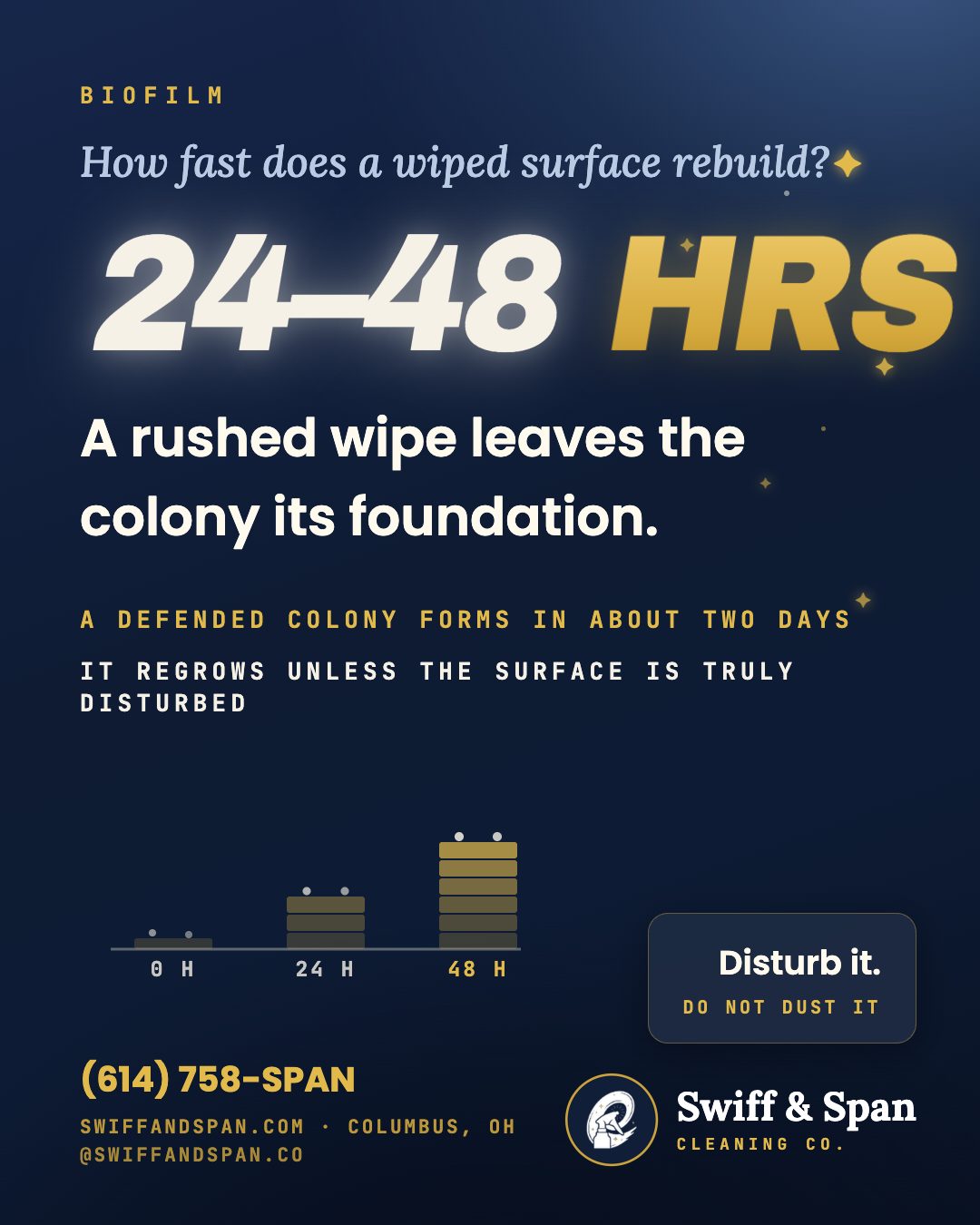
Give it a name, because it deserves one: a city. Cities have infrastructure, the biofilm’s matrix works like plumbing, moving nutrients and waste between layers of bacteria that specialize in different jobs. Cities have defenses, the outer layer of slime absorbs the brunt of a chemical attack so the bacteria underneath survive it. Cities grow, under the right conditions, a biofilm can go from a handful of stray bacteria to a defended, functioning colony in about 24 to 48 hours, layering itself thicker each day it goes undisturbed. And cities, once established, are hard to evict. That’s the part a lot of cleaning routines don’t account for.
How does a biofilm actually resist a quick wipe or spray?
Three ways, stacked on top of each other. First, the matrix itself is a physical barrier, a disinfectant has to penetrate a gel-like layer of sugars and proteins before it ever reaches a living cell, and most surface sprays aren’t given time to do that. Second, bacteria inside a biofilm can shift into a slower metabolic state, which makes many disinfectants, built to disrupt actively dividing cells, considerably less effective against a well-established colony. Third, and this is the one that should bother anyone who’s ever bought a bottle expecting a quick fix: bacteria inside a biofilm can share genetic material and defenses with their neighbors, effectively passing resistance along the way a bad email chain passes along everyone in the group.
None of that requires anything exotic. It happens on ordinary surfaces, using ordinary bacteria, under ordinary conditions, any surface that stays damp, gets touched often, and gets “cleaned” with a fast pass rather than genuine friction and contact time.
Where does biofilm actually hide in a dental office, med spa, or PT clinic?
Not where you’re looking. The obvious spots, waiting room chairs, exam tables, get attention. Biofilm prefers the places that look fine and get touched constantly:
- Sink drains and faucet aerators. Constant moisture, minimal disturbance, and organic material washing through daily, close to ideal biofilm conditions.
- Treatment table and chair joints/seams. The crevices where fabric meets frame, or where a hydraulic base meets the floor, rarely get more than a surface pass.
- Grout lines and caulking around sinks and backsplashes, especially in med spa treatment rooms with frequent handwashing.
- Equipment tubing and handpiece connections in dental and aesthetic settings, where residue and moisture combine in tight spaces a cloth can’t reach.
- Reusable spray bottles and mop heads themselves, ironically, some of the most consistent biofilm incubators in a building are the tools used to clean it.
A quick daily wipe touches maybe a third of that list, and even where it does reach, wiping alone rarely disturbs an established matrix.
Why does mechanical cleaning plus contact time matter more than the product?
Because chemistry needs help, and it needs patience. “Contact time” is the manufacturer-specified number of minutes a disinfectant has to stay visibly wet on a surface to do what the label claims, often 1 to 10 minutes, depending on the product and the organism. Wipe it dry after 15 seconds, which is what a fast pass does, and you’ve applied a fraction of the labeled dose. That’s before biofilm resistance even enters the picture.
Mechanical friction, actual scrubbing, actual agitation, does something a spray alone can’t: it physically breaks the matrix apart, exposing the bacteria inside to the disinfectant that would otherwise bounce off the slime layer. Product plus friction plus time is the combination that actually dislodges a colony. Any one of the three missing, and the “clean” surface is really just a rinsed one.
This is where we build our protocols differently than a once-over wipe service. In New Albany med spa treatment rooms and Dublin dental operatories alike, our crews are trained to treat high-moisture, high-touch zones, sink areas, equipment seams, chair joints, with actual friction and full labeled contact time, not a fast pass timed to the length of the visit. We verify it the same way we verify everything else: an ATP bioluminescence swab after cleaning, reading biological residue in under a minute, photographed and logged so a practice owner can see the number, not just take our word that the surface “looks good.” A surface that looks good and a surface that reads clean are not always the same surface, that gap is exactly where biofilm lives.
We also send the same crew back every time, because biofilm forms fastest in spots that get inconsistent attention, a different person each visit, working from a generic checklist, tends to miss the same crevices a familiar crew has already learned to hit.
If your practice is one of the first 10 to take the Founder’s Deal, you get a 3-month start with the 4th month free and your rate locked forever, and the complimentary walkthrough includes a live ATP test so you can see exactly which surfaces in your own building are reading clean and which ones are still running a colony. Call (614) 758-SPAN.
Frequently Asked Questions
What is biofilm, in plain terms?
Biofilm is a colony of bacteria that has secreted its own protective layer of slime, called an extracellular matrix, and uses it to shelter from disinfectants and a quick wipe-down. It behaves less like loose germs sitting on a surface and more like a small, defended structure that has to be physically broken apart to remove.
How fast does biofilm form?
Bacteria can begin attaching to a surface and building a protective matrix within hours, and a biofilm can become measurably harder to remove within 24 to 48 hours of forming. That's fast enough that a surface cleaned properly on Monday can host a developing colony by Wednesday if it isn't addressed again.
Does a disinfectant spray kill biofilm?
A disinfectant can kill exposed bacteria, but the slime matrix that defines a biofilm blocks much of the chemical from reaching bacteria deeper inside, and most sprays aren't left on the surface long enough to penetrate it anyway. Effective removal generally requires mechanical scrubbing to break the matrix apart combined with the product's full labeled contact time.
Where does biofilm hide in a medical or wellness office?
The most common hideouts are damp, low-disturbance spots: sink drains, faucet aerators, grout lines, equipment seams, and the joints on treatment tables and chairs. These areas are touched or seen constantly but rarely get more than a surface-level wipe.
How can I tell if a surface still has biofilm on it after cleaning?
Visual inspection alone can't reliably detect biofilm, since it can be present on a surface that looks and smells clean. ATP bioluminescence testing swabs the surface and returns a measurable reading of biological residue in under a minute, which is a more reliable way to confirm a cleaning protocol actually reached and removed what was there.
Every Columbus dental, medical, wellness, and commercial facility gets the same offer: a complimentary 30-minute ATP walkthrough. We swab your highest-touch surfaces, on the spot, and hand you the readings. No obligation, no pitch required to see the number. Book your complimentary ATP walkthrough or text (614) 758-SPAN.
Erik Kuusisto, Owner
Swiff & Span Cleaning Company
Keep reading
- What does “clean” actually mean? Inside the ATP numbers
- Clean versus disinfect, and why dwell time decides it
- Bleach is not a magic wand: four common mistakes
- What electrostatic spraying actually does
- Color-coded microfiber and the two-bucket method
- What happens in a complimentary ATP walkthrough
- How we prove clean · FAQ · Contact