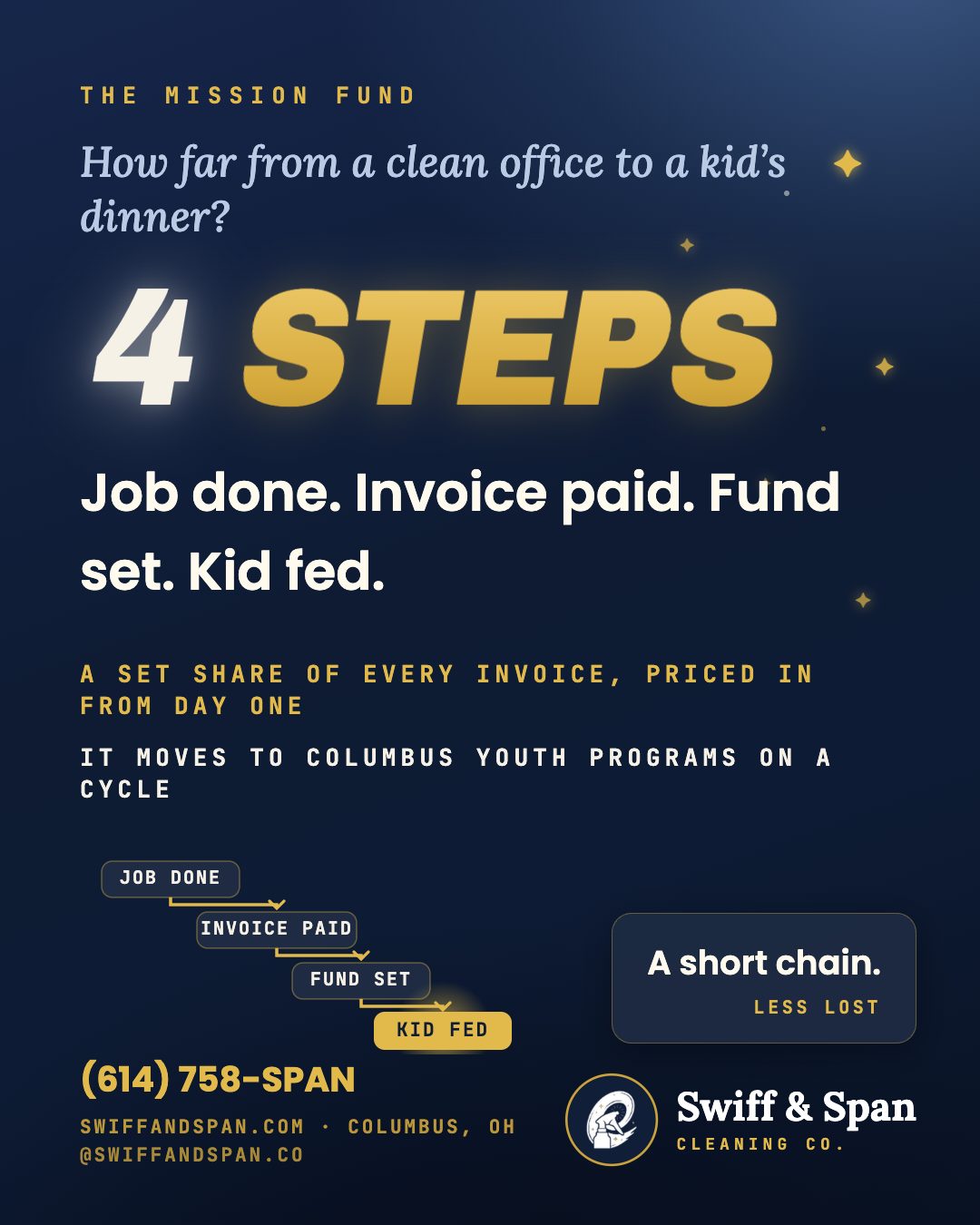
A portion of every invoice Swiff & Span sends, whether it’s a single Dublin dental office or a portfolio of Short North Airbnbs, routes into a fund that supports Columbus youth programs working against homelessness and poverty. The mechanism is ordinary on purpose: the job gets done, the invoice gets paid, a set share of that payment moves into the mission fund, and the fund moves out on a regular cycle to the programs it supports. No gala. No press release. Just a line item that happens every time a crew clocks out.
Here’s what that actually looks like, from one contract, start to finish. The details below are illustrative, a composite built from how a typical Columbus account runs, because no single client’s invoice belongs in a public article. The mechanics, though, are exactly how it works.
What Does “A Portion of Every Contract” Actually Mean?
Picture a mid-sized dental practice in Dublin: three treatment rooms, a reception area, two bathrooms, evening cleaning three times a week. That account gets invoiced monthly like any commercial contract. When the invoice is paid, a defined share of it, set at the time the contract is signed, not adjusted after the fact, is set aside for the mission fund before anything else happens with it. It isn’t a discount the client is asked to fund or a surcharge added to their rate. It’s built into how the job was priced from day one, the same way payroll and supply costs are.
How Does a Cleaning Invoice Turn Into a Kid’s Dinner?
The mission fund doesn’t sit and accumulate for a year. It moves on a regular cycle to Columbus youth programs working directly with kids and teenagers facing homelessness or housing instability, the kind of organizations that run emergency shelter beds, transitional housing, and meal programs for young people who’d otherwise go without. When that fund moves, it becomes exactly what those programs need most: flexible dollars that cover a meal, a bed, a bus pass, a set of stable adults showing up on schedule for a kid whose life has had very little scheduling in it.
So the chain runs like this: a crew cleans a Dublin office on a Tuesday evening, the invoice is paid, the mission-fund share is set aside, the fund reaches a Columbus youth program on its regular cycle, and a kid gets dinner, or a bed, or an adult who’s there again the next week. It’s a short chain. That’s the point. The fewer links between “job done” and “kid fed,” the less gets lost to administration, and the easier it is for a client to actually picture where their dollars go.
Why Build a Mission Into a Cleaning Company at All?
Because Erik Kuusisto built Swiff & Span in Columbus, and Columbus has kids who need it, that’s most of the honest answer. The rest is that a cleaning contract is a strange, quiet kind of leverage. It’s recurring. It’s predictable. It doesn’t depend on one big check in one generous year, it depends on showing up and doing the work, month after month, for clients across Dublin, New Albany, and the Short North who were going to hire *somebody* to clean their space anyway. The mission doesn’t ask a client to give anything extra. It asks them to choose where their regular cleaning budget already goes.
That’s a different pitch than most give-back marketing. It’s not asking anyone to feel generous. It’s pointing out that the money was going to be spent on cleaning regardless, so it might as well be spent with a company that turns part of it into dinner for a kid who needed one.
What Makes This Different From a Marketing Line?
The test for any give-back claim is simple: does it survive someone asking “how, exactly, and how often?” A lot of mission marketing collapses under that question, it turns out to be a once-a-year donation timed to a press release, or a percentage so small it’s mostly symbolic. Swiff & Span’s version is built to survive the question because the answer is boring in the best way: a set share, every contract, moved on a fixed cycle, to real programs, whether or not anyone’s writing about it. The building in Dublin doesn’t know it’s doing this. Neither does the invoice. It’s just how the numbers were set up from the start.
That’s also why this isn’t the headline pitch on every sales call. The differentiators that get an owner to pick up the phone are usually the measurable ones, the ATP reading, the photo-verified visit, the same crew showing up every time instead of a rotating cast from a national franchise. The mission is the thing clients tend to discover *after* they’ve signed, not the reason they signed. Which is how it should work. Nobody should hire a cleaning company primarily because of its charity math. They should hire it because the space gets clean, verifiably, every time, and then be glad, later, to learn what else their contract was quietly doing.
Where Does the Money Actually Go?
For a limited run, Swiff & Span is opening ten Founder’s Deal contracts across greater Columbus: a three-month commitment, the fourth month free, and a rate locked permanently at today’s price. Every walkthrough includes a live ATP reading, so a prospective client can see, in a real number, exactly what their current cleaning is or isn’t catching, before they ever think about the mission fund attached to it. Call (614) 758-SPAN to see if a spot remains.
Frequently Asked Questions
How does Swiff & Span's give-back program actually work?
A defined share of every contract's invoice is set aside for a mission fund at the time the contract is signed, then moved on a regular cycle to Columbus youth programs working against homelessness and poverty, built into pricing, not added as a surcharge or a once-a-year donation.
Which Columbus youth programs benefit from the mission fund?
The fund supports youth programs across Columbus focused on housing stability, shelter, and meal support for young people facing homelessness, the specific organizations and cycle are part of Swiff & Span's ongoing community partnerships rather than a single named charity tied to any one contract.
Does giving back cost clients more on their cleaning contract?
No. The mission share is built into how a contract is priced from the start, the same way payroll and supplies are, so a client isn't asked to pay extra or opt into a surcharge to participate.
Can a client choose where their contract's mission share goes?
Not line by line. The fund is pooled across all Columbus contracts and distributed to youth programs on a set cycle, which keeps the process simple and keeps administrative overhead from eating into what actually reaches the kids it's meant for.
Is this the main reason to hire Swiff & Span?
No, and it shouldn't be. The reasons to hire are the measurable ones: a same-crew team, photo-verified visits, and an ATP reading proving a space is actually clean. The mission is what a client's contract is quietly doing in the background, discovered after the fact, not the pitch itself.
Every Columbus dental, medical, wellness, and commercial facility gets the same offer: a complimentary 30-minute ATP walkthrough. We swab your highest-touch surfaces, on the spot, and hand you the readings. No obligation, no pitch required to see the number. Book your complimentary ATP walkthrough or text (614) 758-SPAN.
Erik Kuusisto, Owner
Swiff & Span Cleaning Company
Keep reading
- What does “clean” actually mean? Inside the ATP numbers
- Clean versus disinfect, and why dwell time decides it
- Bleach is not a magic wand: four common mistakes
- What electrostatic spraying actually does
- Color-coded microfiber and the two-bucket method
- What happens in a complimentary ATP walkthrough
- How we prove clean · FAQ · Contact