Walk into a dental practice in Dublin or Upper Arlington at 7:45 in the morning and look at the operatory. The chair is wiped, the light handle is sleeved, the tray is covered in a fresh barrier. Somebody thought hard about that room. There is a written procedure for it, a between-patient turnover, and in most practices a clinical team that could recite the steps in their sleep.
Now walk twenty feet back toward the door and look at the front desk.
There is a stack of intake forms. A clipboard. A cup of pens. A card reader. A sticky note about the 2:15 who always runs late. The counter edge, the part a patient leans on while they dig for an insurance card, is somewhere underneath all of it.
That counter is the busiest surface in the building, and in most practices it is cleaned with the same frequency as the hallway. Not because anyone decided it should be. Because there is always paper on it.
The arithmetic of one counter
Here is a worked example. It is not a study and it is not a reading from anyone’s practice. It is arithmetic, and you can redo it with your own schedule in about thirty seconds.
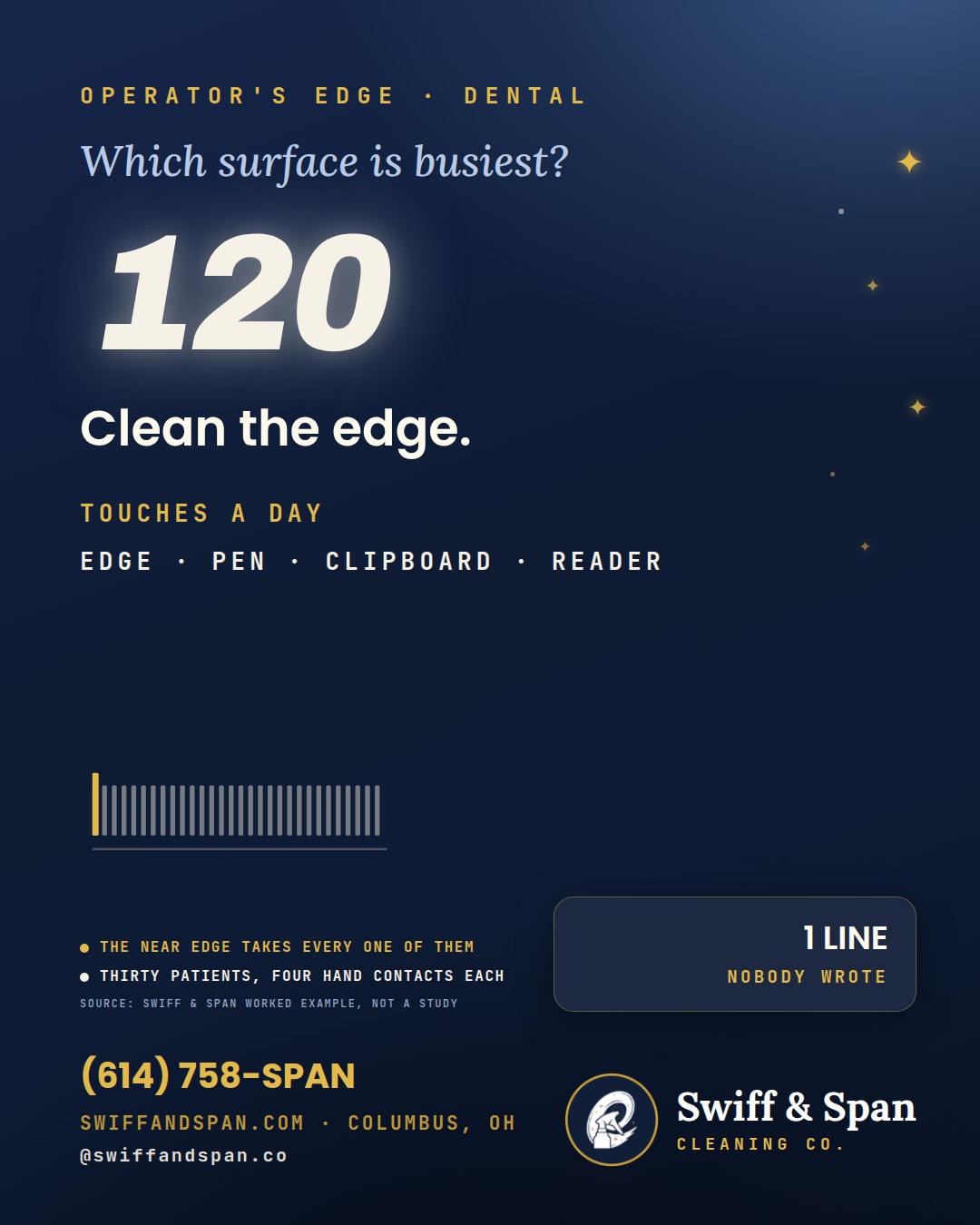
A general dental practice sees 30 patients on a normal day. Each patient makes roughly 4 hand contacts with the front desk between arriving and leaving:
- The counter edge. They lean on it, set a bag on it, rest a forearm on it while they talk.
- The pen. The shared one from the cup, used to sign in, sign a consent, sign a treatment plan.
- The clipboard or tablet. Handed across, held, handed back.
- The card reader. Tapped, inserted, keyed, touched with a thumb on the way out.
Thirty patients times four contacts is 120 hand contacts a day on one counter. That count does not include the companion who came along, the child who touched everything, or the staff on the other side of the desk who handle the same clipboard and pen dozens more times.
One hundred and twenty touches. Then the counter gets cleaned once, sometime after 9 at night, if the night crew can find it.
Why a busy surface ends up being the least cleaned
The instinct is to assume someone is cutting corners. Usually no one is. The front desk falls between three schedules, and it helps to see why each one misses it.
The clinical turnover skips it by design. Between-patient disinfection is scoped to the operatory. Your assistants reset the chair, the light, the tray and the delivery unit. That work is measured in minutes and it is focused, correctly, on the room where treatment happens. The front desk is not in that room.
The front desk team is busy being the front desk. The people who sit there are answering phones, verifying insurance and checking in the next patient. Wiping the counter in the middle of that means moving the paper, and moving the paper means losing track of which form belongs to whom. So it waits.
The night crew cleans around what it finds. This is the part that surprises owners. A professional night cleaner is trained not to disturb documents on a desk. Moving a stack of patient paperwork is a privacy problem and a lost-form problem, so the respectful thing to do is clean the exposed laminate around the stack and leave the stack where it sits. The pen cup gets lifted, maybe. The card reader gets skipped, because it is electronics and nobody wrote down what it can be wiped with.
Put those three together and you get the pattern. The one surface every patient touches first is the one surface that is never clear, and a surface that is never clear is never cleaned.
Frequency is not the same as coverage
We wrote about the operatory version of this problem when we mapped the 28 surfaces in a medical exam room against the six lines a typical nightly scope names. The front desk is the same gap, turned inside out. It is not that the scope forgot the counter. Almost every scope says “reception desk.” It is that the scope names the desk and not the four things on it, and it says nothing about who clears it first.
A counter can appear on the checklist every night and still not be cleaned for a month, because the line was checked while the paper stayed put. That is not a failure of effort. It is a failure of wording.
What the fix looks like
The fix is not a new chemical. It is three sentences written into the scope, plus one verification.
1. Clear-and-clean is a written step, not an assumption
The scope should say who clears the counter and when. In practice this is one of two arrangements:
- The front desk clears at close. Five minutes before the last person leaves, loose paper goes into a tray or a drawer, the pen cup comes off the counter, and the clipboard is set face down on a clear shelf. The night crew is told, in writing, that anything left on the counter surface will be moved to that shelf, not wiped around.
- The night crew clears to a designated spot. The crew lifts everything to one agreed location, cleans the full counter including the edge and the front lip, and puts it all back in the same arrangement. This works, but it has to be agreed in advance, because a crew that moves paper without permission is doing exactly what it was trained not to do.
Either one works. Neither one happens by accident.
2. The card reader and the pen get a daytime line
A nightly clean resets the counter once. It does nothing for patient number 17, who uses the pen that patient number 16 just set down. So the scope, or the office’s own front desk procedure, should name a midday wipe of the card reader, the pen cup and the shared clipboard or tablet. Two minutes, around lunch, is enough to split one long run of 120 contacts into two shorter ones.
On the card reader, follow the device manufacturer’s cleaning guidance first. Most allow a pre-moistened wipe that is damp, not dripping, and prohibit spraying anything directly on the keypad. Where the guidance allows an EPA-registered disinfectant wipe, such as PDI Super Sani-Cloth, the surface has to stay visibly wet for the full contact time on the label. A quick swipe that dries in ten seconds is a clean, not a disinfection. We covered why in the disinfectant contact time piece.
Better still, retire the shared pen. A cup marked for used pens, a second cup for clean ones, and a quick disinfection cycle at lunch and at close removes the most passed-around object in the building from the equation. Our earlier look at the check-in pen goes deeper on that one object.
3. The counter edge gets its own cloth
The counter edge is the part people lean on, and it is the part a quick wipe misses, because the cloth travels across the flat top and never wraps the rounded lip. In our crews’ sequencing, the front desk is cleaned with a dedicated microfiber color that never goes near a restroom, top to bottom, clean to dirty: counter top, then the edge and front lip, then the card reader housing, then the pen cup. Color-coded microfiber and the two-bucket method is the reason that cloth is not carrying anything in from somewhere else.
4. Verify the edge, not the middle
If you want to know whether any of this is working, swab the counter edge, not the middle of the counter. The middle is the part that gets wiped around the paper. The edge is where the 120 contacts land. An ATP reading measures organic residue on that surface and returns a number in seconds. Under 100 RLU is generally considered clean across the industry. Our own target threshold is 25 RLU. The number is only useful if it comes from the surface that matters, so the edge is where the swab goes.
Why this matters more in October than in July
Columbus is at the front edge of respiratory season. The windows close, the waiting room fills, and more of the people signing in are carrying something home from school. The front desk is the one place in the practice where every one of them touches the same four objects in the same order.
That is also why the front desk is the right place to start a seasonal reset. We laid out a four-move version of that reset in Flu Season Starts at the Front Desk. This piece is the other half: why the reset tends to fade by November, which is that nobody wrote down who moves the paper.
Who owns the desk?
If you read one thing into your cleaning scope this week, make it an owner for the front desk. Not “reception area,” which is a room. The counter, the edge, the pen, the clipboard and the card reader, each named, each with a time and a person attached.
This is the same boundary question that runs through where the cleaner’s job ends and your team’s begins. The operatory already has that line drawn. The front desk almost never does, and it is where every patient starts.
If you want to see what your own counter edge reads, the complimentary ATP walkthrough takes about 30 minutes. Erik walks the practice with you, swabs the surfaces you pick, the front desk included, and you keep the readings whether you hire us or not. We serve dental and medical practices across Columbus, Dublin, New Albany, Worthington, Upper Arlington, Bexley, Hilliard and the Short North. Call (614) 758-SPAN.
Frequently Asked Questions
How often should a dental office front desk be cleaned?
At minimum, the full counter, including the edge, should be cleared and cleaned once a day, and the card reader, shared pens and clipboards or tablets should get a second wipe at midday. In the worked example above, a 30-patient day puts about 120 hand contacts on one counter, so a single overnight clean leaves the whole day's contact in one unbroken run.
Why does the night cleaning crew skip the reception desk?
Usually because it is covered in paper. Professional cleaners are trained not to move patient documents, so they clean around the stack. Unless the scope says who clears the counter and where the paper goes, the counter under the paper does not get cleaned. The fix is a written clear-and-clean step, agreed in advance.
Can you disinfect a card reader?
Usually yes, within the manufacturer's cleaning guidance. Most allow a damp, not dripping, pre-moistened wipe and prohibit spraying liquid onto the keypad. If an EPA-registered disinfectant wipe is allowed, the surface has to stay visibly wet for the full contact time on the product label to count as disinfection.
What are the high-touch surfaces at a medical or dental reception desk?
The counter edge and front lip, the shared pen, the clipboard or check-in tablet, the card reader, and the pen cup itself. Staff-side surfaces like the phone handset, keyboard and mouse carry additional contact. The counter edge is the most often missed because a cloth crosses the flat top and never wraps the rounded edge.
How do you know if the front desk is actually clean?
Swab the counter edge with an ATP meter. It measures organic residue and returns a reading in RLU in seconds. Under 100 RLU is generally considered clean industry-wide; Swiff & Span's own target threshold is 25 RLU. Swab the edge rather than the middle of the counter, because the edge is where hands land.
Every Columbus dental, medical, wellness, and commercial facility gets the same offer: a complimentary 30-minute ATP walkthrough. We swab your highest-touch surfaces, on the spot, and hand you the readings. No obligation, no pitch required to see the number. Book your complimentary ATP walkthrough or text (614) 758-SPAN.
Erik Kuusisto, Owner
Swiff & Span Cleaning Company