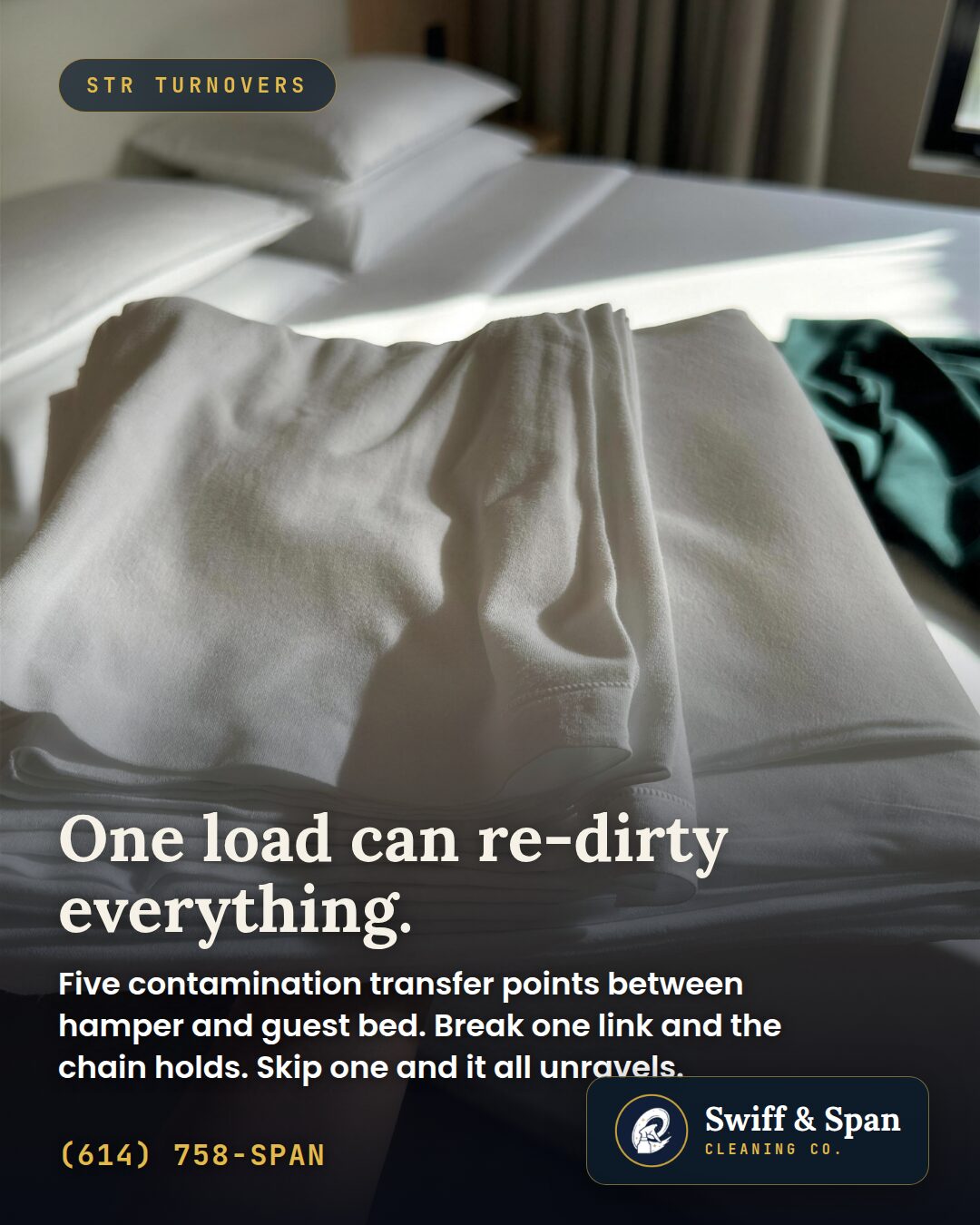
Picture the turnover. Every counter wiped, every mirror streaked-free, every toilet bowl disinfected. The floors are vacuumed and mopped, the trash liners replaced, the remote controls wiped down. The listing photos could have been taken five minutes ago. Then the cleaner pulls a stack of freshly washed sheets from a laundry bag, makes the bed, fans the decorative pillows into position, and leaves.
The sheets smell like detergent. They look crisp. And they may be carrying exactly the kind of biological contamination that the last two hours of cleaning was supposed to eliminate.
This is the linen chain problem. It is not dramatic. It is not visible. It is the quiet last mile of contamination control that most turnover operations never think about, and it can undo a spotless clean before the first guest drops their bag on the bed.
What is the linen chain?
The linen chain is the full path a piece of fabric travels from the moment it comes off a guest bed to the moment it lands on the next one. Each link in that chain is a chance for contamination to enter or re-enter the textile. The links look ordinary, which is part of why they get overlooked.
The hamper. Soiled linens sit in a pile, sometimes for hours, sometimes overnight. Bacteria thrive in warm, damp fabric. The longer linens wait, the higher the microbial load headed into the washer.
The wash. Most residential machines default to warm cycles between 90 and 120 degrees Fahrenheit. That temperature range does not kill the majority of bacteria. Studies have found Staphylococcus aureus, E. coli, and other organisms surviving a standard warm wash and transferring to the next load. A sanitizing cycle requires sustained temperatures at or above 140 degrees Fahrenheit, and many in-unit machines either cannot reach that threshold or are not set to it.
The folding surface. Linens come out of the dryer and get folded on whatever flat surface is available. If that surface was not wiped down with a disinfectant beforehand, the clean fabric picks up whatever was already sitting there. A kitchen counter that held grocery bags. A table that caught a cleaning rag between tasks. A bed that was stripped but not yet disinfected.
The transport bag. Clean linens go into a bag or bin for the trip to the property. If that same bag carried the soiled linens out an hour earlier, it is now a bridge between the dirty load and the clean one. Cross-contamination through shared transport containers is one of the most common and least visible failure points in turnover operations.
The staging surface. At the property, clean linens get set down while the cleaner finishes other tasks. If the linens land on a surface that has not been disinfected yet, everything that surface was carrying is now on the fitted sheet that will touch a guest’s skin for the next eight hours.
Can clean laundry still carry bacteria?
Yes. A residential washing machine running below 140 degrees Fahrenheit does not kill all bacteria, and organisms that survive a warm or cold cycle transfer to the next load.
Yes. A residential washing machine running below 140 degrees Fahrenheit does not kill all bacteria, and organisms that survive a warm or cold cycle transfer to the next load.
A guest does not see bacteria. They see white sheets and a made bed and a bathroom that smells clean. But the body has a way of responding to contamination even when the eyes cannot detect it. Skin irritation, a rash attributed to travel, an allergy flare blamed on the city, a low-grade reaction that the guest writes off as nothing and then mentions in a four-star review with the phrase “something felt off.”
Short-term rental reviews live forever. A single comment about cleanliness pushes a listing down in search results, and it compounds. Three or four mentions of “not as clean as expected” can cost a Columbus host thousands of dollars in lost bookings over a season. The host scrubs harder, replaces cleaning crews, buys more expensive detergent. The linens never get addressed because the linens already look clean.
The linen chain is not a dramatic failure. It is a quiet one, which makes it worse. Nobody investigates what they cannot see.
How do you stop linen cross-contamination?
Preventing linen-chain contamination is not about buying fancier sheets or switching detergent brands. It is about controlling the order of operations so that every link in the chain moves in one direction: from dirty to clean, with no backflow.
Dedicated clean transport. Soiled linens and fresh linens never share a bag. The bag that carries dirty sheets to the laundry does not carry clean sheets back to the property. Two bags. One direction each. It is the simplest fix in the entire chain and the one most often skipped.
Sanitizing wash temperature. Water at or above 140 degrees Fahrenheit, sustained through the full cycle. Commercial linen services that serve hospitality and healthcare maintain this as a baseline. If an in-unit machine cannot reach that threshold, the linen program needs to account for it, either through a secondary sanitizing rinse additive or by routing linens to a facility that can.
Clean surface, then stage. Linens are the last thing placed. Every surface the fabric will touch has already been cleaned, disinfected, and verified. The bed platform is disinfected before the fitted sheet goes on. The bathroom shelf is wiped before the towels are folded onto it. Reversing this order, placing linens on a surface and then cleaning around them, defeats the entire sequence.
Verification before guest-ready status. A surface that reads high on an ATP meter after cleaning is a surface that still has biological material on it, regardless of how it looks. We test high-touch surfaces with a Hygiena SystemSURE Plus ATP meter before marking a property guest-ready. Under 100 RLU is the industry threshold for “clean.” Swiff & Span holds every surface to 25 RLU. The difference between those two numbers is the difference between a turnover that passes a glance and one that passes a swab. What ATP testing measures and how RLU scores work covers the full mechanics.
What does a contamination-controlled turnover involve?
The process is methodical, not complicated, but every step has to happen in order.
Electrostatic disinfection first. High-touch surfaces, bathroom fixtures, kitchen counters, and furniture gets electrostatic application so the disinfectant wraps around edges and undersides instead of pooling on top. What electrostatic spraying actually does explains the physics of charged-particle coverage.
Named EPA-registered chemistry at full dwell time. The disinfectant sits wet for the full contact time on the label. Our rotation includes PDI Super Sani-Cloth, Diversey Oxivir Tb, Clorox Healthcare Bleach Germicidal, and Spartan TB-Cide Quat. Each is matched to the surface and the risk level. A kitchen counter gets different treatment than a headboard. Clean versus disinfect, and why dwell time decides it walks through the distinction.
Color-coded microfiber and two-bucket method. A cloth that touched the bathroom never touches the kitchen. A mop that cleaned the entryway never re-dips into clean solution. Color-coding prevents cross-contamination between zones; the two-bucket method prevents it within a zone. The color-coded microfiber map and two-bucket method shows the full system.
Linens placed last, on verified surfaces. Only after all surfaces are cleaned, disinfected, and tested do the fresh linens come out of their dedicated clean bag and go onto the bed, the bathroom shelf, the kitchen counter. The fabric touches a surface that has already been confirmed clean. The chain stays unbroken in one direction.
What RLU do nightstands and counters read?
A guest will never know the nightstand was tested at 18 RLU before the lamp was set back on it. They will never know the bathroom counter read 12 RLU before the hand towel was folded onto the edge. They will not know about the transport bags, the wash temperature, or the sequencing.
What they will notice is that the room feels right. Not just clean-looking. Not just clean-smelling. The kind of clean that does not trigger the small, wordless unease that makes someone check behind the toilet or lift the comforter to inspect the sheets.
That feeling is not an accident. It is the output of a chain that was never broken.
Does every property get the same turnover standard?
This is the turnover protocol we bring to every short-term rental account across New Albany, Dublin, the Short North, Columbus, Upper Arlington, Bexley, Hilliard, and Worthington. The same sequencing, the same linen-chain control, the same ATP verification. It is how we handle STR and Airbnb turnovers, and the same discipline applies to our work in dental offices, medical and clinical facilities, and wellness and med spa spaces.
If you manage properties in Central Ohio and want to see what your surfaces actually read between guests, here is what happens in a complimentary ATP walkthrough, step by step.
Frequently Asked Questions
How does the linen chain re-contaminate a cleaned Airbnb?
The linen chain is the full path linens travel from hamper to guest bed: washing, drying, folding, transport, and staging. Contamination can enter at any link. A washer that did not hit sanitizing temperature, a folding table that was not wiped, a transport bag used for both dirty and clean loads, or linens staged on surfaces before those surfaces were disinfected. Each broken link adds biological material to textiles that look and smell perfectly clean.
What temperature kills bacteria in laundry?
Water temperature of 140 degrees Fahrenheit (60 degrees Celsius) or higher, sustained for the full wash cycle, is generally required to kill most common bacteria. Many residential machines default to warm cycles well below this threshold. Commercial linen services that serve hospitality and healthcare typically wash at or above this temperature as standard practice.
How does Swiff and Span prevent linen cross-contamination during Airbnb turnovers?
Swiff and Span treats linen placement as the final step in a sequenced turnover. All surfaces are cleaned and disinfected before linens are staged. Fresh linens are transported in dedicated clean bags that never carry soiled loads. The bed and bathroom surfaces where linens will rest are verified clean before placement, and ATP testing confirms that high-touch surfaces read below 25 RLU before the property is marked guest-ready.
If you host on Airbnb, VRBO, or any platform in the Columbus area, the offer is the same as every practice and property we serve: a complimentary 30-minute ATP walkthrough. We swab your highest-touch surfaces on the spot and hand you the readings. No obligation, no pitch required to see the number. Book your complimentary ATP walkthrough or text (614) 758-SPAN.
Erik Kuusisto, Owner
Swiff & Span Cleaning Company
Keep reading
- What ATP testing measures, and what an RLU score does not prove
- What does “clean” actually mean? Inside the ATP numbers
- What electrostatic spraying actually does
- Clean versus disinfect, and why dwell time decides it
- Color-coded microfiber and the two-bucket method
- What happens in a complimentary ATP walkthrough
- How we prove clean · FAQ · Contact