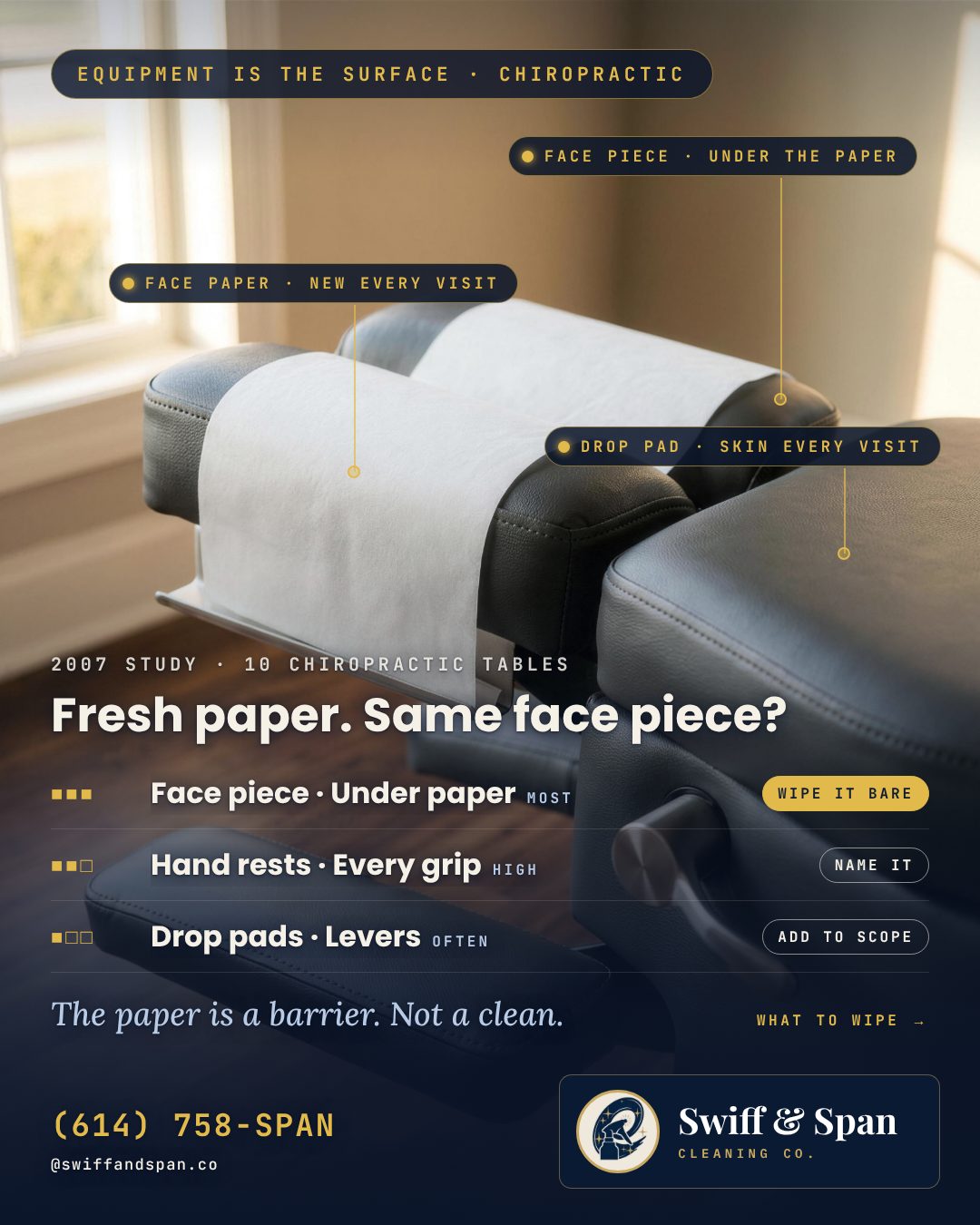
The face paper gets changed for every patient. The face piece under it does not.
That one sentence is the whole problem with how most chiropractic offices think about table hygiene, and in 2007 a research team at Parker College of Chiropractic in Dallas went and measured it. They pulled the paper off ten treatment tables in their own outpatient teaching clinic, swabbed what was underneath, and sent the samples to the microbiology lab.
Every one of the ten tables grew bacteria. One of them carried MRSA.
The short version: face paper is a barrier against skin oil and makeup, not a clean. In a 2007 study of ten vinyl chiropractic tables, all ten grew gram-positive bacteria under the paper and one carried MRSA. Ordinary disinfectant wipes cleared every table the researchers retested. The fix is a written wipe schedule that names the face piece, the hand rests and the parts of the table nobody lies on.
What did researchers find on chiropractic treatment tables?
Bacteria on all ten tables, and methicillin-resistant Staphylococcus aureus on one. The study, published in Chiropractic & Osteopathy in 2007 by Evans, Breshears, Campbell, Husbands and Rupert, swabbed a 6 cm by 6 cm square of each face piece with the paper removed, plus the full contact surface of each hand rest.
The cultures grew gram-positive organisms on every table, including Staphylococcus epidermidis, Staphylococcus saprophyticus and Staphylococcus aureus. The S. aureus isolates were confirmed twice, then tested on a medium that only lets methicillin-resistant strains grow. They grew.
The authors were repeating an earlier finding, not discovering a new one. A 2006 study by Bifero and colleagues in the American Journal of Infection Control had already reported pathogenic microorganisms, including MRSA, on chiropractic adjusting tables. Two research teams, two years apart, same result.
Does that mean my practice has MRSA on its tables?
No, and the study is careful not to claim that. It sampled ten tables in one high-traffic teaching clinic that had dozens of them. It did not count how many bacteria were present, only whether they were there. Cloth-covered tables were left out because they are hard to culture.
The authors say plainly that a teaching clinic may not represent a private office. So read the finding for what it is: proof that a table which looks clean, under fresh paper, can still be carrying organisms nobody wanted there. That is a question worth asking of your own tables, not a verdict on them.
Why doesn't the face paper protect the table?
Because paper is a barrier, not a disinfectant, and it only covers one surface. The study's authors recommend changing face paper for every patient, and in the same paragraph they note that the paper does not prevent microbial growth on the table underneath.
Think about where a patient's face actually goes during an adjustment. Breath, saliva, skin oil and makeup land on the paper, and some of it reaches the vinyl at the edges, through the split and around the nose opening. Then the paper comes off, a fresh strip rolls on, and the face piece underneath goes another day without being touched.
Paper solves the part of the problem you can see. The vinyl beneath it is the part you cannot.
Which parts of a chiropractic table get missed?
The parts a patient grips, leans on or presses into but never lies on. A "wipe the table" line in a cleaning scope tends to mean the long flat pads, because that is what looks like a table. The surfaces in the study were the face piece and the hand rests, and they sit right next to some others nobody names:
- The face piece, under the paper. The split cushion every prone patient breathes into. The single surface the study swabbed most directly.
- The hand rests. Gripped, leaned on and pressed by every patient getting on and off the table. The study swabbed their entire contact surface.
- The edges and seams of the face piece. Where residue collects at the split and the stitching, beyond the edge of the paper strip.
- The drop-piece pads. The thoracic, lumbar and pelvic sections that drop during an adjustment, touched by skin and clothing on every visit.
- The adjustment levers and knobs. Handled by the doctor between patients, often right after a hand-on adjustment.
- The side handles and grab points. What a patient with a sore back holds onto while getting up.
None of these is a floor-plan item. All of them are objects. We see the same gap in every treatment space we walk, from the face cradle on a massage table to the five surfaces a room reset tends to miss: scopes are written by room, and hands work by object.
How often should a chiropractic table be disinfected?
The authors of the 2007 study propose at least three times a day, at the start of the day, at mid-day and at close, plus any time clinical judgment calls for it, such as after a visibly sick patient or when secretions or makeup are visible on the surface. A risk-management guide they cite from the Chiropractic and Osteopathic College of Australasia goes further and recommends wiping the table after each patient contact.
That gives a practice a reasonable split. Your clinical team owns the between-patient wipe and sets your infection-control protocol. A cleaning contractor owns the close-of-day clean, done thoroughly, with every part of the table above named on the checklist and nothing rushed by a waiting room.
What should a chiropractic table be cleaned with?
Something that matches both the soil and the upholstery, used in the right order and held wet for the full contact time on its label. In the study, two everyday products, a 70% isopropyl alcohol wipe with 10% acetone and a Lysol sanitizing wipe, each left the retested tables with no pathogenic microbes. The authors list several acceptable families, including 60 to 90% alcohol, quaternary ammonium compounds, diluted bleach, phenolics and chlorhexidine products.
Two cautions keep that list honest. First, the order matters: clean visible soil, oil and makeup off the surface before disinfecting, because a disinfectant cannot work through a film it was never meant to cut. Our explainer on clean versus disinfect and dwell time covers why. Second, the vinyl matters. Some upholstery makers warn against certain chemistries outright, and the wrong one can crack a face piece within a year. We wrote up which disinfectants damage which treatment tables so you can check your own manufacturer's guidance before a contractor picks a product for you.
And one wipe should not cover the whole table. A wipe that has already crossed the long pads is carrying their residue onto the face piece. Here is why one wipe per surface is the rule.
Can an ATP test tell me whether my table is clean?
It can tell you how much organic residue is left on it, which is the closest thing to a number for "clean" that exists. It cannot tell you whether MRSA or any other specific organism is present, and it does not prove disinfection. Those are lab questions, and that is exactly how the 2007 study answered them.
What ATP does well is catch the surface that looked clean and was not. When verification is part of the scope, we swab the face piece and hand rests after cleaning and read the result in relative light units, or RLU. Our standard is 25 RLU or under. Here is how to read an ATP result, and here is the longer answer to whether ATP testing measures germs.
What should a Columbus chiropractor ask a cleaning company?
Three questions. Does your scope name the face piece, hand rests, drop-piece pads and adjustment levers, or does it just say "treatment rooms"? Which product will you use on my vinyl, and does my table's manufacturer allow it? How will I know the tables were done when I was not there?
A good answer to the last one is a record: a room-by-room checklist, photo documentation and, where it is in the scope, a reading. The same idea runs through the Ohio gym study that found staph on 38.2% of surfaces. Equipment that skin touches every hour needs a written plan, not a good intention.
Your next concrete move
Tonight, after your last patient, lift the paper on one face piece and look at the vinyl in good light, then run a finger along the underside of a hand rest. Then put your cleaning scope beside the list above and count how many of the six parts it names.
If you would like a second set of eyes, I will walk your treatment rooms with you for 30 minutes. It is a complimentary ATP walkthrough for chiropractic offices in Upper Arlington, Westerville, Bexley, Dublin, New Albany, the Short North and Downtown Columbus. We swab the table surfaces you choose, you see the readings on the spot, and they are yours to keep. Here is what to expect from that walkthrough.
A portion of every contract supports Columbus youth programs.
Source: Evans MW Jr, Breshears J, Campbell A, Husbands C, Rupert R. Assessment and risk reduction of infectious pathogens on chiropractic treatment tables. Chiropractic & Osteopathy. 2007;15:8. Read the study. The study sampled ten vinyl tables in one outpatient teaching clinic and did not quantify bacterial counts. Your practice's clinical team sets infection-control protocol for patient care.
Frequently Asked Questions
What bacteria were found on chiropractic treatment tables?
In a 2007 study of ten vinyl tables in one teaching clinic, every table grew gram-positive bacteria, including Staphylococcus epidermidis, Staphylococcus saprophyticus and Staphylococcus aureus. MRSA was confirmed on one of the ten tables.
Does face paper keep a chiropractic table clean?
No. Face paper is a barrier against skin oil, makeup and secretions and should be changed for every patient, but the study's authors note that it does not prevent microbial growth on the face piece underneath.
How often should a chiropractic table be disinfected?
The 2007 study's authors propose at least three times a day, at the start of the day, at mid-day and at close, plus whenever clinical judgment calls for it. A risk-management guide they cite recommends wiping the table after every patient.
What disinfectant kills bacteria on a chiropractic table?
In the study, a 70% isopropyl alcohol wipe with 10% acetone and a Lysol sanitizing wipe each left retested tables with no pathogenic microbes. Clean visible soil first, keep the surface wet for the full label contact time, and check your table maker's upholstery guidance.
Can ATP testing detect MRSA on a treatment table?
No. ATP testing measures organic residue left on a surface, read in relative light units, or RLU. It does not identify specific organisms or prove disinfection. Swiff & Span's standard is 25 RLU or under on tested surfaces.
Every Columbus-area chiropractic office gets the same offer: a complimentary 30-minute ATP walkthrough. We swab your face pieces and hand rests, on the spot, and hand you the readings. Book your complimentary ATP walkthrough or text (614) 758-SPAN.
Erik Kuusisto, Owner
Swiff & Span Cleaning Company