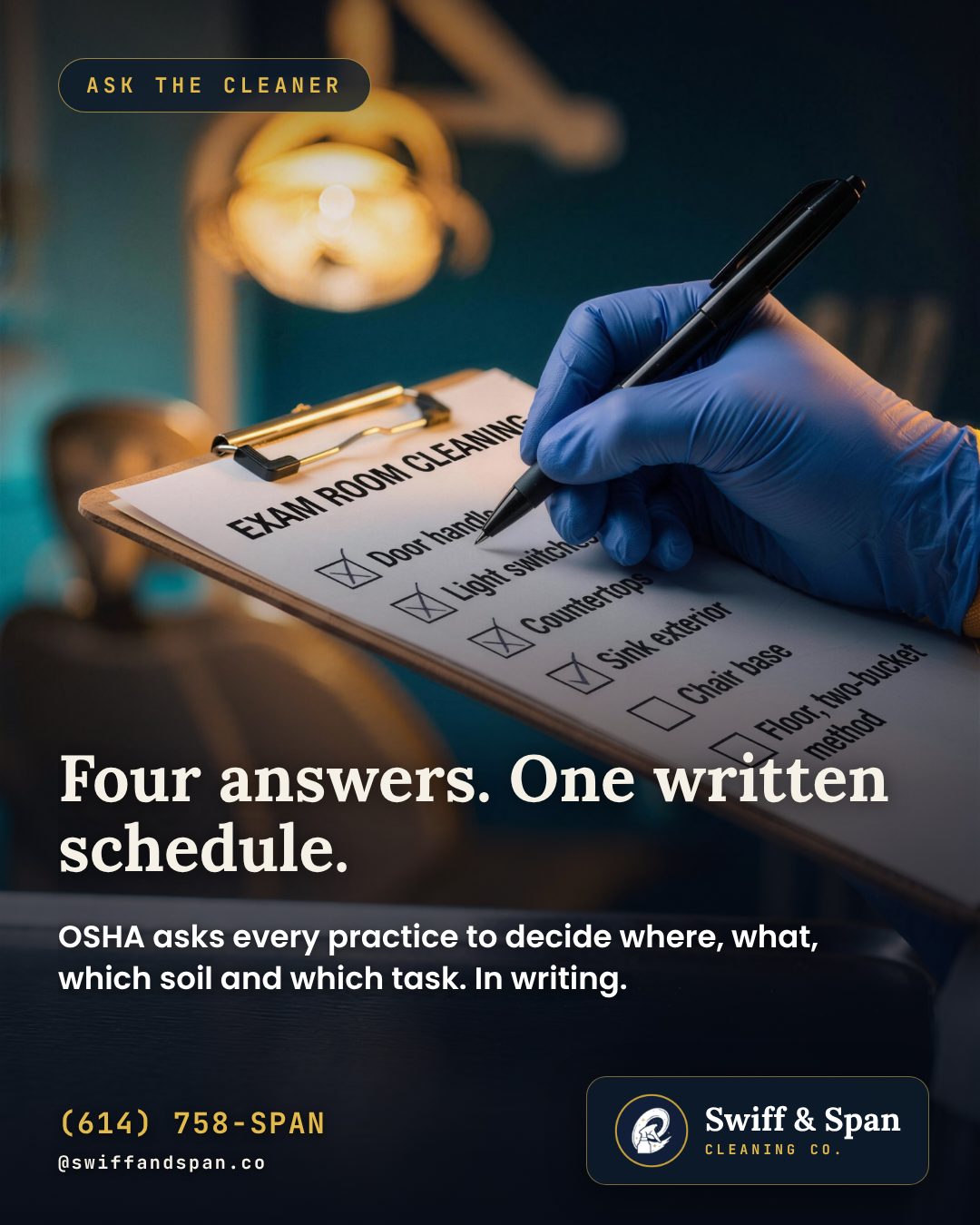
Somewhere inside 29 CFR 1910.1030, the federal bloodborne pathogens standard, there is a sentence that reads like a recipe card and gets treated like fine print.
It says the employer “shall determine and implement an appropriate written schedule for cleaning and method of decontamination.” Then it names exactly four things that schedule must be based on. Not three, not “best practices.” Four.
If you run a dental or medical practice in Columbus, that sentence is addressed to you. Your cleaning vendor cannot sign it on your behalf. What a good vendor can do is make it easy to write, easy to follow and easy to prove. This article walks through all four factors, in plain language, so you can hold your current cleaning scope up against them.
The short version: OSHA does not tell you how often to clean or which product to use. It tells you to decide, in writing, based on where a surface is, what it is made of, what soil is on it and what work happens nearby. A contract that says “wipe counters nightly” has answered none of the four.
A note before we start: Swiff & Span is a cleaning contractor, not an accrediting body or a law firm. We are OSHA-conscious, and this is our reading of a public regulation, not legal advice. Your compliance officer or counsel has the final word.
What does OSHA actually say about a cleaning schedule?
The housekeeping paragraph of the standard, 1910.1030(d)(4), opens with a general duty: employers “shall ensure that the worksite is maintained in a clean and sanitary condition.” The next sentence is the one that matters here, the written schedule, which has to be “based upon the location within the facility, type of surface to be cleaned, type of soil present, and tasks or procedures being performed in the area.”
Two follow-on rules sit underneath it. Contaminated work surfaces must be decontaminated with an appropriate disinfectant after procedures are completed, and again at the end of the work shift if the surface may have become contaminated since the last cleaning. Reusable bins, pails and cans that could be contaminated must be inspected and decontaminated on a regularly scheduled basis.
Notice what is missing: a number of minutes, a named chemical, a required test. The standard asks for a decision with a reason attached. That is why the four factors are worth knowing by heart.
Factor one: where in the building is this surface?
Location decides the risk before anything else does. The front desk and the operatory share a building and almost nothing else.
A reception counter, a waiting room chair and a restroom door pull are touched by patients, parents, couriers and staff. An operatory counter, a handpiece tray and a chairside light handle are touched during procedures. A sterilization area has its own rules, and in most practices those rules belong to clinical staff, not the night crew. (We wrote up where that boundary sits in the dental cleaning scope boundary.)
A written schedule that treats the building as one undifferentiated space has skipped factor one. A useful one starts by listing zones: reception, hallway, restroom, operatory, lab, staff room, and who owns each.
Factor two: what is the surface made of?
Surface type decides which products and tools are safe, and therefore which are allowed on the schedule at all.
Sealed solid-surface counters, vinyl upholstery, stainless steel, glass, laminate, electronics and porous fabric each respond differently to disinfectants. Some upholstery degrades under certain chemistries, and electronics follow the manufacturer’s care guidance, not a spray bottle’s enthusiasm. A schedule that says “disinfect everything” has not read the room, let alone the label.
This is also where color-coded microfiber earns its keep. A cloth assigned to one zone and one surface family does not carry the restroom to the reception desk. Our crews work that way, and the reasoning is in Color-Coded Microfiber and the Two-Bucket Method.
Factor three: what kind of soil is on it?
Soil is the least discussed of the four and probably the most practical.
Dust on a windowsill, dried coffee on a staff-room counter, saliva spatter near a chair and blood on a work surface are four different problems. They call for different responses, different protective equipment and, in the last case, an immediate and specific procedure. The standard separates routine decontamination from a surface that is overtly contaminated, which has to be handled “immediately or as soon as feasible.”
A single soil category also explains why cleaning comes before disinfecting. Organic soil shields what is underneath it. Wiping a disinfectant over visible residue is a ritual, not a reduction. If you want the chemistry behind that, clean vs. disinfect and why dwell time matters covers it in plain terms.
Factor four: what work happens in that area?
The last factor is the one a calendar cannot see. A room that hosts hygiene appointments all day lives a different life than a consult room used twice a week.
Tasks drive frequency. The between-patient disinfection of the operatory belongs to the clinical team, who are in the room when it happens. The after-hours schedule picks up what remains: floors, restrooms, waiting areas, staff spaces, the surfaces nobody has time for between appointments. Where one stops and the other starts should be written down, because the gap between them is where surfaces quietly go unowned.
What does this look like on one page?
Here is an illustrative sketch, not a client record. One line of a written schedule, with all four factors answered, might read:
Reception chair arms and counter edge (location: front of house; surface: vinyl and sealed laminate; soil: skin oils and light residue; task: patient check-in all day). Cleaned each night with a dedicated cloth, disinfected with an EPA-registered product matched to the surface and held for the full label dwell time, photographed on completion.
Notice the structure. It says where, what, which soil, which task, then the method and the proof. Our own broader 28-surface medical office checklist follows the same logic, surfaces first and rooms second.
Who owns the schedule, you or your vendor?
You do. The standard puts the duty on the employer, so the practice decides and approves. A vendor’s job is to propose the schedule, follow it and show you evidence that it happened.
That evidence is where most arrangements go quiet. A dental or medical practice runs on documentation in every other part of the building, yet the cleaning record is often a signature on a clipboard.
Our sequence is written, top to bottom and clean to dirty, so nothing gets recontaminated by the step before it. Floors follow the two-bucket method. Disinfectants are EPA-registered, matched to the surface and held for the full label dwell time. And every visit ends with photo documentation and a room-by-room checklist, with an exceptions line for anything that could not be finished.
How do you know the schedule worked?
A schedule says what should happen. A measurement says what did. We use a Hygiena EnSURE Touch meter with UltraSnap swabs to read organic residue in relative light units, or RLU. Our own standard is 25 RLU on tested surfaces. The reading gives you measurable feedback on whether cleaning removed organic soil, which is what lets a disinfectant do its job. The mechanism is explained in what ATP testing and RLU scores mean.
The team doing the work matters as much as the paperwork. Ours is background-checked, with a minimum of fifteen years of professional cleaning experience, and it is the same crew every visit. The screening standard is laid out in who cleans your facility.
Your next concrete move
Pull your current cleaning contract and your written schedule, if you have one. Take any three lines and ask the four questions of each: where is it, what is it made of, what soil lands on it, what work happens there. If a line cannot answer all four, it is a wish, not a schedule.
If you would like a second set of eyes, we offer a complimentary 30 minute ATP walkthrough for dental and medical practices in New Albany, Dublin, the Short North, Columbus, Upper Arlington, Bexley, Hilliard and Worthington. We swab your own surfaces, show you the readings on the spot and the readings are yours to keep. What happens in that visit is described in what happens in a free ATP walkthrough.
A portion of every contract supports Columbus youth programs.
Source: U.S. Department of Labor, Occupational Safety and Health Administration, 29 CFR 1910.1030, Bloodborne pathogens, paragraph (d)(4), Housekeeping. Quoted language is from the published regulation.
Frequently Asked Questions
What does OSHA require for a cleaning schedule in a dental or medical office?
Under 29 CFR 1910.1030(d)(4), the employer must determine and implement an appropriate written schedule for cleaning and method of decontamination. It must be based on the location within the facility, the type of surface, the type of soil present and the tasks or procedures performed in the area.
Does OSHA say how often surfaces must be cleaned?
The standard does not set a fixed interval for every surface. It requires a written schedule based on four factors, decontamination of contaminated work surfaces after procedures, and again at the end of the shift if a surface may have become contaminated since the last cleaning.
Is the practice or the cleaning company responsible for the written schedule?
The standard places the duty on the employer, which is the practice. A cleaning contractor can propose a schedule, follow it and document that it was followed, but the practice decides and approves it.
How can I show that the schedule was actually followed?
Keep a record for each visit. Swiff & Span ends every visit with photo documentation and a room-by-room checklist, including an exceptions line, and can verify cleaned surfaces with an ATP meter reading in RLU.
What is Swiff & Span's standard for tested surfaces?
Swiff & Span's own standard is 25 RLU on tested surfaces, measured with a Hygiena EnSURE Touch meter and UltraSnap swabs.
Every Columbus dental, medical, wellness, and commercial facility gets the same offer: a complimentary 30-minute ATP walkthrough. We swab your highest-touch surfaces, on the spot, and hand you the readings. No obligation, no pitch required to see the number. Book your complimentary ATP walkthrough or text (614) 758-SPAN.
Erik Kuusisto, Owner
Swiff & Span Cleaning Company