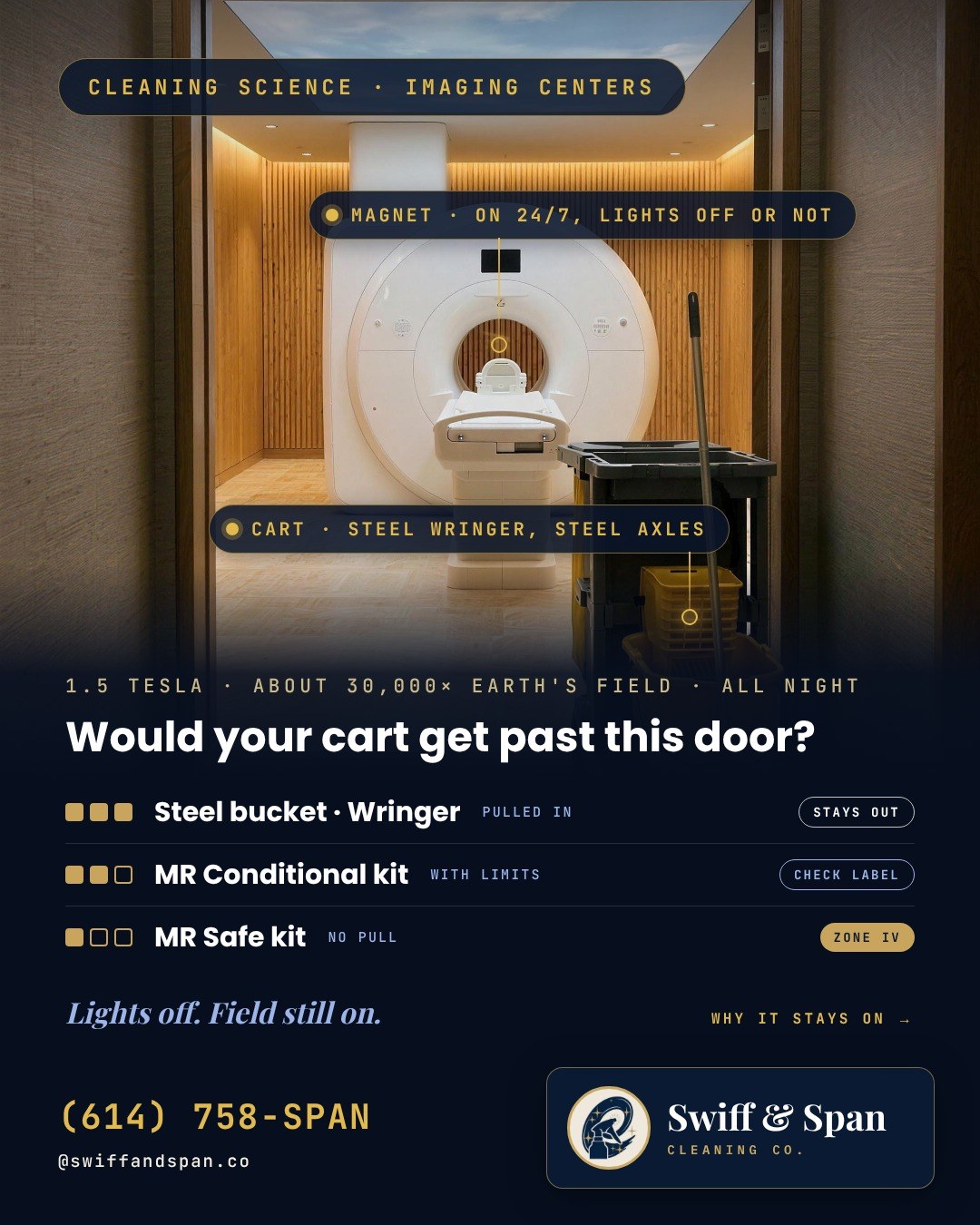
The most dangerous thing a cleaning crew can roll into an MRI room isn't a chemical. It's the mop bucket.
A standard janitorial bucket has a steel wringer, steel axles and steel caster bolts. The plastic on the outside tells you nothing about what's inside. And the magnet it's rolling toward doesn't clock out at 5 PM. That's the first rule of MRI room cleaning, and most cleaning contracts never mention it.
If you run an imaging center in Westerville, from Uptown to the Polaris corridor, most of your cleaning happens after the technologists go home. That's exactly when the scanner room is easiest to walk into and hardest to supervise. Here's why the magnet still matters at night, the four safety zones radiology already uses, what the MR labels on a cart actually mean, who owns which surface, and the six lines every MRI suite cleaning scope should spell out.
The short answer: An MRI magnet stays on 24 hours a day, so a standard mop bucket with steel parts never enters the scanner room. MRI room cleaning in Westerville imaging centers should follow the facility's four ACR safety zones, use a dedicated kit labeled MR Safe or MR Conditional, and put six lines in writing before night one.
Your facility's MR safety program and your MR Safety Officer set the rules for the scanner room. Our job is to work inside them, every visit.
Does an MRI magnet turn off at night?
No. Almost every clinical MRI scanner uses a superconducting magnet that holds its field around the clock. At 1.5 tesla, about 15,000 gauss, that field is roughly 30,000 times stronger than the Earth's, which sits around half a gauss.
Turning it off isn't like flipping a light switch. Bringing a superconducting magnet down takes a planned ramp by a service engineer or an emergency quench, and bringing it back up costs time and money. So the field is there at 10 PM, on a holiday weekend and during every cleaning visit you'll ever schedule.
Why is a mop bucket dangerous in an MRI room?
Because ferromagnetic metal gets pulled toward the scanner, harder the closer it gets. Radiology calls it the projectile effect. A bucket wringer, a cart axle, a vacuum motor or a floor machine can all turn into projectiles.
Oxygen cylinders, chairs, floor polishers and even an infusion pump have been pulled into scanners. The Agency for Healthcare Research and Quality walks through one of those cases in Flying Object Hits MRI. Nobody in those rooms meant to bring metal in. That's the point: the rule can't depend on someone remembering at 11 PM.
So in an imaging suite, the regular cart stops at the door. The scanner room gets its own MRI-safe cleaning kit.
What are the four MRI safety zones?
The American College of Radiology splits an MRI suite into four zones. Zone I is open to the public, Zone II is where patients are screened, Zone III is restricted, and Zone IV is the scanner room itself.
| Zone | What it is | Cleaning crew access |
|---|---|---|
| Zone I | Public areas outside the suite | Normal schedule |
| Zone II | Reception, waiting and patient screening | Normal schedule |
| Zone III | Restricted area outside the scanner room | Only as the MR safety program allows |
| Zone IV | The scanner room itself | Scheduled time, MR-labeled kit, required MR personnel present |
For a cleaning crew, that map answers most questions before anyone has to ask. Zones I and II, the entrance, reception, waiting room and screening area, get cleaned on a normal schedule. Zone III, the controlled area right outside the scanner room, is entered only the way the facility's program allows. Zone IV is entered only under that program, at a time written into the schedule, with the people the program requires standing there. The ACR's MR safety resources are where your MR Safety Officer's rules come from.
What do MR Safe, MR Conditional and MR Unsafe mean?
They're the three labels defined by ASTM F2503. MR Safe means no known hazard in any MR environment. MR Conditional means safe only under the conditions printed with it. MR Unsafe means it stays out, period.
The labels use shape and color so you can read them from across a room: a green MR Safe mark, a yellow triangle for MR Conditional, and a red circle with a slash for MR Unsafe. MR Conditional is the one that trips people up. A conditional item is cleared only for the field strength and conditions listed with it, so a mop that's fine at 1.5 tesla may not be cleared at 3 tesla. Anything unlabeled gets treated as unsafe until someone qualified says otherwise.
That's why we keep a dedicated scanner-room kit: non-ferromagnetic, labeled, counted, and never mixed with the general cart.
Who cleans the MRI table and coils between patients?
Your technologists do, between patients, using the products and methods the scanner manufacturer approves. The cleaning crew owns the room around the scanner: floors, walls, door hardware, cabinetry and the rest of the suite.
Writing that split down matters more than it sounds. The table, pads and coils are patient-contact equipment with their own care instructions. The room has different surfaces and a different schedule. When nobody writes down where one job ends and the other starts, surfaces fall into the gap and nobody owns them. We've seen the same gap in dental operatories, and we wrote about it in where the cleaner's job ends and your team's begins.
What should an imaging center cleaning scope include?
More than “clean MRI room.” A useful scope names six things: a zone map, who opens the scanner room and when, a dedicated MR-labeled kit, approved products and contact times, the technologist and crew split, and an exit count.
- A zone map the crew carries. Your facility's own Zone I to IV layout, on paper, on the cart.
- Who opens the scanner room, and when. A named role and a set time, not “whoever's still here.”
- A dedicated kit labeled MR Safe or MR Conditional. Its own tools, stored apart from the general cart.
- Approved products and their contact times. EPA-registered chemistry your facility approves, kept wet for the full label dwell time. (Why that matters: clean vs. disinfect and why dwell time decides it.)
- The split. Technologists own the table, pads and coils between patients. The crew owns the room.
- An exit count before the door closes. Every tool that went in comes out, counted.
I'd rather hand your MR Safety Officer a written plan than ask for a key. If your current scope can't answer these six lines, it's a wish list, not a plan.
What about the rest of the imaging suite?
Most of an imaging center is clinical space with very busy hands: reception, the waiting room, changing rooms, lockers and restrooms. Those surfaces follow our standard sequence. Clean. Disinfect. Verify. Document.
We clean to remove soil and residue, color-coded so a restroom cloth never touches a check-in counter (here's the system). We disinfect with EPA-registered chemistry according to label directions and full dwell time, with Whole-Room Electrostatic Disinfection where it's included in scope. Where ATP verification is part of your contract, we swab locker handles, changing-room benches and check-in counters and read the result in relative light units, against our Cleaning Target Threshold of 25 RLU. Then checklists and photos document the visit. You can see how we prove clean, or read how the swab works in what ATP testing and RLU scores mean.
The people matter as much as the paperwork. Our team is background-checked, every cleaner has at least fifteen years of professional cleaning experience, and you get the same crew every visit, which is exactly what a scanner-room schedule needs. More on that in who cleans your facility.
Your next concrete move
Ask your cleaning vendor one question this week: which items on that cart are labeled MR Safe? If the answer takes more than a sentence, your scanner room needs a written plan.
If you'd like help writing it, I'll walk your suite with you for about 30 minutes. We'll map the zones together, look at the kit and swab a few high-touch surfaces in Zones I and II. We clean medical and clinical facilities and medical office buildings across Westerville, Worthington, Dublin, New Albany and Greater Columbus. Call (614) 758-SPAN or book your complimentary ATP walkthrough.
See the full measurement system →
A portion of every contract supports Columbus youth organizations.
Sources: American College of Radiology, ACR Manual on MR Safety (four-zone model and MR personnel guidance). ASTM International, ASTM F2503, Standard Practice for Marking Medical Devices and Other Items for Safety in the Magnetic Resonance Environment. Agency for Healthcare Research and Quality, PSNet, “Flying Object Hits MRI.”
Frequently Asked Questions
What cleaning equipment is safe in an MRI room?
Only items labeled MR Safe, or MR Conditional for that scanner's field strength and conditions, and only as the facility's MR safety program allows. Standard buckets, wringers, carts, vacuums and floor machines usually contain steel and stay outside the scanner room.
Does an MRI magnet switch off at night?
No. Most clinical MRI scanners use superconducting magnets that hold their field around the clock. A 1.5 tesla scanner is roughly 30,000 times stronger than the Earth's magnetic field with the lights off and nobody on the table.
Can a cleaning crew go into MRI Zone IV?
Only under the facility's MR safety program. Zone IV is the scanner room. The program decides who may enter, what training they need and who must accompany them. A cleaning vendor works inside that program and never around it.
What does MR Conditional mean on cleaning equipment?
MR Conditional is an ASTM F2503 label meaning the item has been shown to pose no known hazard only under the specific conditions printed with it, such as field strength. Outside those conditions it is not cleared for the room.
Who cleans the MRI table and coils between patients?
The technologists do, using the products and methods the scanner manufacturer approves. The cleaning crew handles the room around the scanner: floors, walls, door hardware, cabinetry and the rest of the suite, on a schedule written down in advance.
Does Swiff & Span clean imaging centers in Westerville?
Yes. Swiff & Span cleans imaging and medical suites across Westerville and Greater Columbus, working inside each facility's MR safety program with a dedicated MR-labeled kit for the scanner room. Call (614) 758-SPAN to book a complimentary ATP walkthrough.
Every Columbus dental, medical, wellness, and commercial facility gets the same offer: a complimentary 30-minute ATP walkthrough. We swab your highest-touch surfaces, on the spot, and hand you the readings. No obligation, no pitch required to see the number. Book your complimentary ATP walkthrough or text (614) 758-SPAN.
Erik Kuusisto, Owner
Swiff & Span Cleaning Company