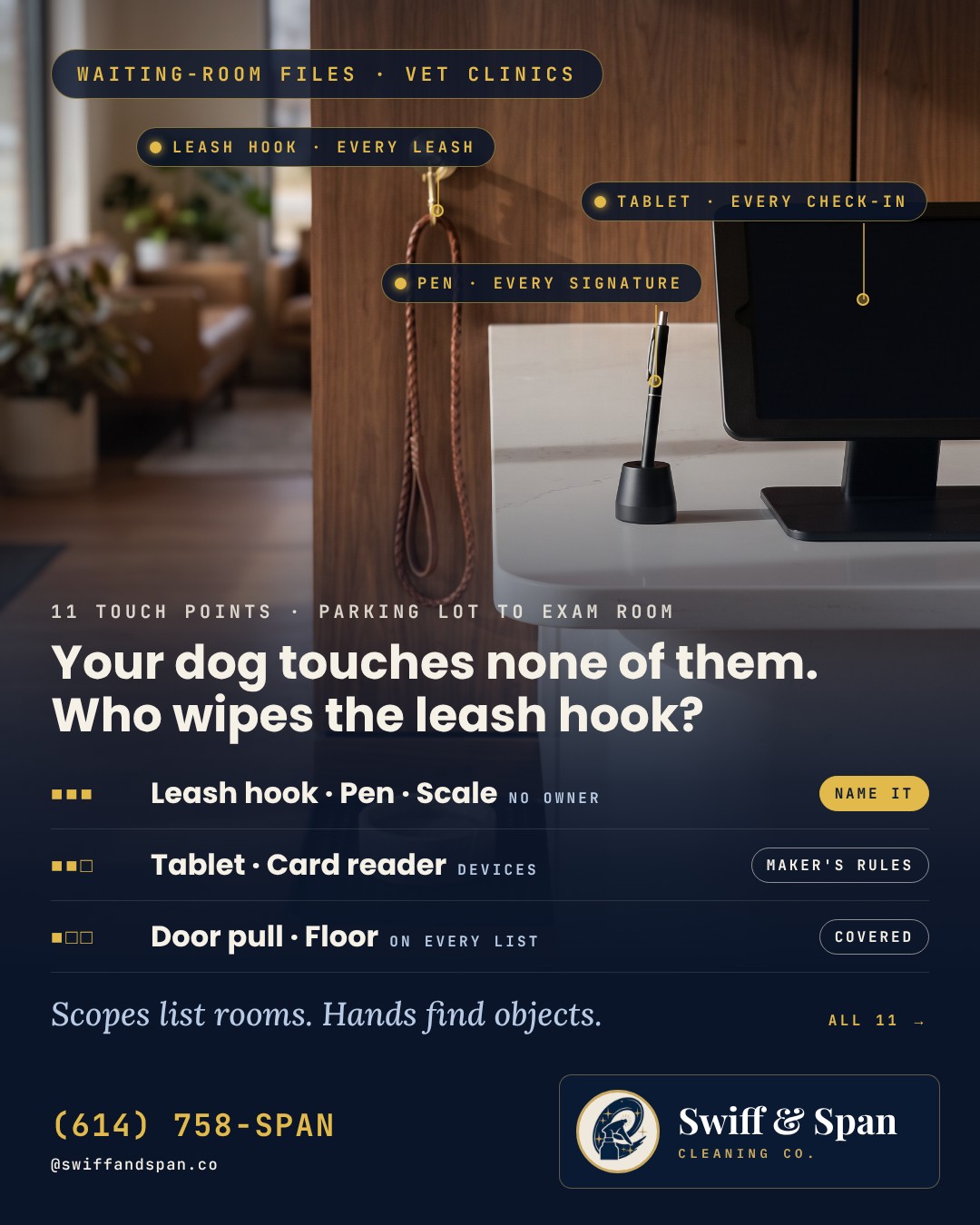
Your dog never touches the front door handle. You do. Then you touch your dog.
That small fact is why a veterinary lobby is a different cleaning job from an office lobby. The hand that opens the door belongs to someone who is about to steady a nervous animal, sign in on a tablet, borrow a pen and tap a card reader, all inside a few minutes and about thirty feet of floor.
We walked the client side of a typical Columbus veterinary clinic the way an owner does, from the parking lot to the exam room, and counted every surface a hand meets. The count is eleven. This is our walk-through list, and it is the list we write into a vet clinic's lobby scope, in order.
The short version: a vet clinic lobby has eleven touch points on one short route, and most of them are small, easy to skip and nowhere near the floor. A scope that says "clean lobby" names none of them. A scope that lists them, in the order a hand meets them, gets them cleaned.
What does a pet owner touch between the parking lot and the exam room?
Eleven things on a typical clinic route: the exterior door pull, entry mat, leash hook, check-in tablet, courtesy pen, counter lip, payment terminal, a lobby chair arm, the pet scale, the water bowl area and the exam room door lever.
Here is the route, in order, with the reason each one earns its own line in the scope.
- The exterior door pull. Every client, every day, usually with a leash or a carrier in the other hand.
- The entry mat. Where wet paws, boots and road salt from a Columbus February all arrive at once.
- The leash hook. A leash that just walked the sidewalk hangs on it. The next owner's bare hand lifts the next leash off it.
- The check-in tablet. A screen touched by dozens of fingers a day, and the one surface in the room that cannot take a soaked cloth.
- The courtesy pen. One pen, many hands, and almost never on anyone's list.
- The counter lip. Owners lean on the edge and slide paper and cards across it. A cloth that skims the middle of the counter tends to miss the edge.
- The payment terminal. Touched at the end of the visit, often by a hand that has been holding a leash for an hour.
- The lobby chair arm. Gripped, leaned on and pulled while an owner calms an animal.
- The pet scale. Stepped on by animals, steadied by hands and in plain view of everyone waiting.
- The water bowl and the floor around it. Splash zone, drool zone and the spot where a nervous dog tends to park.
- The exam room door lever. The last handle before the exam and the first one a hand reaches after it.
Why is the leash hook the surface most cleaning scopes miss?
Because it is not furniture, not a fixture and not on any floor plan. It is a small piece of hardware that every leash in the building passes over, and no checklist owns it unless someone writes it in by name.
The leash hook is the clearest example of a pattern we see in every lobby: cleaning scopes are written by room, and hands work by object. The pen, the hook, the scale handle and the card reader are all objects. None of them shows up when a scope says "reception." We saw the same thing at the dental front desk, where one counter takes about 120 touches a day, and in offices, where a single conference room has 17 touch points.
The fix costs nothing. Write the objects down. A crew that has a line for the leash hook cleans the leash hook.
Why does a vet clinic lobby need its own cleaning scope?
Because animals of every health status, anxious owners and the clinic's first impression all share one floor. The practice's veterinarians set infection-control protocol for treatment areas and specific pathogens. A lobby scope covers the client side and follows what the clinic specifies.
That division matters. Your medical team owns protocol. What a cleaning contractor controls is whether the surfaces owners touch get a written, repeatable clean, in a written order, with a record. In a lobby that is a bigger job than it looks, because the route above crosses wood, stone, electronics, fabric and rubber in about thirty feet. Our veterinary clinic cleaning service starts with exactly that route.
What order should a vet clinic lobby be cleaned in?
Top to bottom and clean to dirty. Start with the door pull and leash hook, then the counter, tablet, pen and chairs, then the scale, and finish with the water bowl area and the floor. The other way drags floor soil onto hand surfaces.
Two disciplines do most of the work. First, color-coded microfiber: one color stays on the counter and payment zone, another stays on the entry and floor, and the two never cross. Our explainer on color-coded microfiber and the two-bucket method shows the system. Second, two buckets for floors, one of solution and one of rinse, so the mop never carries soil back into clean water. The evidence behind that goes back to 1971, and we covered it in two-bucket mopping in a vet clinic.
How long does a disinfectant need to stay wet on a lobby surface?
For the full contact time printed on the product label. EPA-registered disinfectants are tested over a stated dwell time on a wet surface. A wipe that dries early has not finished its job, however clean the counter looks.
Product choice follows the surface and the clinic's protocol. On hard, high-touch surfaces such as the counter lip and the door levers we use PDI Super Sani-Cloth. Where a clinic's protocol calls for bleach on hard floors, we use Clorox Healthcare Bleach Germicidal, diluted and held to the label. Which chemistry matters for which pathogen is your veterinarian's call. Our piece on what it takes to kill canine parvovirus on surfaces shows why the answer is never "whatever is under the sink."
How do you clean a check-in tablet, pen and card reader without damaging them?
By the device maker's care instructions, never with a soaked cloth: only what the manufacturer allows, on a lightly dampened cloth, never sprayed directly. The pen gets wiped and returned to its holder. Each is a ten-second job scopes tend to skip.
One line in the contract, "electronics per manufacturer guidance," does two things. It protects a tablet that costs real money, and it proves someone thought about the tablet at all.
How do you know the lobby was cleaned when nobody was there?
By the record. The clinic is empty when the crew works, so the proof travels with the work: photo documentation and a room-by-room checklist, with an exceptions line for anything that could not be finished.
It is the same idea as the nightly report a bank branch manager can actually use, and it carries straight over to a vet clinic.
When ATP verification is part of the scope, we add a number. We swab lobby touch points such as the counter lip and the payment terminal after cleaning and read organic residue in relative light units, or RLU, on a Hygiena EnSURE Touch meter. Our standard is 25 RLU or under. Here is how to read an ATP result. Our sequence is the same in every building: Clean. Disinfect. Verify. Document.
What should a Columbus vet clinic ask its cleaning vendor?
Three questions, in this order. Does the scope name the leash hook, tablet, pen, counter lip, payment terminal and chair arms, or just say "lobby"? Is there a written sequence, top to bottom and clean to dirty? Is there a photo record after every visit?
If your vendor cannot answer, the invisible marker test will show you which of the eleven surfaces the crew actually reaches. And if you want to know who holds your keys after hours, every member of our team is background-checked and carries a minimum of fifteen years of professional cleaning experience. We wrote out the full screening standard.
Your next concrete move
Walk your own lobby this week the way an owner does, from the parking lot to the exam room, with a notepad. Count every surface a hand meets. Put the list beside your cleaning scope. If your count is eleven and the scope names two, you have found the gap.
If you would like a second set of eyes, I will walk it with you for 30 minutes. It is a complimentary ATP walkthrough for veterinary clinics in Grandview, Clintonville, Worthington, Upper Arlington, Dublin, New Albany, Bexley and the Short North. We swab the surfaces you choose, you see the readings on the spot, and they are yours to keep. Here is what to expect from that walkthrough.
A portion of every contract supports Columbus youth programs.
The eleven-surface list is Swiff & Span's own walk-through of a typical clinic client route, not a published study. Your clinic's veterinarians set infection-control protocol for treatment areas.
Frequently Asked Questions
What surfaces does a pet owner touch in a vet clinic waiting room?
On a typical Columbus clinic route there are eleven: the exterior door pull, entry mat, leash hook, check-in tablet, courtesy pen, counter lip, payment terminal, lobby chair arm, pet scale, water bowl area and the exam room door lever.
Who sets the infection-control protocol in a veterinary clinic?
The clinic's veterinarians set protocol for treatment areas and for specific pathogens. A cleaning contractor covers the client side, such as the lobby, and follows the instructions the clinic provides.
How long should a disinfectant stay wet on a vet lobby surface?
For the full contact time printed on the product label. An EPA-registered disinfectant is tested over a stated dwell time, so a wipe that dries early has not finished its work.
How do you clean a check-in tablet or card reader?
Follow the device maker's care instructions. That usually means a lightly dampened cloth, nothing sprayed directly onto the device and nothing soaked.
What does an ATP swab measure in a vet clinic lobby?
ATP testing measures organic residue left on a surface, read in relative light units, or RLU. Swiff & Span's standard is 25 RLU or under. When verification is in the scope, we swab lobby touch points after cleaning and the clinic keeps the readings.
Every Columbus-area veterinary clinic gets the same offer: a complimentary 30-minute ATP walkthrough. We swab your highest-touch lobby surfaces, on the spot, and hand you the readings. Book your complimentary ATP walkthrough or text (614) 758-SPAN.
Erik Kuusisto, Owner
Swiff & Span Cleaning Company